
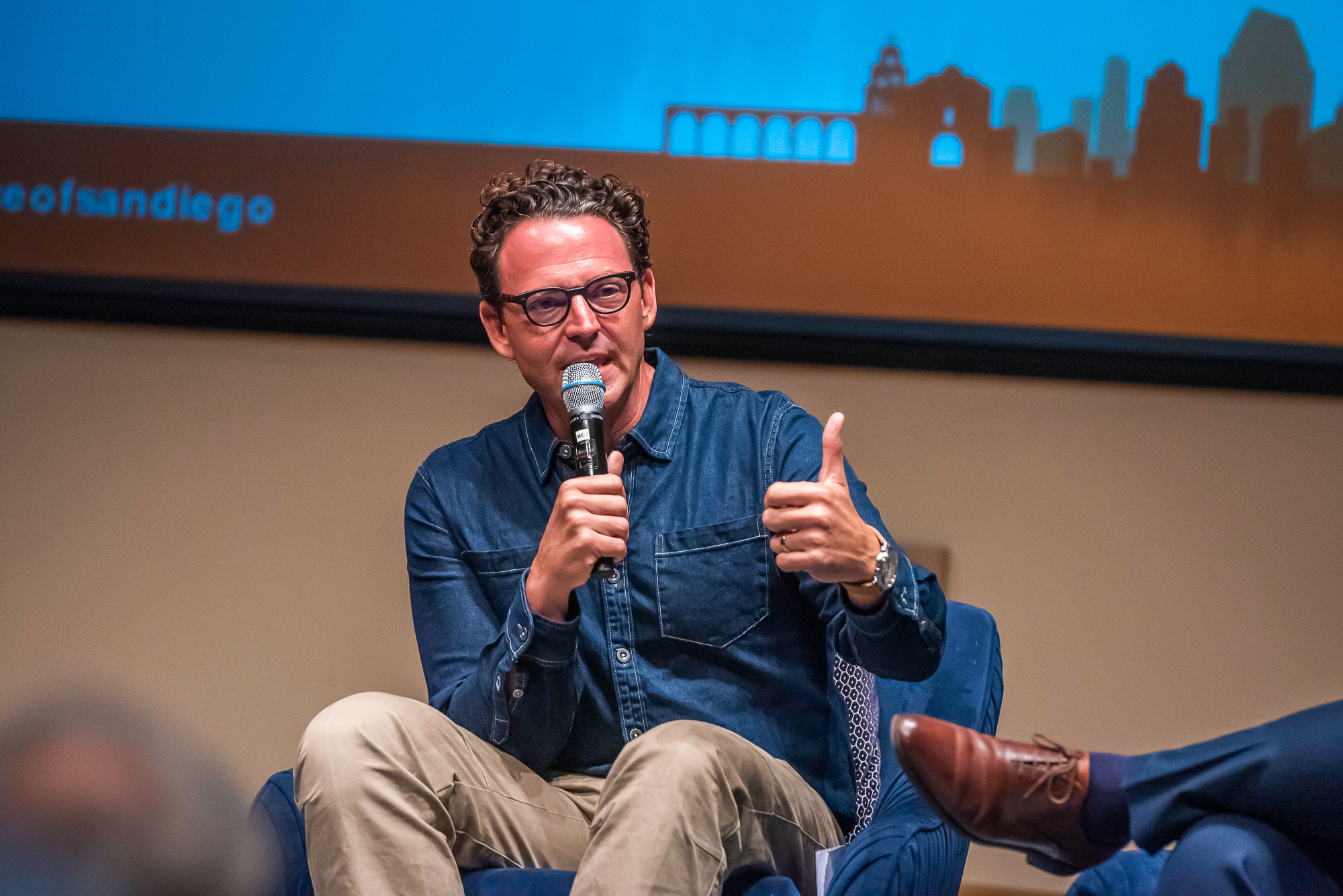
County Supervisor Nathan Fletcher this week formally announced his campaign for state Senate. If successful, he would replace the termed out Toni Atkins, who was also the senate president pro Tem.
That election is a ways off, and we don’t know who else could jump in. But a Fletcher win could kick off a game of political dominoes like we haven’t seen in a decade.
Fletcher will be on the ballot in 2024, halfway through the second term he just won on the county board of supervisors. If he wins, the board he left would have an opportunity to appoint someone to fulfill the remainder of his term.
But the board he vacated would have a two Democrat, two Republican split, so anyone they’d appoint would need to have bipartisan appeal.
If they can’t pick someone, they’d have to set a special election.
The District 4 seat covers the core of the city of San Diego, plus Lemon Grove, La Mesa and the western edge of East County.
Potential candidates for supervisor: That territory would make two members of the San Diego City Council logical contenders: Monica Montgomery Steppe and Stephen Whitburn. Montgomery Steppe won another four years on the Council in November. Whitburn, elected in 2020, could be starting his second term just as a special election to replace Fletcher is underway.
And if either of them is successful, the city of San Diego could soon be looking at its own subsequent special election to replace them.
We mentioned last week that the city attorney’s race could be the only competitive city election during the 2024 cycle. That remains to be seen, but even if it does, it could be closely followed by two competitive special elections in 2025.
The Political Moment for Fast Buses? Maybe
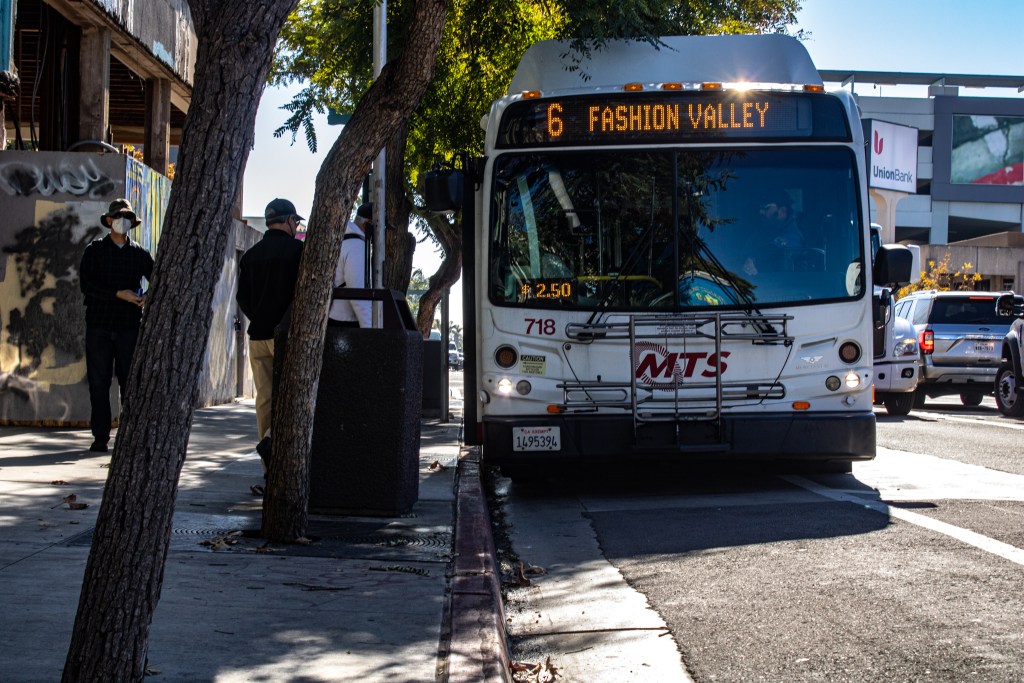
During her State of the County speech earlier this month, County Board of Supervisors Chair Nora Vargas shared the story of Heidi Jimenez, a San Ysidro High School senior who spends 90 minutes each morning taking transit to school, and another 90 minutes getting back home in the afternoon.
She did so by way of announcing that the free bus pass program for minors under 18 was going to be expanded to people 24 and under, to make it easier for college kids and young adults to get to work and school. But she also said something else.
“We have a responsibility to invest in transit frequency enhancement and transportation infrastructure,” she said.
That call for making transit frequency upgrades – making buses and trolleys come more often, so that riding them is more convenient and trips on them are faster – could soon become a more common regional policy priority.
For one, there’s already outside support for it. Circulate San Diego last year put out a report it titled “Fast Bus!” which outlined the simple case for improving transit by committing to improving the bus system. I moderated a panel on the report at last year’s Poltifest.
But it could become the default option for improving transit by necessity.
The San Diego Association of Governments in late 2021 adopted a new, multi-decade outline of the regional transportation plan it wanted to build. But the ongoing fight over the plan’s inclusion of a driving fee has perhaps obscured a more fundamental problem.
Money.
SANDAG’s plan said voters would approve three sales tax increases by 2030, the first coming in 2022. That first one didn’t happen. The next one it expects is one proposed by the Metropolitan Transit System, in the 2024 election. There’s no indication at this point that’s on the way. Then the agency expects county voters to approve another sales tax increase in 2028.
Altogether, that’s supposed to bring in $27.7 billion.
Nevermind that SANDAG has already started the process of amending the plan to remove a regional driving fee, and the $14.2 billion it expected to collect, beginning in 2030.
If the prospect of county voters approving 1.5 cents-worth of sales tax increases, spread across three votes, seems implausible, then it doesn’t particularly matter whether hundreds of miles of new rail lines, infrastructure specifically designed for driverless vehicles, or new hyperloop tracks is appealing.
There won’t be money for it.
Improving buses isn’t free, but it’s quite a bit cheaper.
The Skinny on “Expenditure Lobbying” Reports
Late Friday, we published a new story on a fine that just came down from the San Diego Ethics Commission.
Midway Rising, the developer selected to redevelop the Sports Arena, agreed to pay $5,000 for its late disclosures of a something called “expenditure lobbying” reports.
Expenditure lobbying reports are pretty rare. Even though they were late, Midway Rising’s disclosures were the only ones filed in San Diego last year.
What counts as expenditure lobbying? Basically, it’s any spending meant to influence a city decision that doesn’t involve direct contacts with city officials.
Building a website to tell the public your project is good? That’s expenditure lobbying. Paying a consultant to hold a public outreach event touting all the cool stuff you want to build? Expenditure lobbying. Hiring an economist to do an analysis of how many jobs your project would create? Expenditure lobbying. Hiring a flak to tell reporters about new angles they should pursue about your cool project? Expenditure lobbying.
In this case, Midway Rising hired a political consultant – Dan Rottenstreich – to work on messaging and political strategy, to build a website, and handle press outreach.
He got $154,000 for that service between October 2021 and July 2022.
Not that you would have known any of that from reading the disclosure form that companies are supposed to file for these sorts of expenses, and which apparently few of them actually do, even if Midway Rising would have had it in on time.
The way the form is constructed right now, it doesn’t say who received the money, nor does it say what they were paid to do. It just says which company spent the money, and how much they spent. There’s no way of knowing which category of expenditure lobbying the payment fit into.
We only know as much as we know about Midway Rising’s expenditure because of details that were included in the settlement with the Ethics Commission, which we only know because they filed late.
The settlement says the company self-reported the late filing, after they hired a lawyer, Gil Cabrera, to audit whether they had fully complied with the law. It also outlines a lengthy list of public hearings and decisions that occurred after the development group’s first disclosure should have been in.
Notes
Camp Inspiration Point: Low key this seemed like the biggest news of the week in the biggest crisis in San Diego: homelessness. San Diego City Councilman Stephen Whitburn is pushing for a large space to set aside for homeless residents to be in tents or one large tent with services. But he also wants to significantly ramp up enforcement. He’s not the first to conclude that something dramatic needs to happen to open up spaces where homeless residents can legally be but then close off other public spaces more severely. But is the space large enough and does the city have the force and willingness to push people to it?
Todd Pod? Kinsee Morlan, who used to write the Culture Report for Voice of San Diego and managed our podcasts, had moved on to a job at KPBS and then the LA Times, where she oversaw production of the daily podcast, The Times. She announced this week with news that she was leaving the Times to join Mayor Todd Gloria’s staff.
Correction: A previous version of this story said San Diego City Councilman Raul Campillo lives in the the county’s fourth supervisorial district. He lives in District 2.
If you have any feedback or ideas for the Politics Report, send them to scott.lewis@voiceofsandiego.org or andrew.keatts@voiceofsandiego.org.
Why did VOS contradict itself in stating bipartisan appeal and then Whitburn and the African American lady? Do you take me for a fool or maybe all your readers are fools? Either way, it’s a free country and I would bet the two GOP SUPS would look hard at my dossier when I throw my hat in the ring. I put the kibosh on SANDAG those elites!