
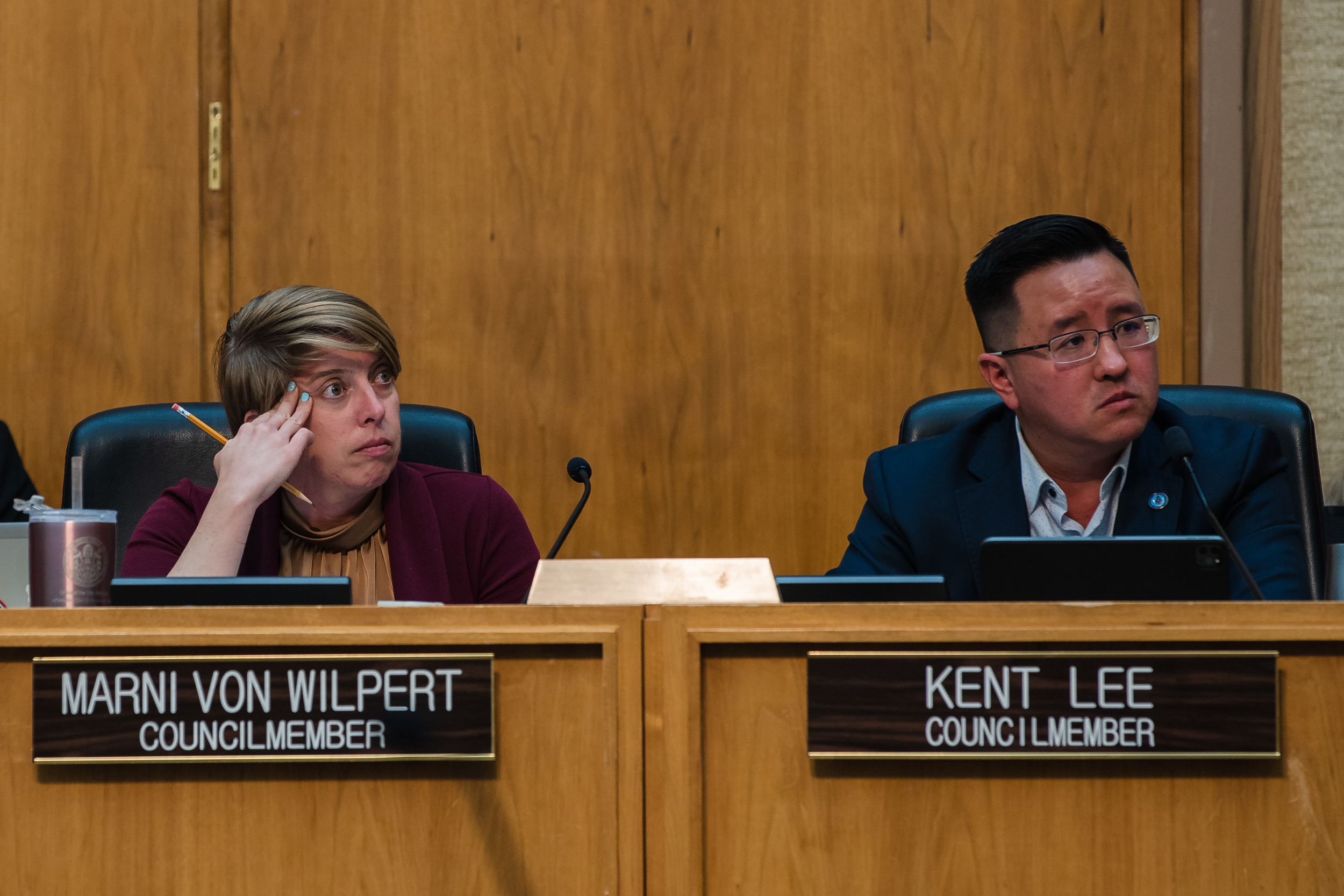
City Councilman Kent Lee was set to join in on the mayor’s proposed budget unveiling on Friday. He was listed as a speaker in a media advisory sent just the day before.
But early Friday, his named was removed and an updated notice was sent to the press. He didn’t appear at the press conference at the city’s Rose Canyon Operations Yard either.
This change followed Lee’s questioning of a controversial proposal to crack down on homeless camps Thursday at the City Council’s land use committee. The proposal, backed by Mayor Todd Gloria, is moving forward, but Lee voted against it.
Gloria’s office was mum on the reason for the change.
Lee’s Chief of Staff Sara Kamiab, however, responded to our email.
“Councilmember Lee will work with his colleagues and the mayor to pass a budget that increases investments in homeless shelter capacity, repairs our roads, and keeps our communities safe, whether or not he is part of a press conference,” Kamiab wrote. “He is focused on doing the job he was elected to do and is concentrating on providing all of his constituents with the critical neighborhood improvements they deserve.”
We asked if Lee was disinvited from Friday’s press conference, but Kamiab did not respond.
Parks and Library Tax Proponents Sue to Prove They Had Enough Signatures
It was big news (to us at least) when the city and county Registrar of Voters rejected a petition to put an initiative on next year’s ballot to raise a parcel tax to fund library and parks programs and infrastructure in the city of San Diego. They said the signature gatherers had collected too few valid signatures for it to qualify for the ballot.
It was a huge blow to the coalition, which included the city’s largest union of city employees and the foundations that support local libraries and parks. They spent more than $1 million and they turned in 111,000 signatures. They only needed just more than 80,000.
But the city clerk contracts out the verification to the Registrar of Voters. To determine if an initiative got sufficient signatures, they pull a 3 percent sample of them and examine those signatures closely. In this case, supporters needed more than 72 percent of their signatures to be valid. So the sample should have more than 72 percent valid. If it’s close, they’ll do a full count.
The registrar found too many invalid and threw the initiative out.
The news: The backers think the examination of their signatures was far too strict and invalidated authentic voters and their wishes.
The Library Foundation, the Parks Foundation and the Municipal Employees Association and the rest of their allies filed a lawsuit arguing that too many of the signatures were thrown out. Some of them for reasons as petty as not abbreviating their street names the proper way the U.S. Postal Service does or for writing their own birthday down instead of the date they signed the petition, as required on the forms.
The coalition released a statement: “Our libraries and parks desperately need help, yet this is now about much more than fixing our civic infrastructure. This is about the rights of voters to petition their government for change, and to be able to trust that their signature is counted. This is an equity issue at its most foundational level, and we want to make sure that no voter who signs a citizens’ initiative is disenfranchised,” wrote Patrick Stewart, the CEO of the San Diego Library Foundation and Michel Anderson, the chairman of the San Diego Parks Foundation.
City Going Forward on Plan Architects Worried About for City Hall Redevelopment
The San Diego City Council this week took the first step to declare five city blocks around the civic core surplus land and give notice to affordable housing developers to get their proposals for that land ready.
The Land Use and Housing Committee voted 3-1 to advance city staff’s effort to get the declaration and start talking to developers. They did not specify whether the land would be sold or leased.
It was a dramatic step in the ongoing discussion about the property that started this summer when the city decided to settle a big part of the litigation over 101 Ash St. and Civic Centre Plaza, the two towers at the center of a major scandal. The city took full control over the buildings and the mayor and City Council immediately put in motion this effort to redevelopment the entire area with an emphasis on housing.
The city actually controls most of six square blocks around its current City Hall, Golden Hall, the large parking garage and the Ash Street and Civic Centre high rises. The plan is to offer all those to affordable housing developers and their partners. The city, however, would keep a sixth block, where the City Operations Building currently sits, under city control. The proceeds from developing the other five blocks would be used in part to fund construction of a new City Hall on that block.
That was the plan about which some designers and architects were concerned.
They had hoped this would be an historic opportunity to create inspiring structures and a unified vision for the area. But if the city builds a new City Hall on the City Operations Building site and then a different group builds out the rest of the area, how unified will it be?
Just this week, Jennifer Luce, one of the city’s best-known architects appealed to dozens of the city’s most involved designers to think about the possibilities the site offered and consider transformative, risky and major structures for the site that could honor city workers, invite people to congregate and characterize the city’s core for centuries to come. Luce was part of a larger group that comprised the city’s Civic Center Revitalization Committee
But the city’s plan, for now, is just to ask developers what they would do with the land and the Notice of Availability staff wants to send out will not have any “absolute conditions” on what the developers should do for the land.
City staff has pointed to the deal coming together at the Sports Arena site as a model for what will happen downtown. On that project, though, the city required bidders to pitch a new or refurbished arena and then made the decision on which of them to support based in part on who had the best plan for the new arena. The plan downtown is to not have any such requirements on the bidder.
That includes the Civic Theatre. The city does not want to require bidders to build a new theater or even revitalize the current one. Jay Goldstone, the mayor’s special assistant for this project, told the committee staff would ask the developers to prioritize labor agreements, middle-income housing, a potential new school for performing arts that San Diego Unified wants to build and to read the report of the Revitalization Committee. Goldstone said the city consulted with the airport authority and he believes buildings as high as 400-450 feet could arise on the land.
On the Theatre, Goldstone said the city would only ask that they preserve the “theatre’s presence.”
When Councilman Joe LaCava asked if that could be said in stronger language Goldstone was reluctant to add stronger language saying the state Department of Housing and Community Development, or HCD, would have to sign off on it.
“I don’t think HCD is going to have a problem with that but who is going to pay for it?” he said.
Another mayoral staffer, Christopher Ackerman-Avila had reassured the architects, engineers and designers gathered to hear Luce at the Regional Design Advisory Council that her ideas could absolutely fit into their plans. But the city is handing over the effort to create a vision for the land to whatever partnerships build on it. The only hard requirement being that 25 percent of the units they build be set aside for lower income residents.
If you have any ideas or feedback for the Politics Report, send them to scott.lewis@voiceofsandiego.org or andrew.keatts@voiceofsandiego.org.
I got news for the kid! Despite me not liking the mayor and his powerful henchmen, doing nothing is not an option.