
San Diego, in its corner of the continent, is at the end of the line of a lot of resources. Gas, railroad and water lines all end here.
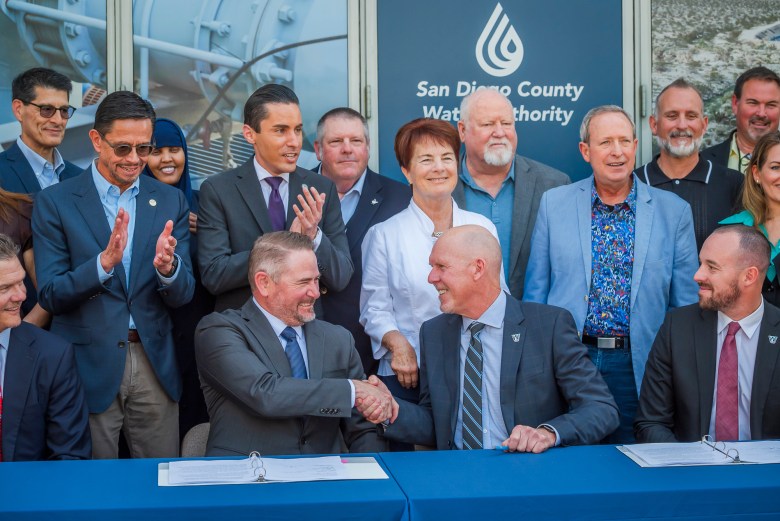
So it was remarkable, historic even, that this week a theory became real: San Diego sold water to another region, specifically Temecula. Our decades of painful, costly, somewhat questionable investments in water reliability really did put us into the position of broker, exporter even. And the promises are flying that relief is coming. San Diegans who pay the highest rates for water around may someday soon see that burden ease because we are not just desperate buyers at the end of the line, we are owners.
It’s tempting to assume this transformation began last June when the San Diego County Water Authority settled its decades-long legal dispute with the giant Metropolitan Water District. That legal dispute ironically cost San Diego ratepayers about as much money every year as this new water sale to Temecula will bring in.
It was extremely costly and only a few people understood why it was even happening and most of those people were making money off of it.
But the settlement wasn’t the beginning of this transformation. The beginning was the elevation of Daniel Denham as general manager of the Water Authority. The moment he began his tenure as the leader of the agency, he decided to completely change the approach of the long, proud, unapologetic authority. It was time to be honest, and vulnerable about the position it had gotten itself into. Yes, its leaders, including him, were right, he said, to urgently invest in water reliability and a diversified portfolio of sources of it, beginning in the 1990s after a drought scare.
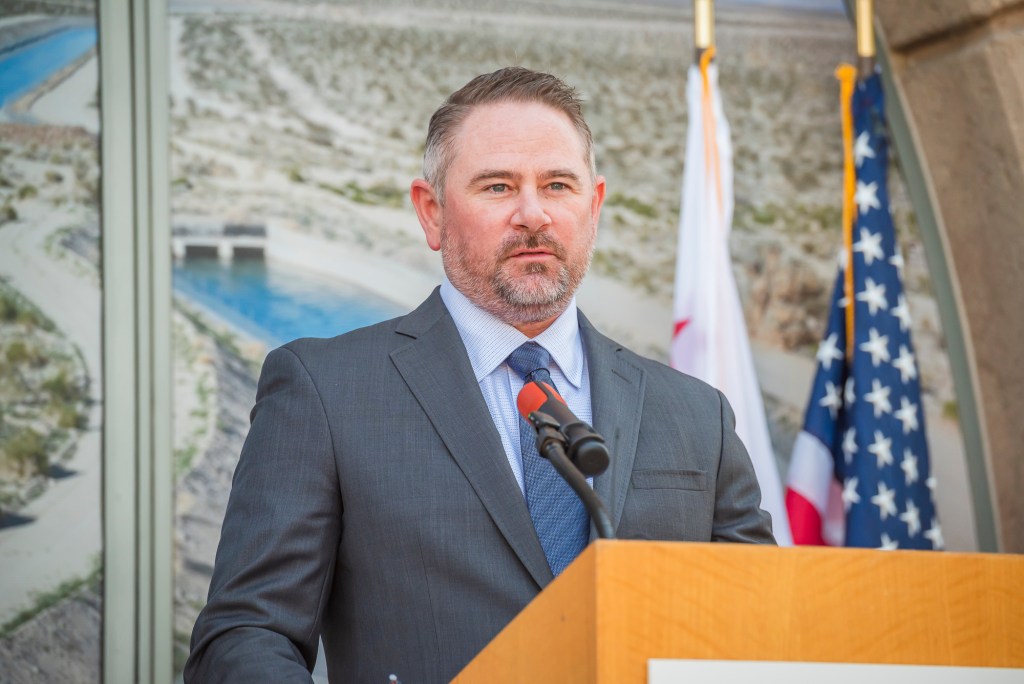
But he acknowledged the frenzy had been costly. Agreeing to pay record-high rates for desalinated water in Carlsbad didn’t look so good in hindsight. The pain ratepayers felt was real and was fueling what could be an existential crisis for the agency.
People often fear that acknowledging something is wrong is a place of weakness. But Denham and his team and the board leadership including former Chair Mel Katz and current Chair Nick Serrano put on a clinic on how acknowledging a problem can actually put you in a position of strength and power.
They quickly moved to settle the long, ridiculous litigation that had strained relations between the Water Authority and Metropolitan. Denham and his general counsel told the powerful lawyers who had kept it going that they should leave. The settlement allowed the two agencies to set a price for how much Metropolitan would charge San Diego to move its water.
And now, they are moving water from an area where growth is plateauing (San Diego) to an area where growth exploded (Southwest Riverside County). It will mean $100 million coming to San Diego in the next five years and a regular payment for 21 years. It’s perhaps the first cost-recovery San Diego’s experienced from the great migration of people to easier-to-buy-a-home land of Riverside County.
In the complex world of water, no water is actually moving from San Diego. We are agreeing to take less of what we already purchased and getting paid for it and they will take more. But even that is an extraordinary development in San Diego’s water history.
Even Councilmember Sean Elo-Rivera, who last year suggested the Water Authority may need to be radically reformed or even dissolved and its costly investments unwound, acknowledged the progress.
“It’s real action that should translate into real benefits for real people,” Elo-Rivera told us.
The Water Authority’s leaders say this is just the start. Their challenge now is to deliver those real benefits. If they become water kingpins in Southern California or even in the Southwestern United States but ratepayers don’t feel real relief, the ratepayer anger will rise.
But at least they acknowledge they must do that and now have some actual proof that they can.
D2 Race Is On
What do you get when a French mime, an MBA student, a merchant marine and a former mayor walk into a community center in Clairemont?
That would be a League of Women Voters candidate forum, of course.
Seven people are running for the District 2 council seat, which includes Ocean Beach, Point Loma, Mission Beach and Clairemont.
Any District 2 voters looking for San Diego’s version of Zohran Mamdani didn’t find him at the forum, which happened earlier this month. The debate was dominated by reaction to new fees, homebuilding and what the candidates viewed as poor management by current city leaders.
Allow me to break out some lanes for you that appeared evident at the forum.
The Independent/Conservative Lane: Though their politics are certainly not identical, three men seemed to be vying for this lane: former Coronado Mayor Richard Bailey, a merchant marine named Mike Rickey and a Point Loma attorney named Paul Suppa.
Among this crowd, Bailey is most likely to have the best name recognition and generate buzz and money for his campaign.
They’re all very much against the recent parking fees at Balboa Park and they all support not charging for parking at beaches or parks in the future.
They all think the current City Council and mayor have done an extremely poor job managing the city’s finances and that city government needs to do a better job saving taxpayers money.
They all came out against policies that make it easier to build housing. (Suppa referred to the “devastating effects of density.”)
There were some surprises.
Suppa, despite coming off as hawkish on spending, said he was “absolutely” supportive of bike lanes. He mentioned two recent bicycle deaths that could have been prevented and said that good bike lanes will help protect children on e-bikes and help people get around the city.
Bailey, meanwhile, said bike lanes are nice but the city should be focussing on more important things. Rickey said it was “absurd” to be creating bike lanes at the expense of parking and traffic lanes.
The Traditional Democrats: This lane is fascinating.
It features a Josh Coyne, a former city council staffer who works for the Downtown Partnership, and Nicole Crosby, a deputy city attorney.
Coyne has the tightest needle to thread.
Coyne is clearly a YIMBY, who supports building more housing, which he made clear. That message doesn’t exactly play well with many coastal voters.
He also made clear that city government won’t get better at delivering services, simply through cutting and finding it efficiencies; it needs revenue.
Coyne moderated his tone more than any other candidate when asked about the concept of paid parking at city parks and beaches.
He said the city should “pause and assess” paid parking at Balboa Park to make sure that it doesn’t hurt museums and other tenants of the park. But he also said it isn’t fair that city taxpayers foot the bill for Balboa, while so many other visitors enjoy it.
Coyne is endorsed by Councilmember Stephen Whitburn and State Senator Catherine Blakespear.
Crosby has also been endorsed by prominent Democrats, such as Supervisor Monica Montgomery Steppe and Assemblymember Darshana Patel.
YIMBYism and raising revenue have been dominant strains of local Democratic politics in recent years, but Crosby did not strongly back either of them.
“I don’t support charging people to go to the park,” she said.
Crosby said she didn’t like the city’s ADU bonus law and that it had caused problems in Clairemont.
“It wasn’t thoughtful growth and it was really about outsider interests,” she said.
That message almost certainly will play better with wealthy coastal Democrats.
The California Coastal Independent: It felt like Mandy Havlik — who ran for Council four years ago and is a member of the Peninsula Community Planning Board — had this lane all to herself.
Havlick, when introducing herself, mentioned land use and environmental protection as two of her biggest issues immediately.
When it comes to land use, Havlick thinks the housing growth that has occurred in San Diego has largely been bad. As she proudly stated, she helped in the fight to overturn voters’ decision to eliminate the 30-foot height limit in Midway.
She’s been endorsed by the Point Loma and Ocean Beach Democratic Club.
She also thinks charging for parking in parks and beaches is bad.
In general, Havlik had harsh words for the current Council and mayor. More than any other candidate, she came off as someone ready to throw punches.
Suppa may have a claim on this lane as well, but if so, he didn’t make it abundantly clear at the forum.
The oddball: No offense at all to Jacob Mitchell, but as far as the field of candidates went, he came off like an afterthought.
Mitchell is from San Diego, went to Point Loma Nazarene University and is working on his M.B.A.
Politically, he was hard to define. Personally, he brought a nice bit of boyish charm to the forum.
When he told the crowd his mom was the biggest donor to his campaign he got the biggest applause of the evening.
Mitchell said he is against parking fees, referred at one point to ADU “favelas” and criticized rising utility costs. But despite that streak of anti-ness, Mitchell came off as curious and open-minded.
About that mime: Daniel Smiechowski has run for office several times. And though he is not on the city’s final list of candidates, he was allowed a seat at the forum… which he occupied only briefly.
Smiechowski came dressed as a French mime and when it was his turn to give opening remarks, he began to play, somewhat confusingly, Auld Lang Syne. The internet already discovered his performance and, rightfully, went a little bit wild for it.
He threw fake money at the crowd and the other candidates and abruptly walked out of the room.
Who gets through: The Primary Election will be held June 2 and the top two candidates will head to the General Election, but as of right now, we can’t handicap this race for you.
La Jollans Draft McGrory to Help Lead Rebellion
The last guy to take on a San Diego mayor and beat him has come on to the cause of La Jolla independence. Former San Diego city manager turned developer and SDSU godfather Jack McGrory has signed on to be the lead negotiator and strategic advisor for the Association for the City of La Jolla.
The Local Agency Formation Commission is leading an independent fiscal analysis of the separation right now that will lead to a discussion at the LAFCO Board and then perhaps a vote of La Jollans. But the fiscal analysis will offer what the alimony payment would be the new city of La Jolla would have to pay San Diego and everyone’s going to want to see that number.
The Politics Report asked him a few questions.
Politics Report: Why?
McGrory: “It’s time for La Jolla to be its own city. If you look at what’s happening, and the services the city of San Diego is delivering, they’re pathetic and incompetent. This is the oldest neighborhood in the city. The infrastructure is extremely old and just look at the streets: It’s an obvious disaster. The main streets are a mess and they’re resurfacing side streets that don’t need it. They clearly don’t know what they’re doing.
“We could do a hell of a lot better job than the city of San Diego. I don’t take a decision like this lightly. I spent 23 years at the city. We had a good, effective city government. Now, it’s just a train wreck. Almost every project they touch is late. They’re spending $90 million for a two acre park downtown and nobody even blinks. What are we doing?”
Politics Report: You think it can work?
McGrory: “We’re prepared to pay it’s worth the effort. The city has, sued us and lost, as they always do. The mayor and council did the same thing to me and SDSU on Misson Valley and we won.
“I made five fundraising calls so far and all five contributed significantly. People here are really, angry as they are throughout San Diego and the issue of fundraising is not a problem.”
Politics Report: You used to be a strong supporter of Mayor Todd Gloria. What happened there?
McGrory: “This isn’t targeting Todd. They’re dealing with a City Charter that is inherently screwed up. It is ambiguous to who’s really in charge. Mayor or City Council? Look at the issue of the trash fee and misleading voters. The Council blames mayor. The mayor blames the independent budget analyst. There doesn’t seem to be anyone in charge down there. Anything getting done in city of San Diego is being done by a nonprofit or the private sector.”
Notes
Scrubbing Cesar Chavez: San Diego City Councilmember Vivian Moreno told us Friday that it’s perfectly fine to get rid of all references to Cesar Chavez in her district before knowing what to rename them. This week The New York Times devastating investigation of alleged sexual abuse has led to warp-speed canceling of the labor icon.
Tough week: “I’ve gone through all the levels of grief, anger, everything and I think we need to rename them with a level head. But we can absolutely remove the name now,” she said.
She said Cesar Chavez Park had already scrubbed references to him and residents should let her know if they see any references. She said the hardest one will be Cesar Chavez Parkway, which will lead businesses to absorb costs associated with renaming. The murals at Chicano Park will also be tough to handle. She said the park’s steering committee will lead on that.
“They absolutely need to go,” she said. “Imagine your a victim of rape and seeing a freaking park named after him?”
Join us Thursday: Voice of San Diego invites you to Women Leading the Conversation on Thursday, March 26 from 5:30 p.m. – 8:30 p.m. The evening will feature a panel discussion about how women are Building the Finest City with some of San Diego’s most influential women leaders, including:
- Angela Shafer-Payne, vice president and chief development officer at the San Diego Regional Airport Authority
- Fabiola Bagula, superintendent at San Diego Unified School District
- Maya Madsen, founder and owner of Maya’s Cookies
- Erica Pinto, chair of the Jamul Indian Village of California
If you have any feedback or ideas for the Politics Report, send them to scott.lewis@voiceofsandiego.org or will.huntsberry@voiceofsandiego.org.