

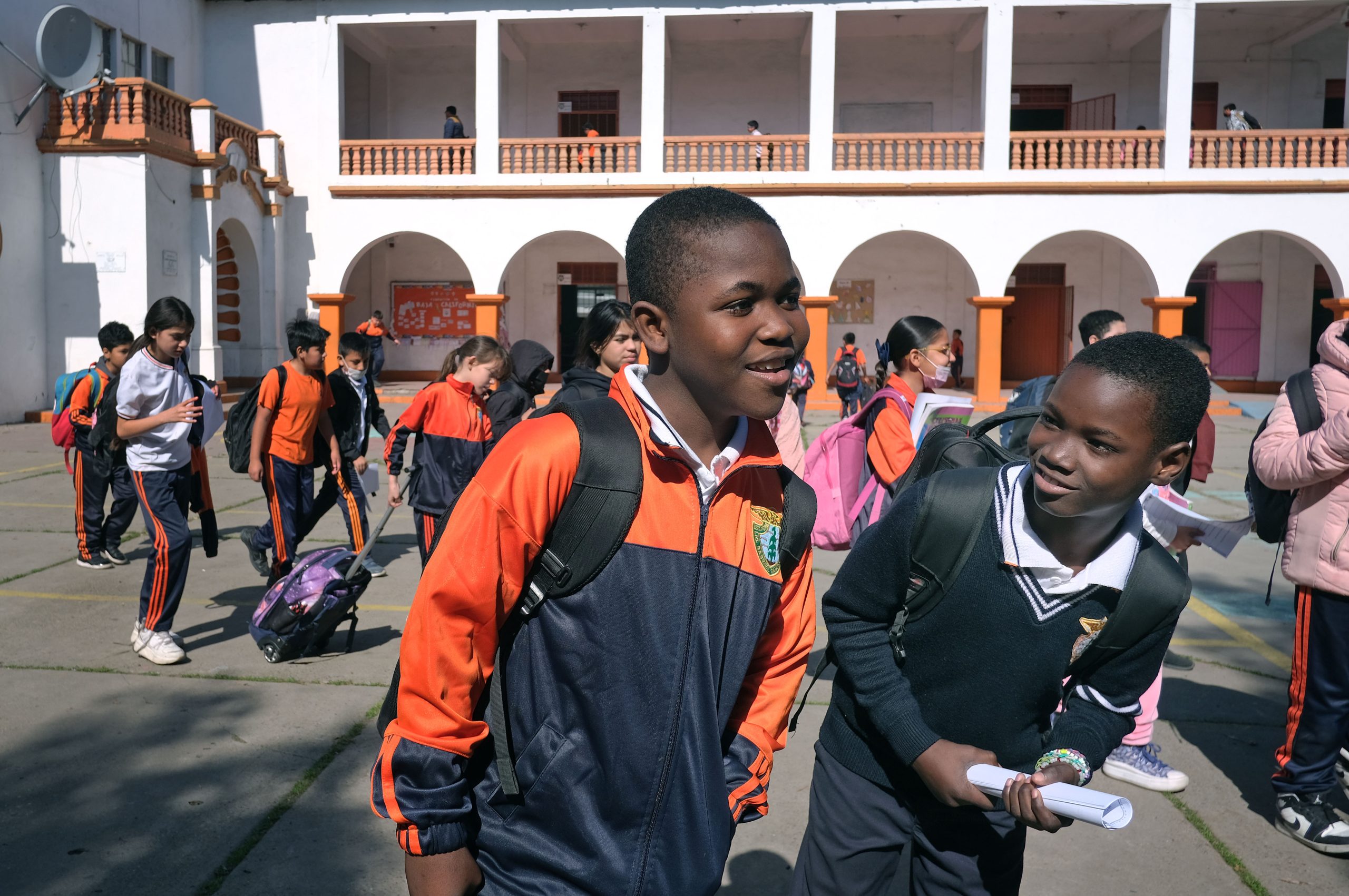
Juan Pedro Rodriguez Senatus was 4 years old when he and his mother left Leogane, Haiti, to join his father in Chile. But after years of economic struggle there, the family pulled up stakes one more time, moving to Tijuana last October.
When I met the sixth grader last Wednesday morning at Gabriel Ramos Millan Elementary School in the city’s Zona Norte, he seemed at home in the large fenced courtyard, shifting easily between Spanish and his native Creole as he translated for me and a cluster of Haitian school mates.
“When I arrived, I could not understand how they were doing additions, multiplications, division, but I’ve gotten the hang of it,” Juan Pedro told me. Math is now his favorite subject.
“Li pa dificil,” chimed in Jamesly Mauricette, a fifth grader who arrived from Haiti speaking only Creole, and still struggles with Spanish. “It’s not difficult.”
Foreign-born children face a multitude of challenges as they adapt to Baja California whether they speak Spanish or not, and schools are where they first make the transition. Unlike California, Baja California’s education system has no second-language programs; newcomers are immediately mainstreamed into regular classrooms with Mexican children.
Smoothing the Transition

“The biggest problem is the language barrier, at first they stick together, Haitians with other Haitians,” Edith Leon, a teacher who tutored Jamesly and his two brothers in Spanish through a digital language course.
At Gabriel Ramos Millan Elementary and other schools across Tijuana, teachers and students have been getting some extra support through a small state program known as Programa Binacional de Educacion Migrante – PROBEM for short.
The program was launched in Baja California in 1997 to send Mexican teachers to the United States to teach summer school classes to Mexican-American students – a means of ensuring that students held on to their culture.
But with shifting migration trends, PROBEM began changing its mission as well.
By the time I first learned of the program in 2011, it focused on children of U.S. deportees – many of whom could not speak Spanish. Today, the picture has changed again, with students from an unprecedented number of countries enrolling in Tijuana’s schools.
Education in Mexico is guaranteed through the ninth grade, and PROBEM ensures that foreign-born students are granted access, no matter their immigration status. Program figures show 42,000 foreign-born students enrolled in Baja California elementary and middle schools; some 30,000 of those are in Tijuana. The largest numbers were born in the United States, followed by Central Americans – mostly Hondurans – and then Haitians, with smaller numbers of students from Venezuela, Colombia and Asian countries.
In most of Mexico, schools have little experience with foreign-born students, Maria Dolores Paris Pombo, an immigration scholar at the Tijuana-based think tank, Colegio de la Frontera Norte told me.
“In Tijuana, schools have developed much greater sensitivity,” she said.
Finding Resources
PROBEM, operated by a six-person staff, has played a big role in easing the students’ adjustment, working closely with teachers and administrators. “They do a lot with very few resources,” Paris said.
She credits director Yara Amparo Lopez, PROBEM’s longtime director, for her willingness to forge alliances and find resources outside the school system. The program places interns from local universities to work one-on-one with students. A Tijuana nonprofit has offered Spanish classes. Two years ago, the office began working closely with the United Nations Children’s Fund, UNICEF.
Across the border, the California Association for Bilingual Education has shared teaching techniques. One group of Baja California educators received special training in through a program focused on language acquisition.
Lopez told me she first picked up on the increase in non-U.S. foreign students in 2006, with the arrival of Chinese children. By 2015, small numbers of Central Americans had started enrolling. Two years later, she began seeing significant numbers of Haitian students.
PROBEM is continuing to expand its role as student needs change. Since 2022, at the behest of Baja California Education Secretary Gerardo Solis, the program has begun addressing the needs of foreign students attempting to transfer to higher grades, a more cumbersome process, especially for those migrants unable to document their previous studies.
Update on the World Design Capital

A Tijuana visual artist, Daniel Ruanova, and a San Diego architecture firm, Heleo, have been tapped to create a pavilion for World Design Capital 2024, a year-long effort between the two cities that highlights design and its potential to connect and transform communities.
The pavilion project, announced Wednesday in San Diego, is a temporary art installation that initially will be set at Tijuana City Hall, and then moved to Balboa Park’s Plaza de Panama.
The structure will “serve as a bridge, connecting people from various backgrounds, inspiring conversations, and fostering a sense of unity,” according to WDC.
Related: Also announced was a schedule of events centered around design scheduled throughout the year, including a community celebration at the Tijuana Cultural Center on Feb. 28, and a World Design Festival in Tijuana from May 1-5. Tijuana and San Diego are sharing the spotlight this year as the first cross-border region to receive the World Design Capital designation from the Montreal-based World Design Organization. The Conrad Prebys Foundation announced last week that it is contributing a $1 million matching grant to the effort.
In Other News
- Tijuana journalist’s car torched: The Baja California Attorney General’s Office is investigating the torching of a vehicle on Thursday belonging to Yolanda Caballero, an independent Tijuana journalist. Video footage showed a man breaking the passenger window, and setting fire to the vehicle. Caballero was reporting a story at the time and away from her car. The incident occurred two days after Tijuana Mayor Montserrat Caballero publicly called out the journalist during an event outside City Hall, blaming her for bringing a protester who was disrupting the gathering. A journalist collective, #YoSiSoyPeriodista, has demanded the mayor publicly apologize for her statement, saying it made the journalist a target.
- Update on CBP asylum app: KPBS-News takes a look at the U.S. Customs and Border Protection asylum appointment system operated through the app known as CBP One, noting that “even though the app has improved, migrants are still forced to wait months to secure appointments.” More than 100,000 migrants have crossed the San Diego-Tijuana border with a CBP One app since January 2023.
- Mexican military at border: Mexican soldiers have set up a camp at a gap in the U.S. border fence south of Jacumba, where large numbers of migrants have been crossing to the United States. The camp is run jointly by the Mexican Army, Mexico’s National Guard, and Mexican immigration authorities, inewsource reports.
- All aboard to Tecate: Shut down for three years during the Covid-19 pandemic, monthly passenger train service between Tijuana to Tecate was recently reopened. The San Diego Union-Tribune went along for the ride last month.
Online job boards are a great place to start your search for online work from home jobs in Canada. The country’s largest and most popular job board is WorkBonds, and there are many other great job boards in Canada that specialize in remote and online work from home. Yes These are some of the best job boards to find work in Canada:
>>>>>>>> https://WorkBonds8.blogspot.com