


For more than 15 years, a pair of sewage treatment plants in eastern Tijuana have presented an opportunity – and a challenge.
The plants, Arturo Herrera and La Morita, raised hopes for a major wastewater reuse effort in the city – for irrigation, construction and industrial use. U.S. and Mexican authorities celebrated their opening, saying the effort would benefit both sides of the border.
But without a network of pipes to deliver the plants’ discharge, most of that highly treated wastewater has gone unused. Instead, 7 to 12 millions of gallons a day are being discharged nearby into the Tijuana River channel – a volume that represents about 14 percent of the city’s water use, according to the U.S. Environmental Protection Agency.
“It’s one of the most depressing things to see all the work it’s taking to treat that water,” Doug Liden, an environmental engineer for the EPA, speaking earlier this month at an advisory board meeting of Tijuana River National Estuarine Research Reserve. “And then you see this nice crystal clear water being discharged into a big cement channel where it flows six miles toward the border, mixing with all sorts of groundwater and raw sewage.”
A proposed solution: Today, as Tijuana faces growing water shortages, authorities with the Baja California water agency, CESPT, are studying a solution: piping the plants’ discharge to a spot just upstream from A.L. Rodriguez Dam, for storage and eventual delivery to a plant that would convert it to drinking water. The project would be one of the first in Mexico that involves what engineers call “indirect potable reuse.”
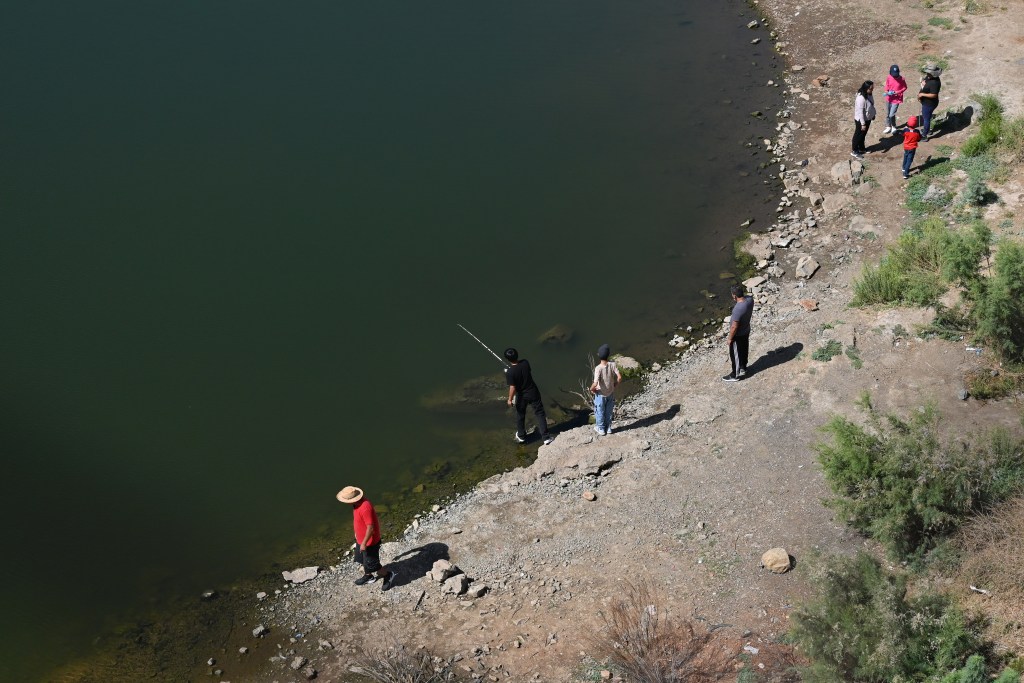
Tijuana receives 98 percent of its supply from the Colorado River, and as drought has forced cutbacks, the state government is searching for new sources, including building a desalination plant.
“We’re in a much more difficult situation than San Diego,” said Hernando Duran, former director of the state water commission and director of Tijuana Verde, part of the nonprofit civic group Tijuana Innovadora.
“Since 2022, the supply has been lower than the demand,” he said.
Duran was head of the state water agency in Tijuana when both treatment plants opened in 2008. The following year, he oversaw an effort to send a small part of that treated water to Morelos State Park. He has continued to champion wastewater reuse. As we sat in a small cafe last week in the city’s leafy Rio Zone, Duran was emphatic. “It’s just inconceivable that today, we’re irrigating these green spaces here with Colorado River water.”
Part of Minute 328: The state’s current project is part of a series of measures that look to reduce the flow of sewage-contaminated water that crosses from Tijuana into San Diego, as well as eliminate discharges into the ocean south of the border. Mexico and the United States in 2022 committed $474 million for a series of infrastructure projects under the treaty known as Minute 328.
U.S. and Mexican authorities have been meeting regularly, and each country has pledged $10 million toward the first phase of diverting the treated effluent from the two plants.
“One thing that is really really encouraging, and this is the first time that I’ve seen this, is that we have a lot of support from Mexico for this project,” Liden, the EPA engineer, told members of the San Diego Regional Quality Control Board earlier this month.
The project’s overall cost would total $90 million, Liden said, with another $12 million annually for operations and maintenance. “All that sounds very expensive, but when you compare it to the ocean desal cost, it actually comes in quite favorably,” Liden said.
Project roadmap: Earlier this year, a 62-page report commissioned by the North American Development Bank laid out the necessary steps for completing the project, from obtaining permits to expanding the treatment plants to ensuring water quality to conducting public outreach campaigns.
“The idea was to start putting more flesh around the concept of reusing the water,” said Salvador Lopez, the bank’s chief environmental officer. “It provides a roadmap as to what actions need to be taken, what infrastructure would be needed and how much it would cost to remove that and how much it would cost to remove that water from the river.”
The report proposes carrying out the project in two phases: an initial phase would involve upgrades to the treatment plants and construction of a conveyance structure to the dam. The second phase involves rehabilitating the drinking water treatment plant.
In the end, both countries would come out ahead, Lopez said. Removing the water from the river would be a “direct benefit” for the United States. And for Mexico, it creates a new water source that is “much more resilient to drought and climate change than bringing water all the way from the Colorado River,” he said.
New Rules for Dog Lovers Crossing the Border
On Saturday, Aug. 3, shortly before 10 a.m., a woman with nine caged dogs in her Honda SUV drove up to the inspection booth at the San Ysidro Port of Entry, the busiest along the U.S.-Mexico border.
Dana Dallabetto is a U.S. citizen living in Rosarito Beach, and the founder of Tragic to Magic, a nonprofit that brings rescued street dogs from Mexico for adoption in the United States. She and two volunteers were crossing to San Diego that morning in three vehicles with 27 dogs in their care. It’s something they do weekly.
But this was their first attempt under the new rules from the U.S. Centers for Disease Control and Prevention for bringing dogs into the United States. As a country at low-risk for rabies, authorities were only demanding proof of a dog import form, and for each dog, the volunteers carried envelopes with a receipt for the new form. As is their usual practice, they also carried a vaccination booklet, as well as microchip and sterilization certificates.
“I’ve got all the paperwork, everything,” Dallabetto told the inspector in booth 20, who quickly waved her through with her canine passengers, including a poodle-terrier mix called Lilly, a Maltese mix called Pepper, and a rambunctious Terrier mix named Benji.
“Yeah, I was a little worried, but they didn’t even check all the envelopes,” said volunteer Denise Lopez, who drove nine dogs in another vehicle. “They asked for the receipts of the forms, and they just checked that, looked at the dogs and just let us pass.”
Nearshoring and security: A new report looks at the rising costs of crime for transnational businesses operating in Mexico, recommending ways to counteract the trend. “Organized Crime & Violence in Mexico: Considerations for Future Nearshoring Foreign Direct Investment,” was presented this month in San Diego at the Institute of the Americas. The author, Cecilia Farfan-Mendez, writes that much of the cost of crime for the private sector “derives from trying to protect their businesses from violence and insecurity in the country.” It noted that in 2021, Baja California was the state with the highest costs in Mexico. One way of improving security conditions is through community violence prevention programs, the report states.
If you need to reach me, please write to sandradibblenews@gmail.com
Good article Sandra. I’m glad Doug Liden is still involved and moving this forward. Let’s hope local and bi-national politics don’t get in the way of a wastewater reuse project in Tijuana. This is a great “kill two birds with one stone” solution (reduce or eliminate TJ River and ocean beaches contamination AND increase drinking water availability in northern Baja)
Let me get this straight…….
Tijuana receives 98 percent of its supply from the Colorado River, and as drought has forced cutbacks, the state government is searching for new sources.
Meanwhile, we have too much water and are getting rate hiked…….
The San Diego County Water Authority has more water than it can use right now after recent rainy years broke multiple years of drought. It’s in a budget pinch, facing a $2 million cut to its budget along with a 14 percent rate increase on the cost of water for its 22 customer water districts.
So Mayor Toad could have sold water to Mexico instead it sounds like?
While recycling kills two birds with one stone, this is not a comprehensive plan. You should consider the C4CC plan.
https://youtu.be/10pNu0ZLqZE