

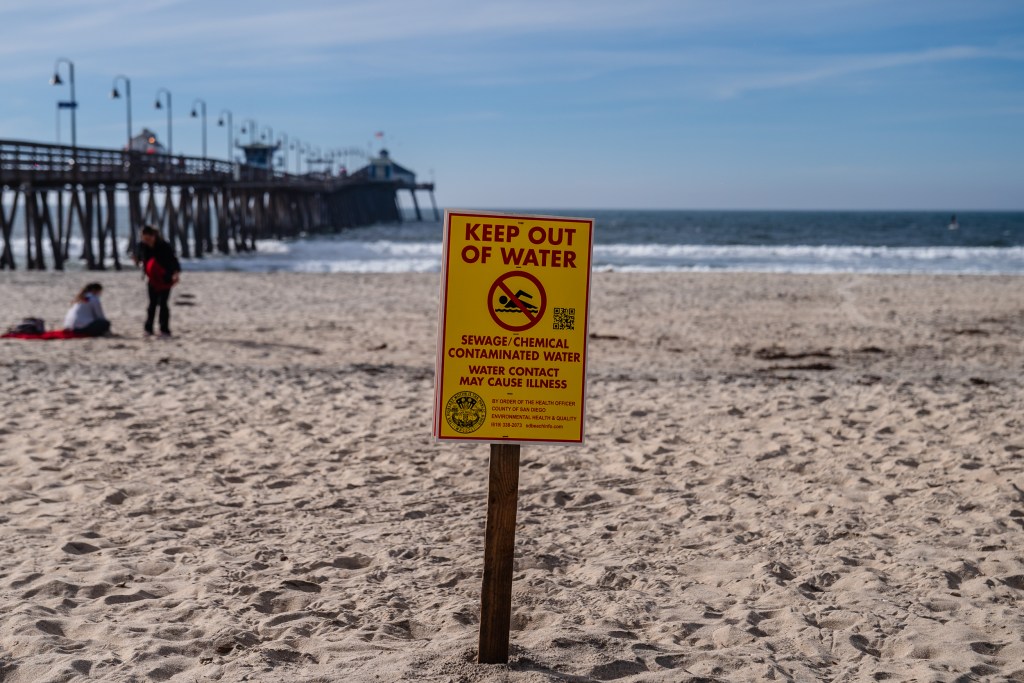
For years, San Diegans understood the environmental disaster that is sewage spilling from Tijuana into South Bay as a water quality problem.
Experts in the emerging field of detecting how polluted water transfers bacteria, viruses and other bad stuff into the air have made it their mission to investigate the Tijuana River estuary. Whatever’s in the water can make its way into your mouth, lungs and gut, these scientists are saying. In other words, the stink that South Bay residents so intimately know could make you really sick.
Now it seems the stakes of the border sewage crisis are incredibly dire. The environmental disaster was bad already for swimmers, surfers, public servants, tourism and sea life when it seemed contained to the coast. If the public sees this materialize as a toxic air pollution crisis as well, they’ll start to wonder: Is it even safe to live and work nearby?
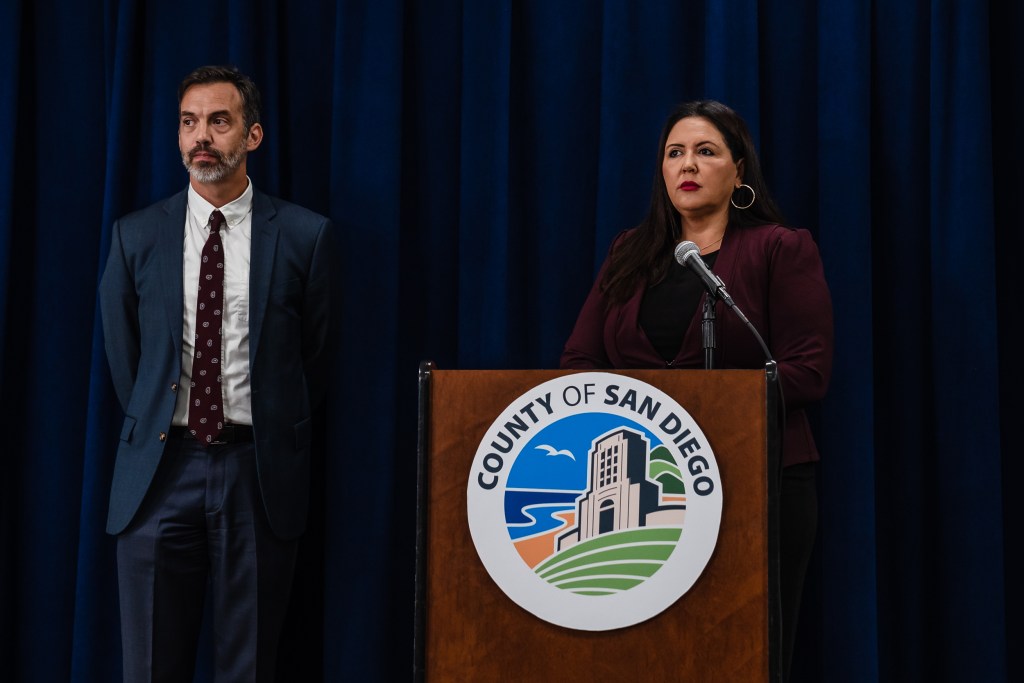
At a Sept. 9 press conference, scientists from San Diego State University and the University of California-San Diego revealed their findings that toxic gases like hydrogen sulfide and hydrogen cyanide emanate and spread from the Tijuana River toward nearby communities. Schools closed outdoor activities, and the county Public Health Department swooped in to verify their claims.
The county couldn’t produce the readings the researchers found. So elected leaders told residents there was nothing to fear; the levels of these gases the county’s own experts measured weren’t enough to be considered a serious public health threat, said San Diego Board of Supervisors Chair Nora Vargas. The scientists later admitted their mistake, that their instruments were falsely reporting elevated levels of hydrogen cyanide, after the county challenged their results in a competing press conference on Sept. 10.
The scientists dropped their messaging on hydrogen cyanide but still insist the levels of sewer gas – hydrogen sulfide – swirling around the river valley are alarmingly high and could be causing an array of health problems around the area – one even claimed that nearby goats had stopped reproducing because of it.

Paloma Aguirre, mayor of Imperial Beach who considers the Tijuana River sewage crisis one of her top issues, continues to back the researcher’s claims, despite efforts by the County Public Health Department, California Department of Public Health and the U.S. Environmental Protection Agency to side with the county and defuse alarm.
She’s altered her messaging to the public on the sewage crisis. In January, Aguirre posted a video of herself next to the trash-filled river near the border showing viewers that trash, not just sewage, affects South Bay residents. In a post Sept. 14, after the press conference with the scientists, Aguirre again stood next to the river, this time, speaking through a pink and yellow gas mask. She didn’t respond to a request for comment on this story.
That leaves residents with the difficult choice of believing a group of scientists and their mayor who says their air is toxic, or county, state and federal health officials who say it’s not. It’s akin to when the county copped out of closing beaches that failed water quality tests and instead rolled out a warning that left the public with another choice: Swim in water we say is unhealthy or not.
The stakes seem much higher now, though.
Enter Kim Prather, an atmospheric chemist from the UC San Diego’s Scripps Institution of Oceanography, who’s been sounding alarm bells that people are breathing toxic gasses emitted by this tainted water.
In a tweet, Prather said the levels of hydrogen sulfide she detected were “extremely high” and a “serious public health concern.”
But that’s not what her data shows when compared to government standards for sewer gas exposure.
After Voice of San Diego made an inquiry with Scripps, Prather released her initial findings measured from Imperial Beach. Her team took readings from 22 sites including one she’s dubbed as a “hot spot” on the Tijuana River where tainted water spills from two concrete pipes, mixes with air and sprays aerosols – small particles that become suspended in the atmosphere — and the focus of Prather’s research. Prather released the data under the condition we explain it has not been peer-reviewed, a step in the scientific process where other experts in her specialty evaluate the work before publication.
The amount of hydrogen sulfide Prather’s research group measured in the air was below the thresholds the state and federal government cite as safe for prolonged exposure. In other words, the air quality doesn’t meet the standard for serious health hazards.
Even Prather’s highest reading, when hydrogen sulfide reached its top sustained peak taken on Sept. 5 (about 958 particles of gas in 1 billion particles of air or .958 parts per million for one hour), the levels were far below established exposure standards (20 parts per million on average for one hour). Her instruments recorded some levels of hydrogen sulfide that were much higher, as high as 2,948 parts per billion, that persisted for a minute. When translated to the scientific units used by regulators, that’s about 3 parts per million. Again, under what regulators consider as safe even for a full hour of exposure.
Prather argued those safety standards were developed to protect workers in occupations that regularly encounter hydrogen sulfide, not community-wide exposure. She pointed to how her measurements greatly exceed the exposure standard set by the California Air Resources Board or CARB of 0.03 parts per million per hour (or 30 parts per billion per hour). That standard is so low, says Amy MacPherson, a CARB spokesperson, because it’s the level people start to smell hydrogen sulfide. It gives local air regulators the ability to start investigating hydrogen sulfide sooner rather than when it poses a bigger public health threat, MacPherson said.
“Hydrogen sulfide levels would have to be much higher (50 parts per million or more) to expect widespread health impacts,” she added.
Still, the U.S. Occupational Safety and Health Administration, or OSHA, the federal agency that sets safety standards for workers, notes that prolonged exposure to low levels of the gas (2 parts per million to 5 parts per million) could trigger nausea, eye tearing, headaches and loss of sleep or airway problems for asthma patients. That seems to be what Prather is trying to draw attention to.
“It’s really important to listen to the community. So many eye, ear, nose, throat infections… skin infections… heart and lung issues, mental issues, the list goes on,” she wrote in an email. “(Hydrogen sulfide) is a great indicator of the presence of sewage (and industrial waste) but there are hundreds of other gases and aerosols. It will take longer for us to quantify those.”
Still, public health authorities swiftly shut down her claims.
“The county has not received any data that as of now indicates a public health concern,” Vargas has said. The levels of hydrogen cyanide were insignificant, and the hydrogen sulfide readings varied, she said, and “are not posing a public health hazard.”
That set Prather off.
So began a series of tweets on the social media platform X directed at Vargas calling her statements misleading, that public health officials were “twisting” data, and ignoring the health complaints of South Bay residents.
“Woke up thinking I am really relieved I have published nearly 300 papers and am an elected member of many academies. If I wasn’t, the lies one supervisor has been telling to try and discredit me in order to dismiss our concerning air data in South Bay would have succeeded,” Prather tweeted on Sept. 12.
Whether what the scientists found was portrayed accurately or not, the publicity they generated around the notion that water pollution can make its way into the air we breathe mobilized local, state and federal action.
The county announced earlier this month the U.S. Centers for Disease Control would go door to door in South Bay neighborhoods to assess health impacts of the sewage. The county Board of Supervisors allocated $100,000 to provide free air purifiers to homes affected by odors. And the Air Pollution Control District is working on a public dashboard, akin to one that shows which beaches are too polluted for public access, to alert communities when air monitors show signs of noxious airborne pollution as well as add more air monitoring sensors around the Tijuana River Valley.
What Scientists Know About Hydrogen Sulfide
Hydrogen sulfide is a highly toxic gas but the threat it poses to human health depends on its concentration and distance to a population, says Wilson Rumbeiha, an environmental toxicologist at the University of California Davis.
Rumbeiha studies the health impacts of hydrogen sulfide on people whose jobs put them in close contact with lots of it in a confined space. Crude oil and petroleum products mined from the ground emit the gas as does rotting organic matter, manure and sewage. Oil and gas workers, farmers working in animal confines (containers filled with many animals packed tightly together) and those maintaining sewage infrastructure or wastewater treatment plants are typically most at risk of serious harm.
The gas at a high level of exposure impairs a cell’s ability to produce energy, Rumbeiha said, which at high levels of exposure can lead to seizures, coma and death.
“That’s what makes it so toxic. It’s considered a metabolic poison,” he said.
People can suddenly drop dead at high levels of exposure, a condition called “knock down,” meaning someone just collapses. What causes knock down isn’t well understood, however.
High levels of exposure mean 500 parts per million and above (that means 500 particles of gas for every 1 million particles of air or 500 milligrams of gas for one liter of air). People with respiratory problems like asthma or COPD can be harmed more easily by the gas at levels of 50 parts per million and above, Rumbeiha said. OSHA says it’s safe for workers to be exposed to up to 10 parts per million of hydrogen sulfide on average over an eight-hour period.
The catch is, the human nose smells hydrogen sulfide at very low, non-threatening levels, like 0.03 parts per million (the California Air Resources’ Board’s standard for when hydrogen sulfide can be considered a “nuisance”) even if the gas is far away. Ironically, hydrogen sulfide at high or dangerous levels causes the exposed person to lose their sense of smell, called anosmia.
“When you smell it, chances are it’s not toxic,” Rumbehia said.
Less understood is the long-term health impacts of hydrogen sulfide exposure even at low levels. There is evidence exposure, even at the OSHA standard, could compromise or irritate the respiratory tract so much so that a person becomes more susceptible to infections like influenza, Rumbehia said. Headache, nausea, sleep disturbances, cough – the kinds of health impacts reported by some residents in South Bay – are known effects of exposure, but researchers still don’t know why, he said.
There’s no treatment for victims of hydrogen sulfide exposure, Rumbehia said, part of his interest in studying the gas.
Correction: One data point in a previous version of this article should have read, ” …the human nose smells hydrogen sulfide at very low, non-threatening levels, like 0.03 parts per million” not .3 parts per million.
Now that we have scientific proof of this known fact, let’s identify the root causes and address them. Or we could just talk about it for 20 years and make a cottage industry out of it like we did the airport relocation “search” and then end up in the same place.
Surprised there was no information about how this became a crisis, about the overwhelming of pipes and plants used to treat the river’s pollution by the floods earlier this year, about the years of neglect for repair and maintenance that led to this breakdown, and, finally, the $400 m federal funds finally approved last month for South Bay International Wastewater Treatment Plant.
This kind of reporting is no better than amplifying the bickering, not helping the public to know what’s going on. VoSD should know better that news coverage like this, too, is irresponsible behavior. South Bay deserves better.
Kim Prather was the person who erroneously sounded the alarm on the spread of COVID-19 via coastal breezes and contributed to the ridiculous closure of the water to surfing/swimming/etc… in San Diego. While this is a serious issue, and she could be correct, she has shown herself to be hyperbolic in statements to the media and general public.
Agreed. Scripts is doing study right now monitoring levels in houses, not random spots next to a low tide river bed. The river is alive. The monsoon. Weather pattern and king tides are allowing the salt marsh to thrive. More wetted area more rot. Is it sewage? or do we live next to a swamp? Genetically detected stage from bellow Rosario, conflated with swamp smell. What’s real?
Government gas safety levels aren’t etched in stone! 40 years ago, I was poisoned by very high levels of formaldehyde gas at work. The “safe” level then was 5.0 parts-per-million (ppm). After decades of more problems and data, CA’s safe level is now less than 1.0 ppm, while USA OSHA is 1.0 ppm. My exposure exceeded 50 ppm – trust me, you don’t want to be one of the people who helps lower the safety level for future generations. It’s much better to err on the low side than the high side of dangerous gas exposure when dealing with a new situation like the South Bay.
Another lazy, lazy, lazy take by ME. Not one interview of the hundreds of residents who have been experiencing symptoms. Not one interview from the officials who claim this is not a threat and what they’ve based their determinations on. Not one source referenced to counter the claims that chronic long term exposure may be detrimental to human health (broad body of scientific evidence that it does). No digging in further to see other comparable cases such as this. No reference to the fact that there are no long term health exposure standards for hydrogen sulfide. No questioning why Nora Vargas has declared the air safe and in the same breath acknowledges the horrid smell of rotten eggs, a clear sign of hydrogen sulfide. No follow up/interviews with the multiple doctors sending in letters of concern who are seeing increases in their practice of children with asthma and coughing. This is a personal blog at best.
Wow! Voice of San Diego how far have you come. You run a ten page puff piece on one of your major donor’s grand daughter (cough cough Rep. Jacobs). And when you could be doing some real investigative journalism, you send in your big guns, Mackenzie.
La Prensa, with little support and limited resources is doing way better investigative journalism than ya’ll.
San Diego investigative journalism is dead.
Esse post me ajudou muito, gratidão!
I’m 59 years old and female. I was diagnosed a couple of months ago with COPD/Asthma and I was beyond scared! My lung function test indicated 49% capacity. After having had flu a year ago, the shortness of breath, coughing, and chest pains continued even after being treated with antibiotics. I’ve been smoking two packs a day for 36 years. Being born without a sternum caused my ribs to be curled just one inch away from my spine, resulting in underdeveloped lungs. At age 34 I had surgery and it was fixed. Unfortunately, my smoking just caused more damage to my already underdeveloped lungs. The problem I was having is that I enjoy smoking and don’t want to give up! Have tried twice before and nearly went crazy and don’t want to go through that again. I saw the fear in my husband’s and children’s eyes when I told them about my condition then they started to find solutions on their own to help my condition. I am 59 now and was diagnosed with COPD/Asthma which I know was from my years of smoking. I started smoking in school when smoking was socially acceptable. I remember when smoking was permitted in hospitals. It was not known then how dangerous cigarettes were for us, and it seemed everybody smoked but I was able to get rid of my COPD and Asthma lung condition through the help of Madiba Herbal Center com my husband bought, WWW. MADIBAHERBALCENTER. COM has the right herbal formula to help you get rid of and repair any lung conditions and cure you totally with their natural organic herbs. I wish anybody who starts smoking at a young age would realize what will eventually happen to their bodies if they continue that vile habit throughout their life.