

Every election cycle, for many years, we have run the Voice of San Diego Elections Contest and this year, we have made it into a much easier-to-fill-out form. I collaborated on the lines this year with old Politics Report pal Andrew Keatts, of Axios San Diego.
So make your predictions here. The winners will get lunch with Keatts, Andrea Lopez-Villafaña and me.
Responses must be in before the polls close Tuesday evening.
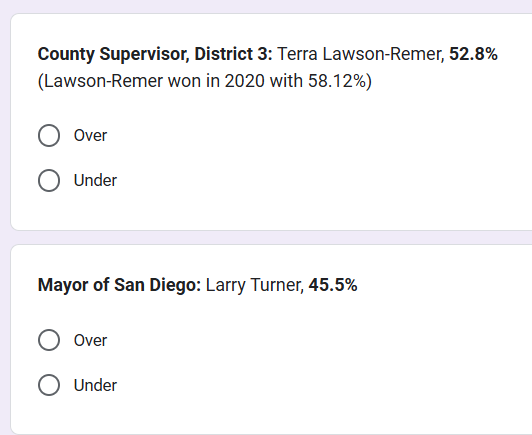
Usual disclaimer: Don’t get mad about the lines we took. We have no idea what’s going to happen. As with any over/under we just tried our best to find a line that we thought would be hard to choose between over and under. If you think we’re off, let us know by winning the thing.
Usual disclaimer II: If we didn’t include a race you care about it is because we are snobs and look down on that race and the people who care about it and not because we just had to limit it somewhere.
The Frye Run: It’s Been 20 Years
Five days before the election and a towering fire breaks out between SDSU and Talmadge and it seems at least possible, if not likely, that an encampment residents had complained about caused the blaze?
It doesn’t get much worse than that for a mayor running for re-election. I drive that little stretch of Montezuma Road every few days and I always marvel at the grove of hundreds of untrimmed palm trees packed in there like a newly opened box of fireworks. My feelings about palm trees are no secret (they are more flammable than match sticks, provide no shade but plenty of homes for rats, especially under their untrimmed skirts) but I never actually thought the grove would ignite.
People had no trouble concluding it was homeless residents who started it. Here’s the official line from Monica Muñoz, the fire department spokesperson:
“Our investigators have not yet determined the cause of the fire. We know it started in or very close to a homeless encampment,” she said.
The mayor’s challenger, Larry Turner, jumped on the story and held a press conference with two City Council candidates and a neighbor who had warned the city about just this risk.
The relentless bad news bogging down the final days of San Diego Mayor Todd Gloria’s re-election campaign reminded me of 2004.
Then it occurred to me. My god, it has been 20 years since that transformative for the city of San Diego and an election so big, we still feel its effects today.
20 years ago today: The city went to the polls on Nov. 2, 2004. It’s remarkable how similar the ballot was to this year’s. On it was a half-cent sales tax extension for the county transportation system known as TransNet. Also on the ballot was a hotel-tax increase for the city of San Diego. It was Proposition J – a straight increase to the hotel-room tax without any promise for how the city would spend the money. Just like Measure E this year, without any restrictions on how it would be spent, the measure only needed a bare majority of support from voters.
It was key to the city’s fiscal health, they told us, and it lost with 58 percent of voters choosing the no.
Mike Aguirre won election as city attorney. The half-cent sales tax extension for TransNet got the two-thirds needed. It was the last local tax increase to get two-thirds.
More interesting for us now, though: Proposition F. Voters had to decide on a proposal to make the city a strong-mayor form of government. The mayor would become the chief executive officer of the city, rather than the presiding member of the City Council.
In a way, then Mayor Dick Murphy was on the ballot twice. Voters had to decide whether to re-elect him and whether to – after two years of planning — give him power over the city’s thousands of employees the mayor had not had for 70 years.
But in 2004, just like now, there was no end to the bad news for him.
One day there’d be another revelation about the then-still-titillating pension scandal. The next? A credit-rating agency would suspend the city’s ability to borrow money. Maybe even the same day, the mayor, who had prioritized clean water, would learn of a massive sewage spill (we used to have lots more of those along the city’s coast, not just at the border). He faced two equally silver-haired prominent political figures who day in and day out hammered Murphy and exaggerated the already big scandals the city faced.
Murphy somehow got through the primary but then, in November, the unthinkable happened. He suffered an utterly humiliating defeat to the populist Councilmember Donna Frye, who had pulled together a write-in campaign.
She won. Well, she got more votes. But then Murphy’s lawyer (Bob Ottilie who recently filed a complaint against city attorney candidate Brian Maienschein. He also a few months ago tried to disqualify Turner from the ballot for his questionable residency in San Diego.) successfully argued that about 5,000 of Frye’s write-in votes were not valid. While voters had written her name in, they had not actually filled in the bubble next to it.
Murphy won but it had been a bruising battle and the news only got worse. Within months of his second term beginning, he resigned in disgrace – never to enjoy the new strong-mayor powers of the office that he had argued were necessary for the city’s leader to be more effective.
Now, the strong mayor: Gloria probably has the inertia needed to win re-election. But if 2004 taught us anything it’s that re-election doesn’t spare the mayor. The city can cave in on a mayor quickly. It’s seething and fury about the state of homelessness is animating Turner’s campaign – daily revelations feed each other. Like 20 years ago, it becomes easier and easier for detractors to add up each setback as Gloria’s.
Like Frye’s write-in campaign, a flurry of too-little, too-late actions to make a change have made the race more interesting. It may, like Frye, shock us all Tuesday.
More likely, Gloria, like Murphy, will cling to the job. It’s so hard to oust an incumbent. But far from providing the mayor relief, after his re-election, the fury won’t end and it could, with each fire, each failure, get much worse.
Snapdragon Stadium Slips Up
This is really bad: The San Diego Wave FC announced Friday that their game Sunday at Snapdragon Stadium has been moved to Louisville, Ky. They said the field at the stadium was not adequate and while they studied it and considered other local options, they ultimately had to move it to Kentucky.
“The safety and well-being of all players is our top priority, and the current field conditions at Snapdragon Stadium, which are the responsibility of a third party, have not met the standards required for a safe playing environment,” the club wrote.
A bad sign: Snapdragon Stadium hosts many sports and concerts already but next year it’s adding the highest level of men’s soccer with the inaugural season of San Diego FC. SDSU officials long parried questions about how it can handle so much use but while there have been major complaints about the playing surface, this is the first time a major event has been canceled.
Snapdragon response: The stadium (it’s a living being) issued a written response saying it could have had the field ready for Sunday. Regardless, the stadium said it is dedicated to investing whatever resources are needed to fix up the turf.
“Our commitment includes integrating grow lights, exploring additional sod farm opportunities, evaluating different grass types and adopting diverse installation methods,” the stadium wrote.
Notes
Why all the texts: Contributor Mason Herron wrote up an explainer for us on why campaigns have embraced text messaging so much.
Lawsuit: Lisa Halverstadt reported Friday James Carter, former deputy director of the city’s homelessness strategies department, sued the city over alleged racial discrimination before his fall 2023 resignation.
You should get this: If you are at all interested in South County politics and policy, you should get our new South County Report, by Jim Hinch. He’s doing a great job.
If you have any feedback or ideas or questions on the contest, send them to scott.lewis@voiceofsandiego.org.