

For years, the city and the county have squabbled over responsibilities and jurisdiction.
In the last decade, those battles have made major headlines twice.
As our Will Huntsberry reports, bureaucratic tug-of-wars played out during both the devastating January floods and a 2017 hepatitis A outbreak that afflicted dozens. Talk of permits and regulatory roadblocks loomed large in both situations.
In our latest review of What We Learned This Year, Huntsberry states what’s unfortunately obvious: the city and the county don’t play well together, especially in a crisis.
Something else we learned: California’s plastic bag ban backfired. If you missed it, you can read yesterday’s story here and all of our stories about what we learned this past year here.
Border Sewage Plant Finally Able to Treat Tijuana Pollution

Two years. That’s how long a sewage plant run by the United States government had been violating its own permit to treat Tijuana wastewater before sending it to the Pacific Ocean.
November marked the first time since July of 2022 that the South Bay International Wastewater Treatment Plant could say that the treated water it produced was in compliance with the Clean Water Act, confirmed Morgan Rogers, the plant’s operation manager. Rogers attributed that to some major fixes of broken pipelines in Mexico and clean-ups of some key plant infrastructure that had been battered by a hurricane.
At least one San Diego-based environmental group, Coastkeeper, sued the International Boundary and Water Commission (or IBWC, the federal agency responsible for border water quality issues) for the hundreds of permit violations water coming out of the plant produced. It’s not just sewage the plant receives from Tijuana, but also trash and large amounts of sand which often clog-up the plant’s machinery.
Sand is a large reason why the plant was out of compliance with its permit in the first place. Sediment had filled up what are known as the plant’s “primary sedimentation tanks,” which allow solids to settle and wastewater to move onto the next stage for treatment, to a degree that they were breaking down.
Things got worse after a pair of key sewage pipelines snapped in half on the Tijuana side of the border in July of 2022. Then Hurricane Hilary, a year later, sent four times as much water than the plant is designed to handle through the system.
One by one, Rogers’ team cleaned out and fixed the sedimentation tanks and finally saw the fruits of their labor in the November water quality tests.
“This is a big deal for us,” Rogers said. “We’re very happy we’ve reached this milestone.”
There’s still work to do. The plant still has hundreds of millions of dollars worth of maintenance and expansion needs in order to treat more Tijuana sewage, which keeps waste out of the Tijuana River – the major cause of beach closures in South Bay.
Trump, Musk Moves Stall Tijuana River Sewage Fix
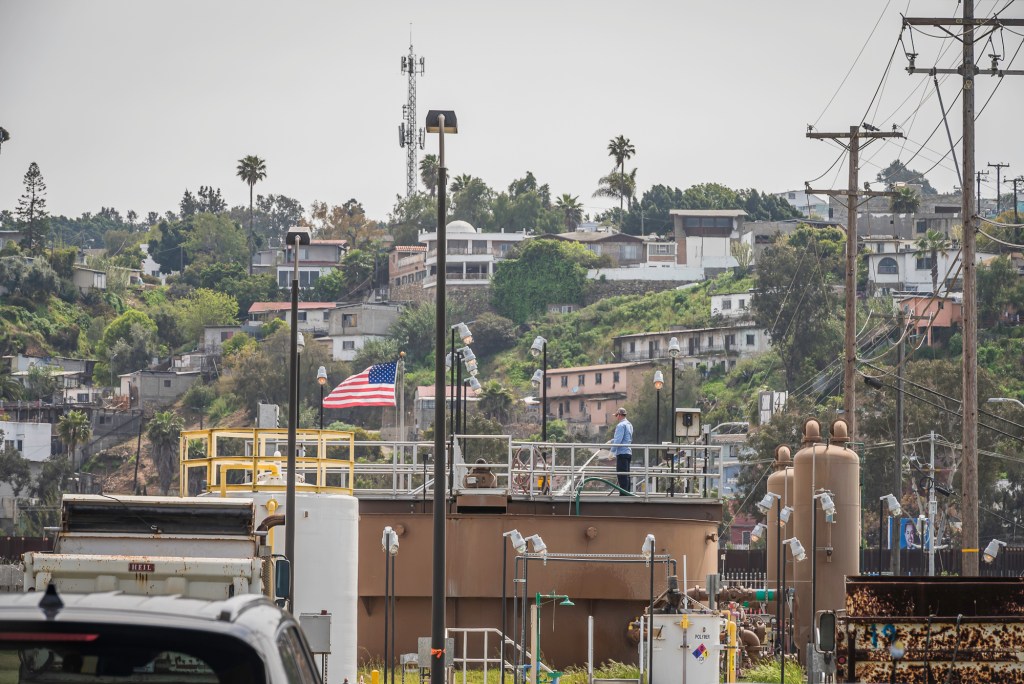
President-elect Donald Trump and ally Elon Musk’s last-minute rejection of a bipartisan spending bill to avoid a government shutdown put desperately-needed money to the polluted Tijuana River valley at risk.
Things were looking up on Tuesday when Democrats and Republicans announced they successfully negotiated a spending plan to keep the federal government open through March. The plan included $250 million to help fix a busted wastewater treatment plant responsible for treating Tijuana sewage before it spills into the Pacific Ocean.
But the next day, Trump and incoming Vice President JD Vance called on Republicans to allow the government to shut down unless the deal nixed elements they felt Democrats desired. Musk took to X, which he owns, calling on Republicans to vote against the bill.
Parts of the federal government will shut down if Congress can’t agree to another bill by Friday at midnight.
San Diego and other California lawmakers celebrated the win earlier in the week because members of both parties had agreed to include Tijuana River funding in a $100 billion disaster relief package attached to the government spending bill.
“Just a few months ago, we broke ground on the project to fix and upgrade the broken plant — now we have the money to finish the job,” read a Tuesday statement from Rep. Scott Peters, a Democrats who represents a swath of San Diego that includes the city of Coronado which is impacted by sewage tainting its coastline.
In Other News
- City staff want to quash a footnote in city code allowing developers to pursue more dense projects only in the Encanto area. (KPBS)
- The county said earlier this week that UC San Diego Health ended talks over a hoped-for behavioral health hub, but the health system’s CEO says that’s not quite right. (Union-Tribune)
- inewsource’s Steve Breen produced a visual review of the San Diego’s deadly fentanyl crisis.
- There’s one group of city workers still caught up in the aftermath of the city’s now-overturned pension reform measure: about 1,000 police officers denied credit for time they spent in the police academy. (Union-Tribune)
The Morning Report was written by Lisa Halverstadt and MacKenzie Elmer. It was edited by Andrea Lopez-Villafaña.