


There were few surprises at the border last week as President Donald Trump launched his second term. True to his campaign vows, he suspended asylum appointments, prepared to dramatically step up deportations and moved to end birthright citizenship.
Yet here in Tijuana, Trump’s first day took an unexpected turn. Just hours after the new U.S. president took the oath of office, Tijuana officials removed a well-respected human rights activist from his post as the city’s director of migrant affairs. That same day, a little-known city official with a degree in international law, Nivia Karely Ruiz Berumen, was named as provisional director.
Jose Luis Perez Canchola said he was asked to step down after speaking out repeatedly in recent weeks about the need for greater coordination among city, state and federal officials, and calling for the reinstatement of a federal fund to support local migrant shelters. He said that a top city official, Arnulfo Guerrero, accused him of making statements that were alarmist and exaggerated.
At a City Hall news conference four days after the dismissal, Guerrero read from a prepared statement that said the action was necessary “in maintaining an institutional narrative.”
Perez Canchola’s defenders said the decision removes one of Tijuana’s most experienced migrant advocates at a critical time. Dozens of nonprofit and religious shelter operators, academics, human rights activists and others have signed petitions protesting City Hall’s action.
His City Hall bosses “saw me as someone who was usurping a role that corresponds to high-ranking federal or state authorities” Perez Canchola told Zeta newsweekly. “I’m not going to start arguing with someone who doesn’t understand the dynamics of migration.”
If the city hoped to mute Perez Canchola, his dismissal has had the opposite effect. The story quickly became national news, covered by Mexico City news outlets. “They fired me because I demanded coordination in attending to migrants,” Perez Canchola said in a nationally broadcast interview to Azucena Uresti of Grupo Formula.
Amid uncertainty of what’s to come, the incident offers a window into the pressures bearing down on Tijuana, the largest city on Mexico’s northern border. Tijuana has long been a major migrant corridor – whether it’s deportees being returned to Mexico or asylum applicants and others hoping to enter the United States.
Traditionally, religious, nonprofit groups and citizen-led initiatives in Baja California have played a pivotal role in providing shelter and other support to these people in transit. But as Mexico’s federal government has stepped in to lead the reception of deportees, local advocates say they have not been taken into account in the government’s plans. It’s not just deportees that need attention, they say, but large numbers of asylum seekers now stranded at the border without the possibility of U.S. appointments.
President Claudia Sheinbaum’s administration has stressed a carefully crafted response to Trump’s directives, one that involves Mexico’s consulates in the United States as well as close coordination with state authorities in Mexico. On Jan. 20, the Mexican president announced a program for deportees called Mexico te Abraza, which includes the opening of nine large federal shelters exclusively for deportees in Mexican border cities, including Tijuana.

Perez Canchola has been involved in human rights and migrant protection for decades. He has served as the state’s ombudsman on human rights, and was head of migrant affairs in the city during a previous administration. A founding member in Baja California of MORENA, Mexico’s ruling party, he was appointed to his current position last fall by incoming Mayor Ismael Burgueño, also a party member.
Perez Canchola had been warning that Mexico was not prepared to receive large numbers of deportees, and in recent weeks called for the re-establishment of the Fondo de Migralidad, special federal fund to help non-government shelters support migrants.
Perez Canchola was still in his government position on Jan. 20 when he showed up at a plaza outside Mexico’s El Chaparral Port of Entry, where more than 100 devastated asylum seekers had just learned all appointments were canceled. Perez Canchola was the only municipal official who arrived on site as he urged the migrants to seek shelter rather than stay out in the cold.
But later that evening, he was out of a job. Perez Canchola said his dismissal was the result of his public statements. Guerrero, the city official, “accused me of exaggerating and lying,” Perez Canchola said in a written statement. Perez Canchola said Guerrero presented him with a resignation letter that he voluntarily signed.
Supporters in Tijuana were quick to speak out.
“These moments of uncertainty and anxiety … call for officials who are truly socially committed, with a humanitarian sensibility, sensitive to human pain, but above all experienced in the topic of migration. Perez Canchola has all these characteristics,” read a letter by the Coalicion Pro-Defensa del Migrante, a coalition of nonprofit shelters in Baja California.
Another letter, whose authors include several migrant advocacy group representatives and an academic, said the firing was carried “with little ethics and in a threatening manner.” It cited Perez Canchola’s years of experience, his knowledge of the border, his track record as a human rights advocate and his “impeccable record as a public official.”
On Thursday, city officials responded to the outcry during a mayoral news conference at City Hall. Guerrero, the city’s secretary-general, read a prepared statement that praised Perez Canchola as a “tireless defender of human rights.”
But Perez Canchola’s statements were not aligned with City Hall’s vision, Guerrero said. The city requested he resign, due to “the necessity of maintaining an institutional narrative aligned with this government’s objectives, especially as regards an issue as sensitive as migration.”
Though he no longer directs migrant affairs for the city, Perez Canchola said he plans to continue to speak out – but now as a substitute member of the Tijuana City Council.
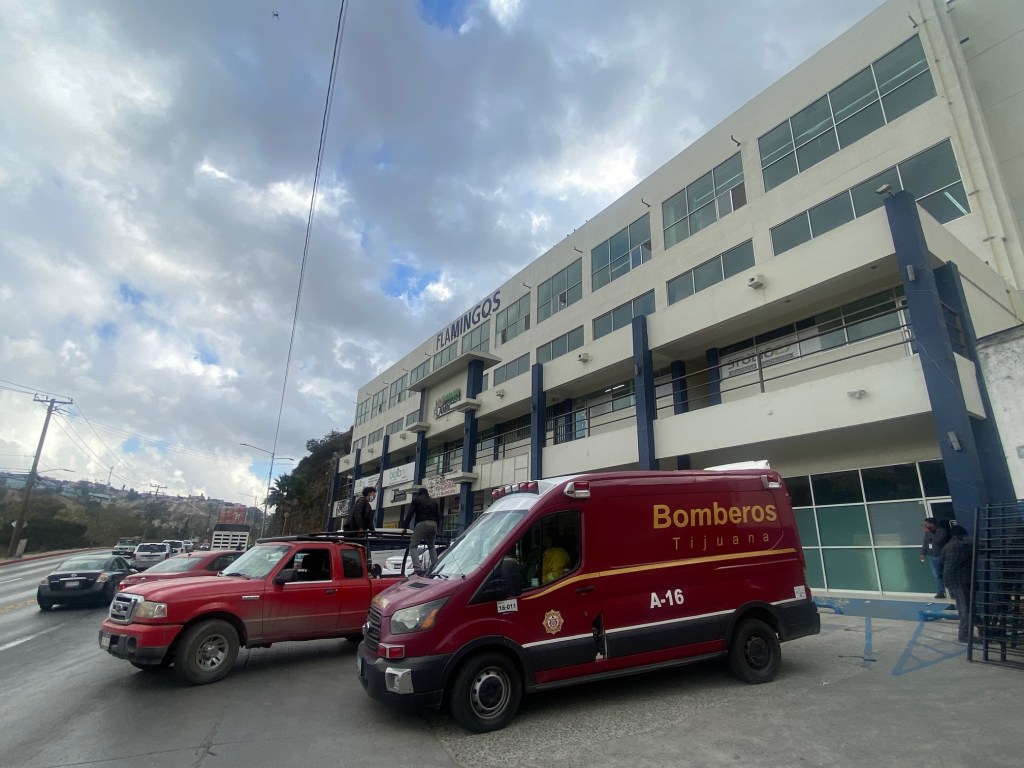
Shelter for Deportees: A former Tijuana entertainment center known as Flamingos is being converted into a federal shelter for the exclusive use of deportees, as pledged under the “Mexico te Abraza” program. Authorities are opening the 2,600-bed shelter in preparation for an expected increase in deportations under the Trump administration. The shelter is headed by Mexico’s federal government, with support from the state of Baja California and the city of Tijuana. Mexico’s Education Secretary, Mario Delgado, joined Baja California Gov. Marina del Pilar Avila and Tijuana Mayor Ismael Burgueño in an official opening of the new center, still a work in progress on Saturday. Besides food and shelter, deportees will be offered medical care, psychological counseling, job counseling, and bus fare back to their home states if they request it, authorities said.
Trump’s tariffs: President Trump has threatened to impose tariffs of 25 percent on Mexican and Canadian products as early as Feb. 1. But “right now, there are no instructions to anybody at CBP (U.S. Customs and Border Protection) to start collecting duties from Mexico,” Eduardo Acosta, vice-president of R.L. Jones Customhouse Brokers said Wednesday.
Acosta was one of the speakers at a webinar organized by the Otay Mesa Chamber of Commerce, “Major Trade Impacts Coming from the New US and Mexico Administrations.”
Change is afoot, Acosta said: “There’s a lot of uncertainty still as to how our region, I’m talking primarily about Tijuana, Baja California and San Diego, what are we going to look like in two or three months?”
Other News
Southbound Sentri: A Mexican federal legislator is proposing a “trusted traveler” program for southbound vehicles crossing from San Diego to Tijuana through Mexico’s El Chaparral Port of Entry. Gilberto Herrera Solorzano, a member of Mexico’s ruling MORENA Party representing Tijuana’s Sixth District, said the program would be similar to the U.S. SENTRI program. Speaking last week at a meeting of the Smart Border Coalition, Herrera said he wants to address the lengthy and stressful afternoon southbound border waits that confront many cross-border commuters. Herrera plans to propose the program to the Mexican Chamber of Deputies’ Commission on Northern Border Affairs. In an interview, he said that the lane could also be used by people crossing for business, medical appointments or for just for a meal. Herrera wants any revenues from the lane to be earmarked for a special program to fill potholes in Tijuana’s streets.
Keep Baja Wild: A talk at 7 p.m. on Friday (Jan. 31) at the San Diego Natural History Museum will look at “how binational collaboration is shaping the future of conservation.” Leading the discussion will be staff from the Ensenada-based nonprofit Terra Peninsular and the San Diego Natural History Museum. The talk will include a screening of the documentary “Artistic Expedition through Baja California, 1962” featuring an expedition from Tijuana to La Paz by the late Tijuana artist Manuel Cruces Cuellar. Tickets are $15 for non-members and $12 for members. RSVP at this link.
Serie del Caribe: Professional baseball teams from the Dominican Republic, Mexico, Puerto Rico, Venezuela and Japan will square off starting Friday at Mexicali’s Nido de los Aguilas stadium for the Serie del Caribe. The tournament, which ends Feb. 7, consists of 14 games and is organized by the Caribbean Professional Baseball Confederation. As of Monday, there were no single-ticket sales, but a series of 3, 4 and 5 tickets could be purchased through this website.