
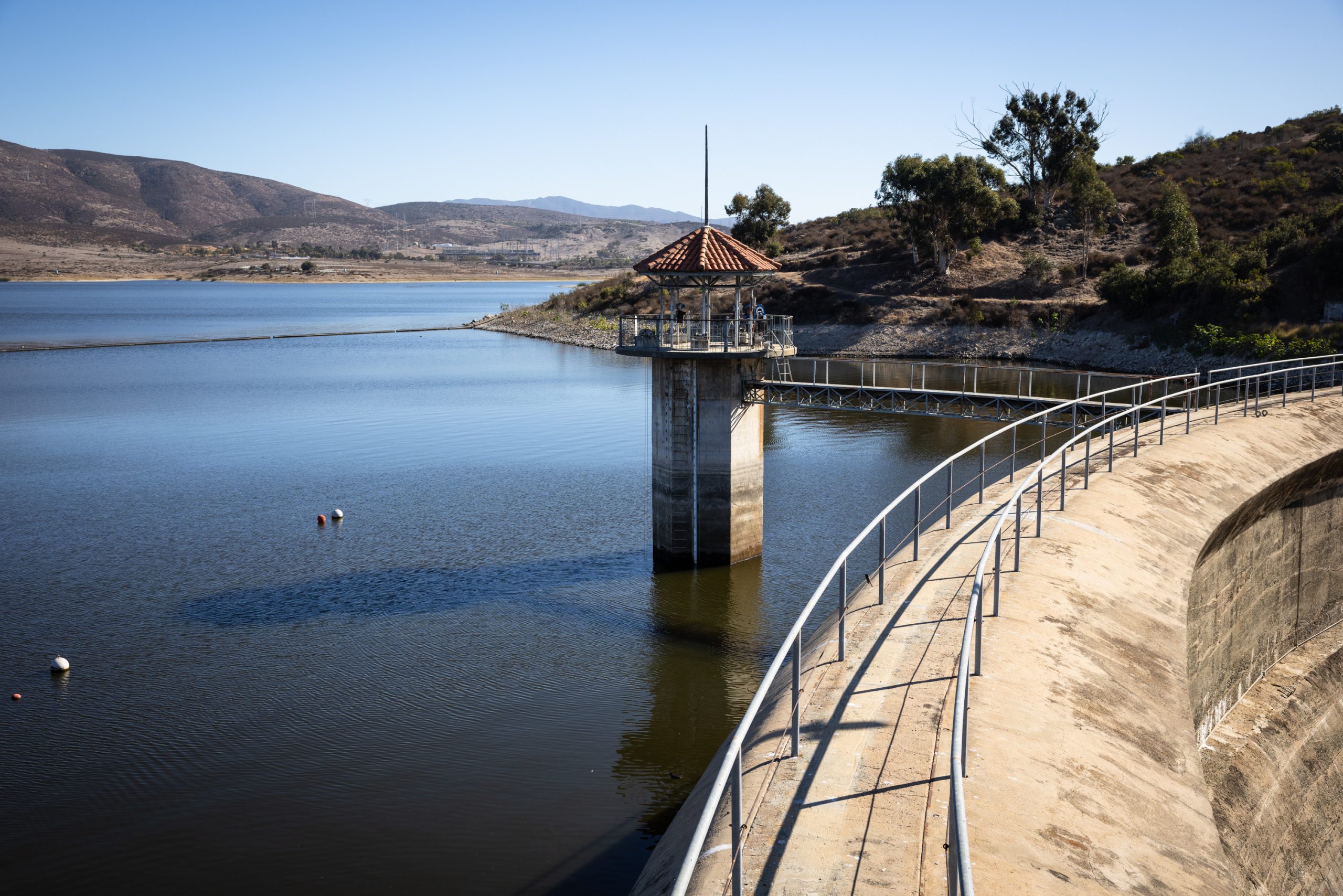
Sweetwater Authority, which supplies drinking water to roughly 200,000 customers in Chula Vista and surrounding communities, learned last month that its main reservoir contains levels of a toxic industrial chemical that could require expensive treatment or necessitate decommissioning the reservoir entirely.
The elevated chemical finding came as part of a year-long testing process required by the Environmental Protection Agency, or EPA. An earlier sample taken late last year found PFAS levels high enough to require public notification. Samples taken last month found even higher levels of one chemical, PFOA, that the EPA has designated a “hazardous substance” posing “a substantial danger to the public health.”
The levels found last month, if confirmed by follow-up testing, could trigger a state rule that would require Sweetwater Authority either to stop using water from Sweetwater Reservoir, blend reservoir water with cleaner water bought from an outside agency or notify customers that their drinking water contains elevated levels of a hazardous chemical.
“We don’t have treatment in place” for PFAS chemicals, said Justin Brazil, director of water quality for Sweetwater Authority. “Our options right now are…we could take the [reservoir] out of service or blend” reservoir water with uncontaminated water bought from an outside agency.
Brazil said installing treatment to remove PFAS chemicals from reservoir water could cost at least $40 million. Buying water from an outside agency could cost up to $10 million per year.
Asked whether water from the reservoir was safe to drink, Brazil said, “That’s a good question and a valid concern. We’re not physicians here but we do follow the rules for contaminants that are set by the EPA and the state of California.”
PFAS chemicals are a class of industrial chemicals used in a wide variety of everyday products, ranging from electronic devices to fire retardants. They are known as “forever chemicals” because they remain present in the environment long after their production.
PFOA, one of the chemicals found in Sweetwater Reservoir, has been linked to numerous health hazards, including pregnancy complications, liver damage and cancer. Recent EPA guidelines found that PFOA is “likely to be carcinogenic to humans.”
Sweetwater officials said they do not yet know how PFAS chemicals made their way into the agency’s reservoir.
In an interview late last year, agency general manager Carlos Quintero called the chemicals “one of the sins of civilization” and said anything from storm runoff to decommissioned landfills in the Sweetwater River watershed could have contaminated the reservoir.
Brazil said the agency took a follow-up sample of reservoir water last week to confirm the January results. Results of the follow-up test will be made available later this month, he said.
The agency also plans two more rounds of testing in April and June. Those rounds will then be averaged with the agency’s other two rounds of testing to produce an overall assessment of PFAS levels in the reservoir. If that assessment exceeds federal guidelines, the agency will have until 2029 to fix the problem.
Brazil said agency officials are working with state regulators to determine how best to respond to the immediate problem of high PFOA levels.
Susanne Bankhead, a spokesperson hired by the agency to conduct public outreach about PFAS chemicals, said the agency’s elected board of directors ultimately would decide how to respond to the problem of reservoir contamination. “We’re looking for a balance of safety, fiscal prudence and rapid response,” Bankhead said. “We don’t yet know what the effect on water rates could be. It’s complicated.”
Sweetwater Authority will hold two public outreach meetings this month to discuss the presence of PFAS chemicals in drinking water. The meetings will take place at 5:30 p.m. on Thursday, Feb. 13 at the Chula Vista Public Library Civic Center Branch and at 5:45 p.m. on Wednesday, Feb. 19 at the Bonita-Sunnyside Library in Bonita.
Annexation Alarm in Lincoln Acres
Residents of Lincoln Acres, an unincorporated community of roughly 2,100 people surrounded by National City, have scheduled what resident and neighborhood activist Alisha Morrison described as an emergency meeting on Feb. 20 to discuss the possibility that National City officials are seeking to annex the community and make it part of the city.
“Here we go again,” Morrison said in an email to Voice of San Diego, referring to what she described as past efforts by the city to take over the fiercely independent community. Morrison, whose family has lived in Lincoln Acres for several generations, said residents prize the area’s historic connections, lower taxes, relaxed atmosphere and rules permitting chickens and other farm animals on residential property.
The flyer advertising the upcoming community meeting conveys a high level of alarm. “A SILENT STORM IS BREWING AND IT IS SMELLING LIKE ANNEXATION!!” the flyer says in bold type and red letters. “Come learn how you can help save yourself.”
National City Councilmember Marcus Bush confirmed that he has discussed whether his city should absorb the small community in its midst. “I’m the one who started this conversation,” Bush said. “If people want to point fingers, point them at me. This came from Marcus Bush.”
Bush, who said he grew up in Lincoln Acres, said the border between the two areas “zig zags” and sometimes creates confusion for law enforcement and other public officials. “People call 911 and we have police and sheriffs disagree about who should respond,” Bush said. National City has its own police force, while Lincoln Acres is patrolled by county sheriffs.
Bush said he understood that Lincoln Acres residents “worry that the history and community will get lost,” if they are annexed by National City. But Bush said there could be benefits to the change in governance. “Does it make sense to have people in charge of Lincoln Acres [at the County Hall of Administration] in downtown San Diego or in National City?” he said.
Morrison said she is hoping for a strong turnout at the Feb. 20 meeting. “Safety in numbers,” she said in her email.
In Other News
The Chula Vista City Council tonight will consider whether to allow a developer to convert 287 planned single-family homes near Olympian High School in Otay Ranch Village to multifamily units that could house up to 45 families per acre. According to a city staff report, the developer seeks to build a higher density project because the surrounding neighborhood has become more densely populated in recent years.
The Union-Tribune reported that Chula Vista continues to stonewall an applicant for one of the city’s cannabis licenses despite an appellate court ruling ordering the city to award the applicant a license. The applicant, Laura Wilkinson Sinton, told the U-T that the city’s refusal to award her a license was part of “a pattern of malfeasance” in the city’s cannabis permitting process.
The National City Council next week is expected to consider whether to award an additional $25,000 to a consultant who has been helping the city renegotiate the amount it is paid by the Port of San Diego for police, fire and other services provided on port-owned properties. City officials contend the port underpays for the services. Port officials disagree but say they’re open to renegotiating when the city’s current service agreement expires.