
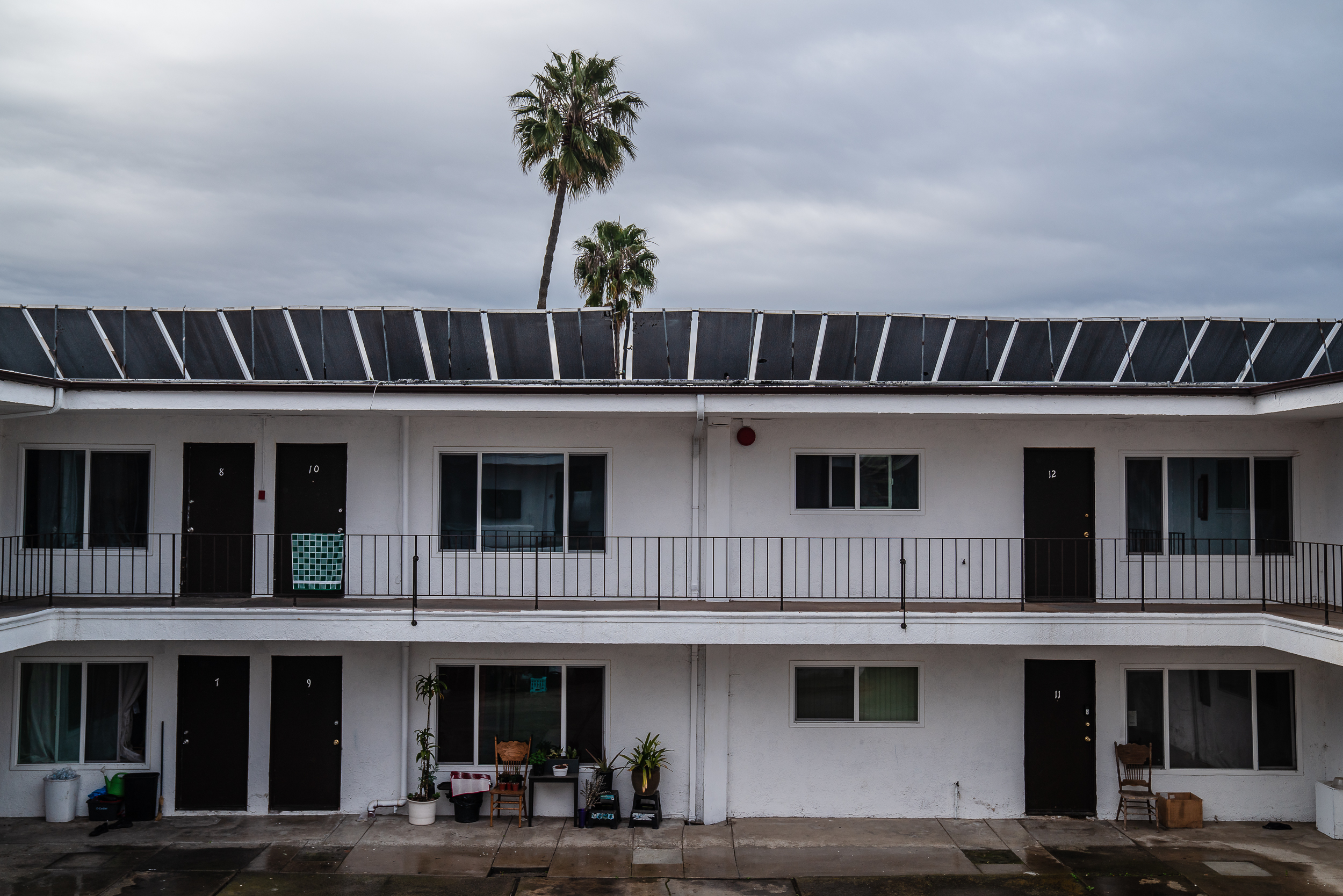
Housing authorities across San Diego County are bracing for possible cuts to federal rental assistance programs that advocates warn could impact tenants with Section 8 vouchers.
Even before the latest funding threats, all but one of the region’s six housing agencies stopped doling out tenant-based vouchers to families on their already years-long waiting lists to focus on keeping existing voucher-holders housed.
Officials overseeing the city and county of San Diego’s housing agencies each made that tough call nearly three years ago. Oceanside made a similar decision more than a year ago while National City and Encinitas last pulled from their lists in mid-2024.
All were cautious about the potential fallout of a growing mismatch between federal rental assistance funding and rising rents before the latest Congressional budget debates. They stopped handing out new vouchers knowing it would only increase average waits already ranging from eight to 15 years – and resolving to keep commitments they’ve already made.
“We don’t want to get into a position where we’re having to force people off of the program,” said Leilani Hines, Oceanside’s housing director.

Yet advocates now fear that could happen amid uncertainty about the federal budget. The Center on Budget and Policy Priorities recently predicted that even flat funding levels could be perilous for families with Section 8 vouchers.
“Many families could lose their homes because the funding shortfall would be so severe that some housing agencies would have no choice but to end families’ ongoing assistance,” the organization wrote.
The top Democrat on the House Appropriations Committee projected that the proposed continuing resolution released by Republican House Speaker Mike Johnson last week and passed by Congress late Tuesday could threaten rental subsidies for 32,000 families nationwide.
Local housing agencies’ tough decisions are meant to prevent that scenario.
About 30,000 families across San Diego County now rely on federal rental assistance doled out by local housing authorities. Most count on so-called housing choice vouchers that require them to find landlords who accept Section 8 and to pay about 30 percent of their income in monthly rent.
The tally of families on Section 8 waiting lists regionwide is about six times more than the number now receiving rental assistance, though families can add their names on multiple lists.
The bottom line: More families want rental assistance than can get it. The federal Department of Housing and Urban Development, which disperses Section 8 voucher funding, estimated in 2023 that just one in four families eligible for rental assistance across the nation receives it.
In San Diego County, just one housing authority is now handing out new tenant-based Section 8 vouchers. That’s Carlsbad, which now provides rental assistance to about 635 families and is awarding a couple vouchers a month as families exit the program.
But Christian Gutierrez, the city’s housing services manager, noted that Carlsbad’s wait list has been closed for at least a few years.
“We are in a place where we want to serve folks who are on our current wait list,” Gutierrez said.
Still, Carlsbad is also grappling with surging rents and tight budgets that other housing agencies are facing.
Most housing agencies across the county reported that the amount they are spending per voucher spiked about 50 percent over the last five years, an increase tied to increasing rents.
The growing costs are hitting some agencies’ budgets especially hard.
City housing authorities in San Diego, Oceanside, National City and Encinitas each spent more on rental assistance payments than they received last year, a move that agencies typically handle by dipping into reserve accounts with HUD’s approval.
San Diego County months ago started taking action to prepare for a shortfall it forecasted for this year.
Nick Martinez, assistant director of the county’s Housing and Community Development Services, said the county built an $11 million reserve last year with the expectation that it would need it to get through this year. That meant not using all the money it got from HUD last year for vouchers so it could build up a cushion.
“Generally, we’re spending 100 percent of our funding, but last year we built a reserve so we’d have that for this year,” Martinez said.
For now, Martinez and other housing agency officials across the county are hoping for the best as Congressional budget debates continue. They already know their voucher programs don’t meet the demand for assistance. For now, most are focused on keeping commitments they have already made to existing voucher holders.
“We’re just waiting and seeing what will happen,” National City Community Development Director Carlos Aguirre said. “It’s all at this point speculation.”
Section 8 lacks clear and transparent process for qualifications. If there is a “more needy” family than you, you get skipped. And “more needy” refers to “more people” so the larger the family or the more kids the family has, the more likely or quicker they are to receive Section 8. Honorable President Trump should audit Section 8. Beneficiaries most likely also receive other government benefits like free healthcare, cash allowance, food allowance, possibly federal disability benefits. My projection is that government spending for benefits is close to $3k per month per “needy person” not including the cost to run the programs. How can we know if people receiving Section 8 are from San Diego? Out of State poor and disabled people, have they been getting Section 8 faster than San Diegans because they are “more needy”?
Yes I know for a fact all the people from out of state get served before the people that reside in SAn Diego. So not fair
Yeah no. More needy is people with disabilities. You make it sound like getting the paltry amount of SSI and about a hundred ish in food benefit is the life of luxury. Yes we get Medicaid, for basic level of care. Yes it is going to San Diegans, otherwise one must port from another place and it’s not easy or even feasible always.
Section 8 in Encinitas? Really?
03/12/2025, HI, how are everyone I am members of Republicans National Committee paid never change so There SAN DIEGO CA MUST HAVE CRIMINAL RECORD HISTORY AND FINGERPRINT 10 CARD AT POLI CE DEPT OR SHERIFF ( FEE FOR FINGERPRINT CARD ) DONT FRAUDULENT APPLICATION ( MUST CHARGE FINED 10,000 AND GO FEDERAL JAIL 6 YEAR ) DONT USE FROM CHILDREN NAME AND SOCIAL SECURITY NUMBER. ALL IMMIGRATION PEOPLES FAMILY MUST RETURN BACK TO MEXICO AND WHO CANT SPEAK AMERICANS MUST RETURN BACK MEXICO ( ELDERLY PEOPLES NEED HOME SAFETY I L H C T PROGRAM 60-70 % ) AVAILABLE FOR ELDERLY PEOPLE. BY KHARIDJA NICHOLS AKA CARRIE BELL CARTER
What???
PROPOSAL: http://WWW.300X3.COM
ORIGINAL: https://voiceofsandiego.org/2022/09/16/you-have-failed-us-and-yourself-bill-walton-has-had-it-with-the-mayors-approach-to-homelessness/#comment-604973
Hi am Amina I need low income housing am with disability low income I have no place to live thank you so much