

When school districts shut down for in-person instruction in March of 2020, many educators thought the disruption would only last a couple of weeks. An unknown virus was spreading across the world infecting hundreds of thousands. Tens of thousands had already died.
It was an unprecedented situation, and for many, it seemed reasonable that an unprecedented response was needed. But few foresaw just how long students would end up attending school on their computers at home. Many students in San Diego County wouldn’t see the inside of a classroom again for over a year.
In the years since those shutdowns, the pandemic’s toll on students has become clear. Test scores have dropped across the country, while student absences have skyrocketed. Schools have been hit with waves of behavioral issues as kids whose social-emotional health was badly damaged by growing up during the pandemic have returned to campuses. The recovery from those side effects has been halting.
Less than half of the schools that lost ground are even showing signs of recovery, according to a new metric created by Voice of San Diego and the UC San Diego Extended Studies Center for Research and Evaluation. As we reported earlier this year, only 13 percent of San Diego County schools were doing better last year than they were before the pandemic. Nationally, only about 100 school districts were doing better than before the pandemic, according to a report created by researchers at Harvard and Stanford
East County’s Santee School District is one of them. It’s the only district in the county that earned that distinction.
Some of the strategies district staff have implemented look similar to those common at high performing schools – a reliance on data, high standards and a commitment to social-emotional learning. But Santee also stands out in one notable way: it was one of the first local districts to reopen after shuttering its doors during the pandemic.
Here are three reasons why district leaders think they’re bucking the educational post-pandemic slump.
They Reopened Early
The prospect of reopening schools during the first year of the pandemic was incredibly contentious. Covid was tearing through the country and some staff and community members literally feared for their life.
Years later, however, the impact lengthy closures had is much less contentious. Studies have shown that students in districts that were closed the longest experienced the most learning loss. They have also shown that reopening schools didn’t seem to significantly worsen the spread of Covid, as many had feared.
At Santee, district leaders’ decision to reopen for in-person instruction earlier than nearly every other local district led to some tension, Ted Hooks, principal of the Chet F. Harrit School said. But things became more natural over time. Hooks said some of the questions staff raised even helped.
“Any change is going to get a lot of questions, but when they’re good questions, and they force you to reflect the right way, and you progress better because of them, they’re welcome,” Hooks said.
The district developed a hybrid model and reopened its doors in September 2020. About 85 percent of their parents/families opted to send their children back in-person. While some districts offered to bring students back for only a couple days a week, Santee brought kids back for half days five days a week.
That return was split into two – half of the students came in for a half day starting in the morning, the other half came in the afternoon. Students were then sent home with additional schoolwork that they completed on their district issued iPads. While officials admit the arrangement was a scheduling nightmare, it had the side-effect of reducing class sizes.
Once the decision to reopen was finalized, school leaders busied themselves with ensuring their campuses were as safe as they could be – all things considered. They installed air filters and plexiglass barriers in every classroom, replaced HVAC systems and required students to take temperature checks before entering the classroom and socially distance. Each day between sessions, staff would also thoroughly clean the campus.
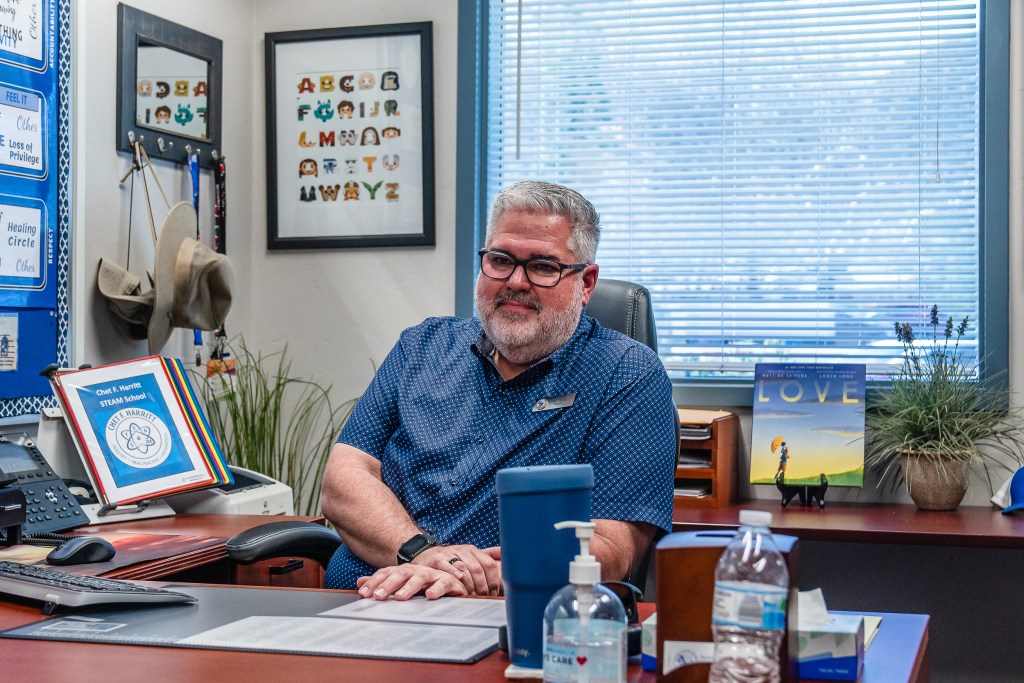
Once the district implemented the exhaustive measures, Hooks said staff’s “shoulders dropped.” It was still weird, he said. After all, everyone was masked. But many staff and even parents felt that school was the “most welcoming, consistent place for kids to be,” given the tumult that had engulfed pretty much everything around them.
It also led to some unexpected upsides.
“Some of my teachers tell me they made the strongest connections with students during that time,” Hooks said.
That may have been because they were working with students in smaller groups, or because the world outside of school had become so intense. In any case, some of the staff’s deepest fears about reopening didn’t come to fruition.
“We were shocked when we came back … that it wasn’t as different as we were worried it would be. We were expecting a (performance) dip, but our data kept showing that’s not necessarily happening the way we were worried it would,” Hooks said. “We basically said, ‘don’t slow down. Don’t start remediation that isn’t required. Figure out what kids need, provide it and get them to that high expectation.’ And that kind of became the mantra moving forward.”
Walking through the campus of Chet F. Harritt, you’re struck by the copious amounts of open spaces: fields, playgrounds and courtyards. Some of the campus’ indoor areas even have wide doors that swing open, allowing for a sort of indoor/outdoor mixture. Teachers made good use of those spaces during the pandemic. Kids explored a stream that runs adjacent to the campus, sometimes using it to conduct experiments, they worked in the school’s outdoor science labs or doing reading classes in the open air.
“The teachers took on a huge mantle, and they learned and grew in ways none of us expected,” Hooks said.
Commitment to Social-Emotional Needs
Santee Superintendent Kristin Baranski said one of the key investments district officials made during the pandemic wasn’t a strictly academic one, but one that acknowledged the social-emotional needs of students. The district hired a full-time counselor at each of its schools.
Officials even rolled out a new social-emotional learning curriculum during the pandemic.
“The big overarching theme is that during Covid, we didn’t stop, even though we were forced to do things differently,” Baranski said.
Research has long shown that there are yawning gaps in the social-emotional support students get from schools. This was especially true during the tumult of the pandemic, and the similarly chaotic post-Covid years when students struggled to shake off the effects of and emotional disorders they may have developed as a result.
And while a significant portion of young people experienced negative psychological impacts from the pandemic, those who learned remotely the longest felt those impacts most acutely. All of this is why Baranski and Hooks feel the additional social-emotional supports the district offered played a big role in stabilizing students and helping them continue to grow.
“Everybody needs that feeling of security before they’re ready to do bigger things. I think we were able to provide that,” Hooks said.
Years later, and despite budget cuts, Santee has been able to maintain the investments they made during the pandemic. Baranski aims to ensure those investments continue.
“Strong academic supports are really important thing for us in this district, but emotional supports are just as important because our kids and our families need that, especially right now,” Baranski said.
Reliance on Data and Extended Supports

Time and time again, research – as well as our reporting – has indicated that thoughtful and consistent data usage can play a key role in ensuring students succeed. And both during the pandemic, and in the years since, administrators and educators at Santee have leaned into that strategy.
That data-fluency can sometimes yield some interesting insights, Hooks said. For example, during a meeting last year, Santee’s data guru showed Hooks that the district’s English language learner students that have been reclassified as fluent were actually outperforming the English-only students in most learning areas.
“It just it kind of tapped that final nail for a lot of us as leaders, that a second or third language is a valuable trait that really gets you further in life. It is a gift to be able to speak more than one language,” Hooks said. “I was floored by that, and it was the data that showed us.”
District educators also turn to data for more day-to-day interventions. Baranski said students are frequently given formative assessments, that allow educators to not only learn more about the challenges students face but also to figure out ways to fill the educational gaps. Leaders have also embraced a site-based approach to curriculum support by hiring curriculum resource teachers at each school. Those teachers lead professional development, collaborate with classroom teachers on lesson plans and can even help analyze student work.
That collaboration has allowed educators to put significant energy into instituting robust multi-tiered systems of supports, school jargon for a framework that allows educators to deliver layered, comprehensive and targeted interventions to individual students. Sometimes that means creating individualized six-week academic interventions, other times it means ensuring a student gets additional counseling support.
“That has been a major focus this year. So, I’m hoping that our scores will continue to climb,” Baranski said. “Because we don’t think we’re just lucky. We think we are leading in this.”
Now the question is how other local districts can replicate this success. Thanks Jacob for a welcome bit of positive news!