

Jim Crouch says he knows too much to do nothing. So, he’s trying to do something. Something big.
What’s big in Crouch’s world is reestablishing native oaks in Southern California. And what he knows a lot about is how to propagate, nurture and distribute thriving seedlings.
He has potted and given away thousands of young oaks, and now he’s recruiting others to help multiply his already impressive operation.
Crouch, 73, is a retired middle school science teacher. He walks with a cane due to bad hips; he’s had one replaced and needs a new one on the other side, too. Every step is painful. But that doesn’t stop him — or even slow him down.
He estimates he has grown, from acorns, about 6,000 oaks in his Escondido backyard since 2018. He’s given away seedlings for free to interested parties. And if all goes according to plan, he’ll help raise and disperse 20,000 more trees – in 2026 alone.
He’s devoted energy, time (about 8 hours a day recently), and money (roughly $4,000 a year) to his cause, which he prefers to call a passion, not an obsession.
Keystone species
Crouch’s oak fascination is rooted in science, which he taught in Valley Center.
“More species depend on oaks than any other tree,” Crouch said. “Natives, especially oaks, evolve together.”
Oaks are considered a “keystone” species because so many other species, including several mammals, more than 30 types of birds and hundreds of caterpillars, rely on the trees for food, shelter and habitat.
In 2024, Crouch focused on preserving and expanding the population of the rare and vulnerable Englemann oak (Quercus engelmannii). Englemanns inhabit the smallest range of any oak in California and the Southwest. They are native only from Pasadena to northern Baja, and loss of habitat has limited the trees to mostly fragmented patches. The vast majority of the trees, 93 percent, are in San Diego County.
The biggest stands of Englemanns are east of Ramona. The trees do best, Crouch said, in environments with an annual average of at least 14 inches of rain, and from about 1,400 feet to 4,200 feet in elevation.
Englemanns are special to Crouch. They have a sparser crown, smoother leaves and a lighter-green foliage than the more common coast live oaks (Quercus agrifolia).
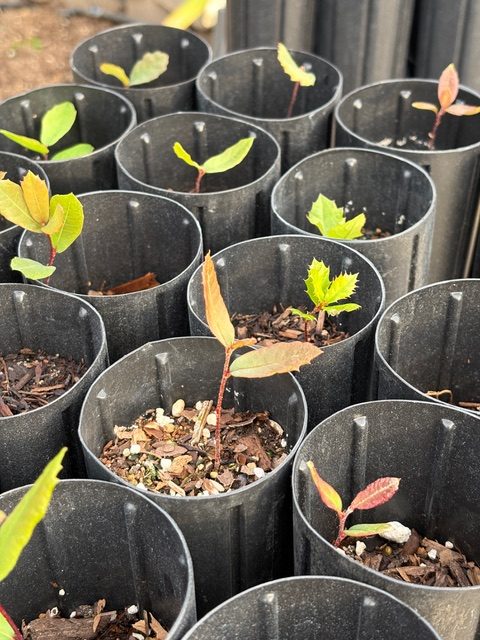
Early this year, Crouch had more than 2,500 tube-shaped pots, each with a carefully selected Englemann acorn, in his backyard. Through trial and error and consultation with botanists and other oak experts, he’s learned how to identify acorns that are most likely to sprout, and what nutrients and conditions the seedlings will need once they do.
He’s created what he believes is the acorns’ ideal growing medium. It includes special potting soil from a nursery in Orange County, and oak leaves ground up in a blender. The ground leaves provide mycorrhizae, which promote a symbiotic relationship between plant roots and fungi. He’s also learned what procedures and set-ups are needed to prevent the introduction of pathogens.
His long, tubular plastic pots, which he gets from a supplier for 50 cents each, are perfect for the acorn’s radicle, its first root. The radicle becomes the tree’s tap root, and it needs deep soil. Many oaks and other trees grown in shallow pots end up with coiled roots that stunt if not eventually kill the tree.
Crouch hopes his growing cadre of volunteers will help properly site, plant and maintain his seedlings. Dozens of people showed up at his house and expressed an interest after CBS News 8 in San Diego did a TV segment on his efforts in January.
Among the many groups Crouch has worked or consulted with are Native American tribes in North County; the San Diego Botanic Garden; the nonprofit Tree San Diego; the Ramona Wildlife Center; the San Diego Zoo; the California Native Plant Society; and the Global Conservation Consortium for Oak in Chicago.
‘Exceptionally committed’
By early April, Crouch had distributed 1,563 seedlings to 93 planters.
Grant Curtis, a member of the Ramona Grange, helped with the distribution at a recent seed exchange in town. About 40 people took a total of 100 of Crouch’s Englemann seedlings.
“Jim’s great,” Curtis said. “This is a passion for him, and it shows. He’s exceptionally committed.” Curtis plans to help get Crouch’s next crop of seedlings planted in 2026.
Crouch says he’s “blown away” by the expertise, dedication, help and kindness he’s encountered since he started propagating acorns seven years ago.
“If you’re a nature lover, good luck finding a jerk in the gang I hang with,” he said.
Gloria Warren is among Crouch’s gang. She owns 20 acres near Lake Wohlford and the Guejito Ranch east of Escondido and is a fellow Englemann lover. She has about 100 Englemanns on her property, where she’s lived for 50 years, and she’s helped Crouch gather thousands of acorns for his propagation efforts.
“I’m just amazed at what he does,” Warren said. “He’s just such a dedicated person. I’m glad I can help him in some small way.”
One of Crouch’s biggest helpers is Hillcrest resident Tanner Smith, who studied biology at UC San Diego. Smith has assisted with acorn harvests, soil prep, planting and building racks for the seedling pots.
Smith believes Crouch is doing important work for oak woodlands, one of California’s most threatened environments.
“We’ve got to not only protect what we have, but we have to help restore these ecosystems,” Smith said. “It’s really great stuff that he’s doing. I think it’s critical.”
Englemanns, once far more common in the region, can play a big role in repairing damaged native habitats in Southern California, Crouch believes.
Besides their graceful appearance (often described as “spectacular” or “majestic”), Crouch said one of the Englemanns’ selling points is that they are far less susceptible to pests like the gold-spotted oak borer. The “GSOP” has killed tens of thousands of coast live oaks, canyon oaks and black oaks in San Diego County’s backcountry. Englemanns aren’t immune, but they are rarely seriously injured by the beetles.
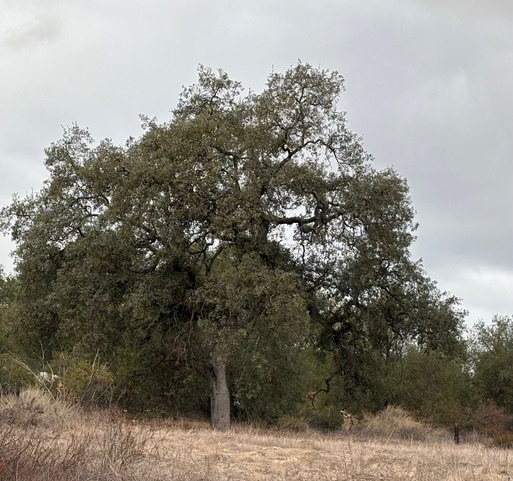
But Crouch recognizes that Englemanns aren’t suitable in much of San Diego County. He’s also raised and distributed thousands of live oak seedlings, and he’s trying to find good sources for acorns from scrub oaks (Quercus dumosa). Both species can do well closer to the coast.
Now he’s hoping to create a team of propagators willing and able to replicate his backyard operation. If he can find nine, he can reach his 20,000-oak goal in 2026.
“I only had 2,500 seedlings this year,” he said. “I don’t know how big of a difference that would make. Twenty thousand would surely make a difference.”
Besides the help, he’s looking for sponsors, because as his operation grows, so do the costs. So far, he’s raised about $2,000, but much more “seed money” is needed to fund additional backyard oak nurseries.
Phil Burke, who has 18 acres in Pala east of Fallbrook, has contributed to the cause. He’s also planted about 200 seedlings on his property over the last few years. His growing oak forest includes Englemanns, live oaks and scrub oaks. He’s also given Crouch’s young trees to friends, including 40 to a man in De Luz, northwest of Fallbrook.
“Jim’s a good dude,” Burke said. “He’s got some ambitious goals, and he’s going to need money to meet them.”
This is such an interesting concept. Two things: I think the author misspelled the tree name; it should be Engelmann vs. Englemann. Also, any thoughts on these oak trees’ fire resistance?
We lost a lot of our mature oaks to the Gold Spotted Oak Borer. (about 20 of them). We have lots of young oaks coming up on our property and we care for and nurture them. We have one you Engelmann oak on our property that was given to us. I think this man is doing a good Thing. We have donated you oak seedling s in the past. We still have some fire scarred oaks on our property from the 1971 fire that came through here.