
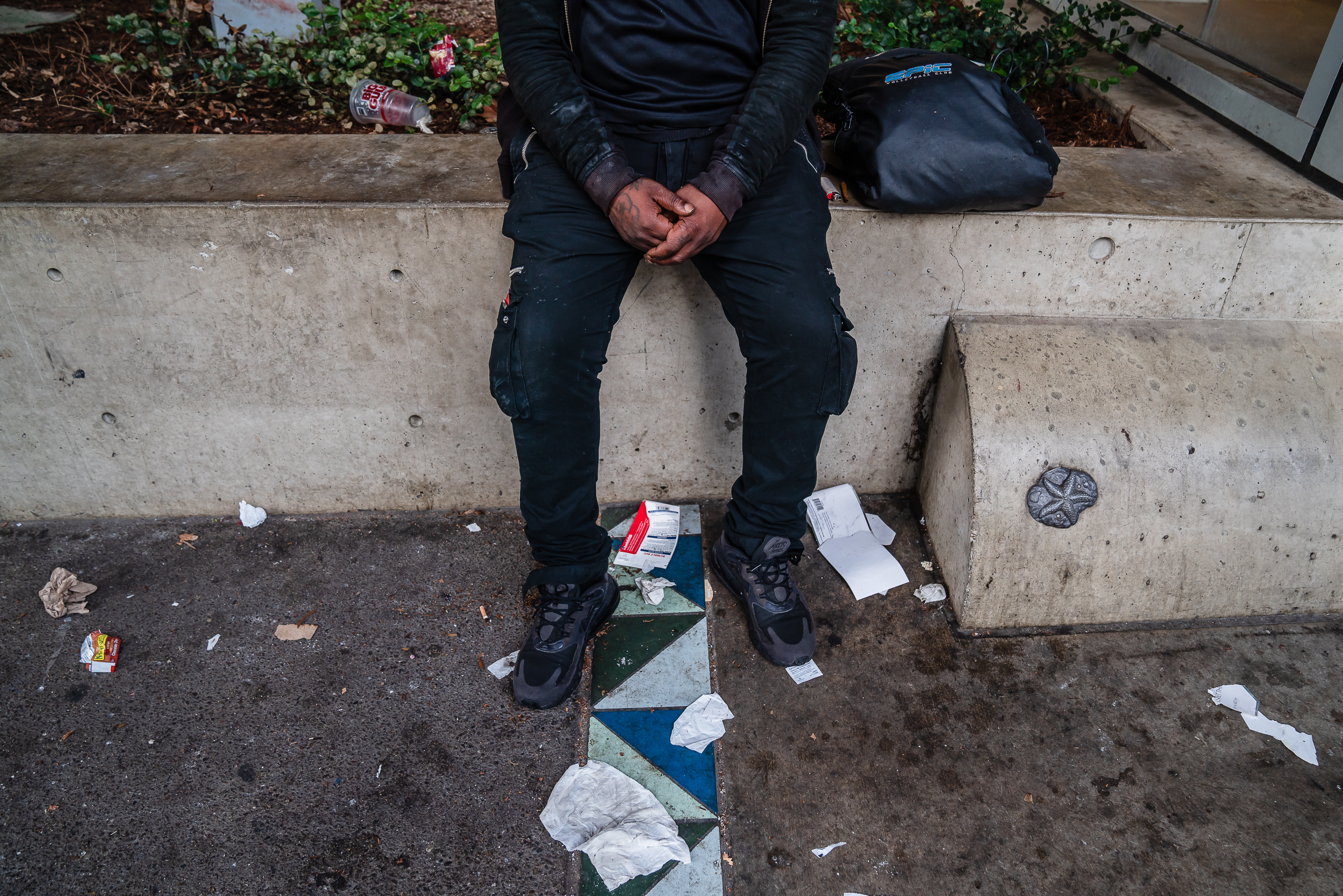
Blanton is the executive director of Shoreline Community Services, which supports unsheltered individuals in San Diego’s Central Beach Area and operates The Compass Station, a trauma-informed drop-in resource center.
On May 9, a man at the Pacific Beach Public Library became agitated and began swinging a hatchet at desks and computers. Library staff and security got him outside, and police were dispatched. Officers repeatedly commanded him to drop the weapon before shooting him multiple times. He remains hospitalized in critical condition.
We know this man.
His story illustrates the failure of every public system meant to protect him — and our community.
Since August 2024, we have interacted with him 19 times during his visits to The Compass Station, providing support to improve his health and help him secure housing. We offered transportation to the Social Security and county benefits offices and helped him apply for a birth certificate, which is essential to accessing housing and healthcare.
But his health kept declining.
He cycled through hospitals, jails, recovery programs, clinics — always returning to the street. We called 911 three times when his condition became life-threatening. Despite worsening symptoms, he was repeatedly discharged.
Once, he arrived at our center in a hospital gown, his belongings in a plastic bag. He was cold, disoriented, vulnerable. We clothed him — and didn’t see him again for more than three months.
When he returned, he had a trash bag duct-taped to his colostomy port. Our nurses gave him proper bags and instructions, but he couldn’t manage his own care. The port got infected. He developed a fever. Blood and feces seeped from the site. He became incoherent. We called 911 again. He was taken to the ER, then discharged.
On April 22, we made the heartbreaking decision to ban him. The health risk to others had become too great.
We explained as clearly and gently as we could. He yelled — he wanted help. Then he picked up a heavy stanchion and swung it. His response was so violent, we barricaded ourselves inside and called the police again.
It was clear he was gravely disabled and a danger to himself and others.
That was 17 days before he was shot.
He had accessed every available resource — none were adequate.
Hospital: Was he unmanageable? Did records say he left against medical advice?
Psychiatry: He was discharged with medication but had no phone or transportation.
Jail: Brief incarceration, then release.
Crisis Response: Mental health teams couldn’t intervene — he was violent.
Primary Care: He could “walk away,” so likely wasn’t diagnosed as incapacitated.
Shelter: His hygiene and health made him ineligible.
Permanent Housing: He lacked the executive function to complete the process.
Every system failed him — and our community.
He should have qualified for involuntary psychiatric treatment. Why didn’t he?
Did no one know how to access it? Is it even available?
Are county and city programs tasked with recommending conservatorship simply ineffective?
At the library, police used violence because every other system had already failed.
Our question is the same as yours: Is violence really the only solution?
Right now, the answer appears to be yes. But that is not public safety.
Police with drawn guns outside a library do not make us safer. Waiting for someone to unravel doesn’t make us safer. Discharging dangerously ill people back to our neighborhood doesn’t make us safer.
San Diego has programs — mental health, care coordination, housing, street medicine – that help hundreds. But they are not helping the violently mentally ill — the group that poses the greatest risk and that we most consistently fail.
This man was a clear threat. We referred him to program after program. Our efforts could have led to care. This didn’t have to end in gunfire. To ensure public safety, we need fewer professionals saying, “He’s beyond our scope,” and more who know exactly what to do when someone is gravely disabled and dangerous.
We understand some people blame providers like us for “bringing” homelessness into the community. But people experiencing homelessness are already here. They sleep in parks, alleys, sidewalks — not because we serve them, but because there are no alternatives. We don’t cause homelessness; we respond to it. And the best way to reduce its impact is to help people access care, not ignore them until tragedy forces action.
We want to improve the welfare of our unhoused neighbors and keep our neighborhood safe. We believe both are possible, but only with a real pathway to psychiatric care for people too ill to care for themselves. Not a return ticket to the streets.
I am homeless with deterioration of my heart Health I am stuck at a safe camping site and m being singled out by other homeless clients staying here as well, I’m trying to improve and work seriously to get housing but it’s one step forward two steps back for takes forever to do anything so I can get a job meanwhile the hatred continues here and it’s very stressful and depressing I’m going to tell use this I was out here 3 years ago on the streets in the downtown area for 2 years and I can say this for sure everybody and anybody that I knew back then is all gone now and I believe honestly with everything in me that the folks that are here that are using this case a camping sites and the shelters or the folks that don’t want help they are bent on entitlements and handouts and resources that are given to them freely where they don’t have to do anything to get them the same camps are riddled with drugs in one of them is whatever with violence the police or are constantly there and it’s a shame
Big yes to everything you said here.
Big yes to everything you said here.
This whole article screens free advertisment for the mental health wing
What’s even stupider is that “we need a facility “TO SEE IF THEY HAY-WIRE IN THE BRAIN”
Medication DOES NOT PERMANENTLY cure any SERIOUS mental illness and these pyschiactric facility’s don’t even care if people don’t need treatment AND FORCE IT ON THEM ANYWAYS as in THEY ARE A PART OF THE VIOLENCE IN SOME MENTALLY ILL INDIVIDUALS, they are already unstable and they dump inhumane treatment and abuse on them with shady public defender’s WHO FORCE TREATMENT ON PEOPLE WHO DON’T NEED IT OR WERE EVEN CLOSE TO NEEDING IT
but they keep dumping those who do WHO WERE DEFINITELY KNOWN to be so unstable and HAY-WIRE in the brain that the “SAFETY” was completely disregarded, and this also puts other homeless people at risk of being victim to these PEOPLE/PATIENTS that were carelessly left unsupervised (and while blocking family members who were supervising them”)
As in medication DOES NOT PERMANENTLY cure any serious mental illness
Just a bunch of malpractice and carelessness
They shouldn’t be taught to hate their medication and to fear the system
With the same results too
“The medication wore off”
And same person **Are they going to attack someone or do something to get attacked**?
The severity doesn’t go away PERMANENTLY *****Everytime******
This is just to influence homeless people to get violent or self-harm
Which forced treatment has that consequences
This isn’t something that is a last resort and it’s like most of these shot victims could lounge out 100 ft with their hand-weapon (as they clearly go definitely HAY-WIRE in the brain) and your trying to talk them to sanity when the real underlying cause is way beyond THAT
Forcing treatment even on semi mental people is wrong and forcing this on homeless people is also wrong
All this does is show how careless and greedy the mental health wing is
and that the SEVERITY OF THE SAME PERSON keeps being underminded and adding a bunch of homeless people under false labels is malpractice, that keeps taking money and solving nothing
Force treatment doesn’t work
15x times failed
Leaving the person even worse
I’d like to see this case and its questions presented to the Board of Supervisors.
“He should have qualified for involuntary psychiatric treatment. Why didn’t he?”
Because the system put in place to put people like this in involuntary psychiatric treatment facilities has been watered down by the County’s implementation of the “Care Court” program – in short, you have to voluntarily submit to the program, which people with untreated psychotic conditions rarely consent to do. The County is failing these people by making the ‘involuntary’ part of the system voluntary.
https://voiceofsandiego.org/2025/02/27/san-diegos-care-court-isnt-forcing-treatment/
Beautifully written but sad, Caryn. I was at my desk when I heard the gunshots, rapid-fire, one after another. Then I heard sirens coming from all directions. I stepped outside, and a young man told me what happened. One half a block away, near a daycare center, a children’s playground, and in a busy neighborhood, a policeman opened fire on a homeless and ill man. Why was he not using a Taser gun? Why did he have to shoot so many times? It was senseless and dangerous. My son died from suicide in a jail cell after trying to get help over and over again. This made me think that it could have been my son. I hope this man’s family or friends find him a probono attorney.
Pamela Taylor
Pacific Beach, CA
Police could have shot not to kill, I was at the library just after he left. I did not see him. But I saw many many police cars! Not sure if that many are necessary.they could have used a rifle shot like used to quiting animals so they could handle him arrest him etc.. Guns that kill should not be used till all other tools have been used.
Porque a los enfermos mentales les preguntan si quieren ayuda ? Ellos no pueden valerse por si mismos hay muchos enfermos mentales en la calle que están dañando ciudades aquí en City Heights demasiado enfermos mentales en la calle
No permitan las drogas por eso hay tantas personas enfermas mentales
There is no way to undo the harm caused to this one individual. While people debate, blame, and hypothesize about a problem and its solutions, here is a direct result of such actions. The inhumane treatment of people like Tyreke, or in remote resemblance, for that matter. The city of San Diego can easily take away the desperately needed services of this politically powerless population; they’ve quietly done so for the past fifteen years.
What many do not realize (or perhaps care to know) is that there is also a systematic, discriminatory practice working against those without shelter.
If you have no shelter, that is an automatic red flag. Police contact of any type, (need not be criminal in nature) red flag. Mental health issue of any type. Red flag.
Tyreke could easily be my daughter, myself, or any number of loved ones I know. We, for unknown reasons, escaped this far worse fate. No longer in the madness of struggle, that is Maslow’s pyramid, were fortunate to (finally) be sheltered. At least for the moment.
It cannot be underscored the trauma of homelessness does to a soul.
We are not blessed; unless, by comparison, others are condemned. (survivor’s guilt for thing of which I have no control)
No, this failure is a societal one. A responsibility that belongs to each of us for the plight of a growing problem.
The better question is how do we care for the obvious human in need among us? What is the definition of a vulnerable citizen in need? Who are we as a society to believe any one is more or less than is value to be worthy of the least consideration as stated in our very constitution? Or is that dignity reserved for sheltered only?
I do believe that as a whole we are capable of, and can, do better.
San Diego needs to start using the Bola Wrap restraining system, a non-lethal system for quickly & remotely “wrapping up” a violent psychotic individual’s legs & arms, with deployable tightening Kevlar cords… after which the disarmed individual can be placed in a rubber room and straightjacketed; so they can safely be medicated and treated… on a weekly basis if necessary, for the rest of their lives, despite the millions of dollars yearly, out of Toad’s budget, per psychotic.
🌴 San Diego is truly a paradise for beach lovers! I found so many hidden gems on this site: https://visitsandiego.us 🏖️