
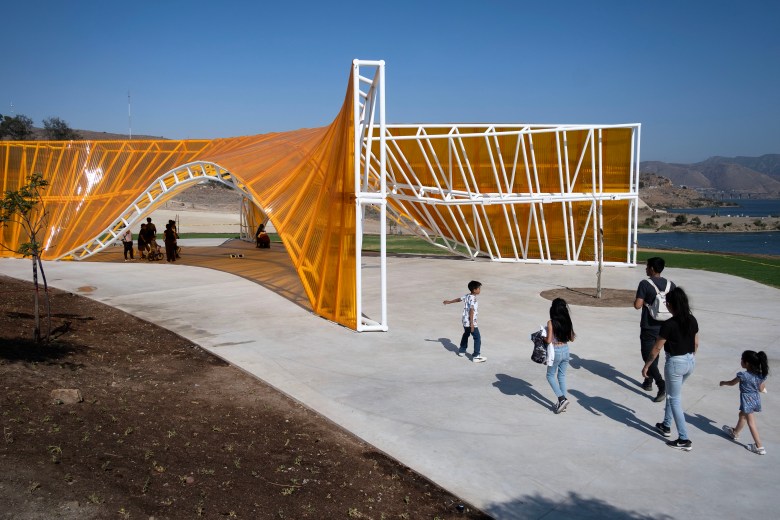
For a San Diego-Tijuana design team, this was a coveted assignment: Creating a temporary pavilion to celebrate the region’s World Design Capital designation. Set inside Balboa Park, the structure would be a place to celebrate design and collaboration in the cross-border region.
“We put all our hearts and souls and minds into it,” Barbara Leon, architect and founder of Heleo Architecture + Design, told me about the piece, EXCHANGE Pavilion.
Built with $300,000 in funding from the city of San Diego, the EXCHANGE pavilion has been the World Design Capital’s most enduring and visible legacy. But now, more than seven months after the pavilion’s removal, and its relocation this month to Mexico, the pavilion’s designers are left with mixed feelings. They have been unable to pay some of their suppliers, and though they are grateful for the new setting, the designers are asking to be acknowledged for their work.
Earlier this month, when Baja California Gov. Marina del Pilar Avila inaugurated the pavilion at Esperanto Park, the design team was not invited.Avila did mention the designers and the World Design Capital in her remarks, but a new state government plaque does not credit them for the piece. Nor does it explain that it was created under the auspices of World Design Capital 2024.
“There are very few binational initiatives that try to erase the border, even if it’s just an illusion,” said the project’s Tijuana team member, artist Daniel Ruanova. “One of the things that concerns me is that the story of why this pavilion exists does not get told.”
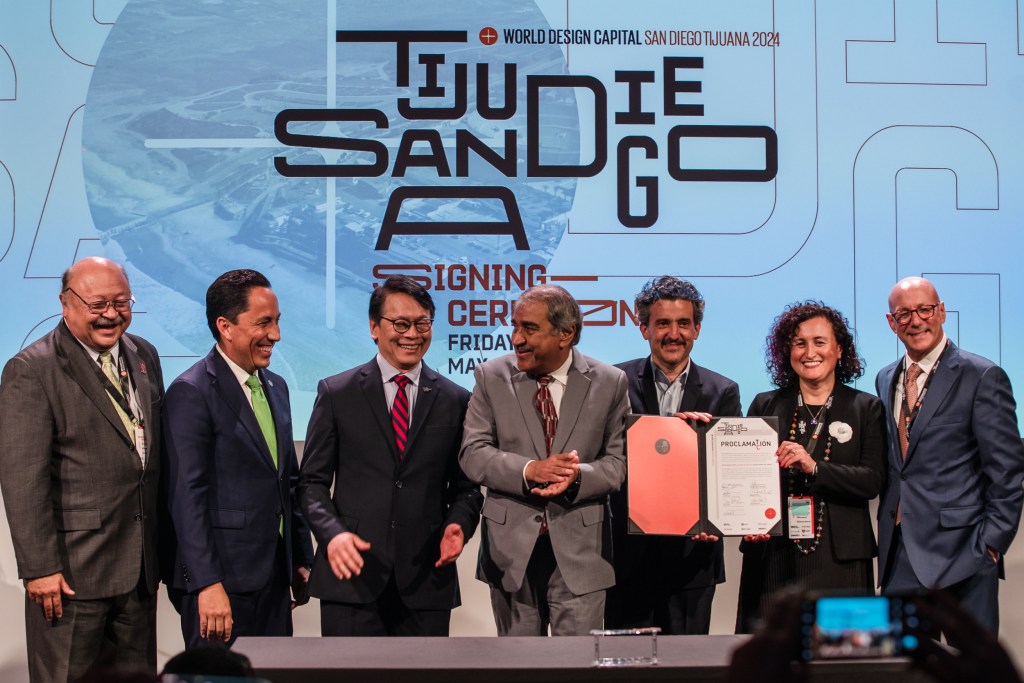
The story dates back to 2021, when San Diego-Tijuana won the designation from the World Design Organization, becoming the first cross-border region to receive the title. Spearheading the local effort were five organizing partners: The UCSD Design Lab, the Burnham Center for Community Advancement, the Design Forward Alliance, and the cities of San Diego and Tijuana.
“This project will not just bring jobs and investment to San Diego now; it will leave lasting impacts for years to come,” said San Diego City Councilmember Raul Campillo, an early champion of the designation.
To oversee the year-long schedule of activities, fundraising and marketing campaigns, a nonprofit was created, World Design Capital San Diego Tijuana 2024, or WDC. San Diego’s contribution to the organization of $3 million was critical to the effort, with set amounts earmarked for programing planning, production and marketing. The contract stipulates that a sum of up to $300,000 of those funds be set aside to pay for a pavilion.
When the WDC solicited proposals for the pavilion, stipulating that the team include a cross-border colaborator from Tijuana, the Heleo-Ruanova bid was among numerous responses they received. The team was among three finalists invited to submit full proposals. After evaluation by a peer selection panel, they were chosen to create the EXCHANGE Pavilion.
One of the requirements was that the pavilion be easily moveable, and the final product consisted of eight separate pieces made with steel and translucent polycarbonate. To save money, the Heleo turned to contractors in Tijuana.
Last August at the EXCHANGE Pavilion’s unveiling in Balboa Park, Leon and Carlos Hernandez, her husband and partner, received much applause for their work. But behind the scenes, they were struggling for money to pay suppliers – on their website, the architects list the cost of the project as $384,000.
“This was a bid that was awarded based on very, very schematic drawings and estimates that were put together in less than three weeks,” Leon said. “We tried to get under as much as we could. We had to slash our own fee. It was very difficult to get to work financially.”
The pavilion’s backstory also opens a window into the overall funding challenges faced by World Design Capital 2024. A financial review conducted by San Diego’s Office of the Independent Budget Analyst last August showed that the nonprofit’s anticipated revenues were half of what staff had initially projected – from down from $10.9 to $5.3 million. The report estimated that the city of San Diego’s contribution would account for about 43 percent of the nonprofit’s funds.
The idea was always to set the pavilion in Tijuana as well as San Diego, but a plan to subsequently place it outside Tijuana City Hall never materialized for lack of funding.
“We don’t regret having done this. And obviously we would have done a few things differently if we had to do it all over again, to protect ourselves financially, because we now have experience,” Leon said.
“We feel a little bit let down,” Leon said. “I guess it speaks to how little sometimes our work is valued in general,” Leon said. “So many artists keep taking on projects that are ‘passion projects’”and they don’t get really adequately compensated for it.”
Joanna Salazar Harris, chief operations officer for World Design Capital 2024, said in a response to written questions that the design team had received additional support to address cost overrun issues, but that “Heleo is responsible for covering remaining costs.”
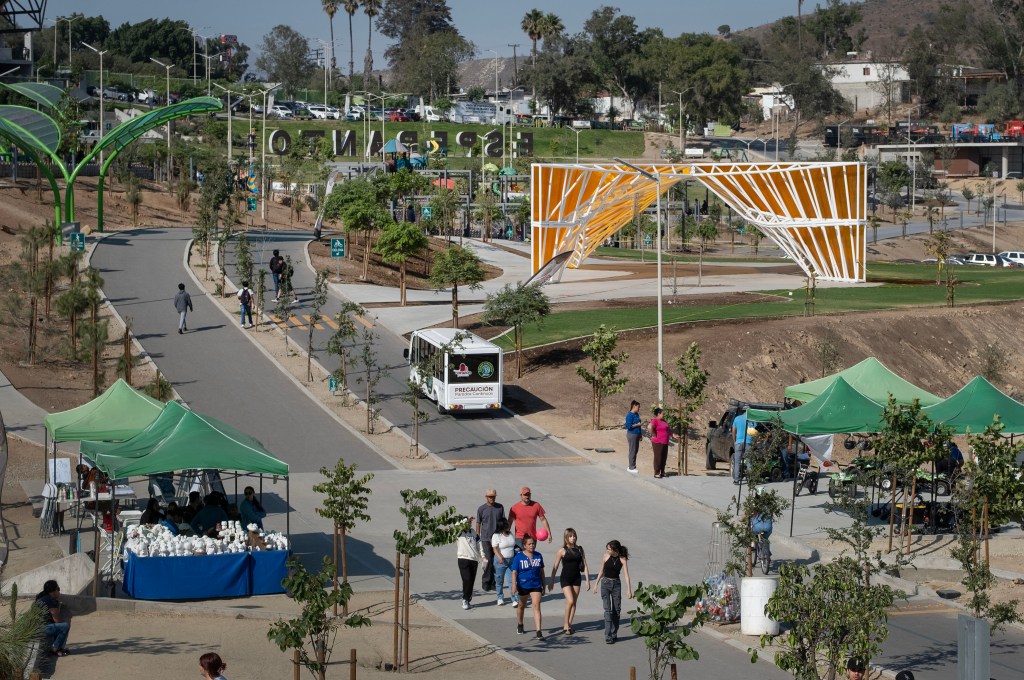
Last week, I drove to see the piece in its new setting inside the sprawling Esperanto Park at Tijuana’s eastern edges that overlooks A.L. Rodriguez Dam. Children played on equipment and rolled in the grass, families gathered around picnic tables, amid smells of carne asada and the sound of music pounding from a speaker.
On that weekday afternoon, there was little activity around the pavilion, now renamed Pabellon Jose Galicot, after the Tijuana businessman and president of the nonprofit Tijuana Innovadora, who was key to having it moved to its new setting. The plastic benches have yet to be brought across the border, and the LED display has not been set up. Occasionally, a family strolled by, but mostly it was quiet, a place to take in the scenery of water and dry brown hills as the wind blew through its arches.
Who paid for the pavilion? Though paid for with San Diego city funds, World Design Capital 2024 initially retained ownership of the pavilion, and made the decision to sell it.
“Everyone’s hearts wanted it to go to Tijuana,” Leon said, but a proposal to sell the structure to the city government fell through for lack of funds.
Eventually, “a group of anonymous donors in Mexico raised the funds to purchase the pavilion from WDC,” said Salazar Harris. “We cannot disclose the purchase price at the donor’s request.”
At the pavilion’s Tijuana inauguration ceremony, Baja California’s governor thanked the Galicot and Muzquiz families for donating the pavilion. But Jose Galicot told me the families had only paid for the cost of moving it and re-assembling it.
October relaunching: Galicot and his Tijuana nonprofit are planning to relaunch the pavilion in October, with a large public ceremony and a new plaque that will name the design team.
“We want it to be an area of meditation, an area of discussion and study, something that would little by little give a different dimension to the park,” he said.
Ruanova was pleased when he drove out last week to see the pavilion in its new setting. “What can be better than to see it in a place where people will use it. I was worried that it would end up as nothing more than a roof for an outdoor street market.”