
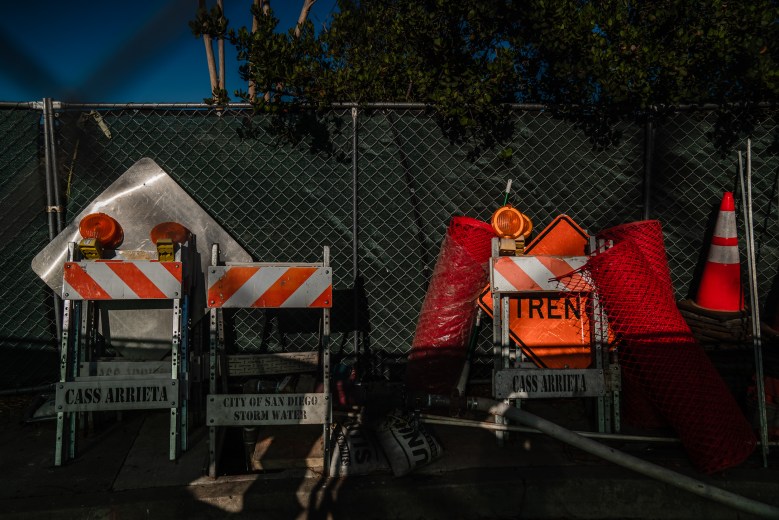
For eight years, David Smith constantly monitored the Navajo Community Planning Group’s development impact funds. The Navajo area includes the communities of Allied Gardens, Grantville, Del Cerro and San Carlos.
“We had over $3.5 million in the DIF account,” said Smith, a former board member of the community planning group. “Then all of a sudden I looked down to the fund balance and we were at 287 grand. And I’m like, ‘well wait a minute. What? What happened? Where did all our money go?’”
Development impact fees are one-time fees paid by developers to the city of San Diego when they build new housing. The money, often called DIF funds, is used for public infrastructure, and planning groups like Navajo issue yearly recommendations of how the money generated in their neighborhood should be spent.
The recommendations have historically given community groups a great deal of control in directing DIF money to specific projects. But in this case, city officials used $3.5 million from Navajo’s development fund on an emergency storm drain pipe repair without informing the planning group.
Smith and other members of the Navajo Community Planning Group said the city disregarded their priorities in how the DIF money should be spent and, worse, did not notify Navajo when they nearly emptied the account for the repairs in early 2024.
“The community is not able to direct the funding in the way we want to,” said Kevin Sullivan, treasurer of the Navajo Community Planning Group.
Heidi Vonblum, the city’s planning director, said the city isn’t required to get planning group approval when it uses a community’s DIF funds.
She said the city explores a variety of funding sources for projects like stormwater repairs. They look at the general fund, bonds, and other funding measures. Community development funds sometimes can be a funding source, if a planning group has made storm drains a funding priority.
Councilmember Raul Campillo, who represents Navajo, said the city should have communicated better with the Community Planning Group members.
“I understand that we are in tough budget times, but the solution is not to raid the very neighborhood funds that residents are counting on for projects like parks, libraries, and other critical infrastructure,” Campillo said in a statement.
“If a step like this is going to be taken, it should be done transparently, with clear communication to the community – not buried deep in a budget appendix,” he said.
San Diego’s storm water infrastructure funding backlog came under renewed scrutiny last year after the catastrophic floods in January 2024. The floods displaced at least 1,000 people and damaged over 500 buildings in some of San Diego’s most neglected neighborhoods. Residents there had been asking for stormwater improvements for years.
The city’s ongoing structural budget deficit and dire stormwater needs have collided. City officials are under massive pressure to make stormwater improvements. The city’s current budget for stormwater operations is $50.8 million. The City Council pushed for an additional $760,000 during budget deliberations in June but Mayor Todd Gloria vetoed it.
Members of the Navajo Community Planning Group wanted the funds prioritized for things other than stormwater.
Navajo lists its priorities in what is called a Capital Improvement Program (CIP) Priorities Request List yearly. In 2023 and 2025, the group requested the city fund community spaces and roads with Navajo’s DIF funds.
For example, the group wanted realignment of the Alvarado Canyon Road to help traffic coming off Mission Gorge Road. Smith said the city had already spent millions doing prep-work to establish the cost and timeline of the fix. Navajo wanted to put their funds toward getting the $35 million project closer to the finish line.
The Allied Gardens Recreation Center expansion was their next priority. “The facility is aging and it’s going to probably need at some point a $15 million rebuild. But it needs probably a $3 million jumpstart,” said Smith.
Other priorities included the expansion of the Benjamin Library and San Carlos Library.
“We can’t do any of that now,” said Smith. “We don’t have the money anymore.”
Each community DIF fund has a different set of eligible projects in their public financing plan. A public financing plan lists existing facilities or projects that need improvements, and which ones are eligible for DIF funding. Navajo’s plan was last updated in 2015.
In its plan, Navajo did list storm drains as an eligible project. It’s an item sandwiched between pedestrian access and traffic signals in their financing plan. Therefore, Smith said it was a loophole for the city to allocate the funds where they wanted.
“We don’t have any certainty now that our own internal projects that we desperately need to fund might ever get funded,” he said.
Prior to 2021, each community planning group had its own DIF pot and made recommendations to city officials on how they wanted it spent each year. City officials then used the recommendation document to guide how they would spend the money.
It works similarly now. Only, all the DIF funds go into a communal pot. But planning groups still submit their recommendations every year and city officials are supposed to use those recommendations in deciding how to spend money.
Both city officials and Navajo planning group members agree that the money sitting in Navajo’s account had been there since before 2021.
The city also spent DIF funds on other stormwater repairs in 2024. The city used $1.5 million from Clairemont Mesa’s fund, and $128,000 from La Jolla’s fund for repairs in those respective areas.
The La Jolla Community Planning Association and Clairemont Mesa Community Planning Group did not respond to requests for comments. The emergency stormwater repair done in Navajo was initiated in early 2024 to replace a failed section of a storm drain pipe in San Carlos that caused a sinkhole behind a residential home. The total project cost was $4 million.
We do not elect men of morality and conscience to lead us but rather animals of the jungle.
Sure, the City could have been more communicative, but it also sounds like it was an emergency project.
If the sinkhole was left there, members of the community would be screaming about repairs being necessary for such a dangerous situation. After the January storm at least the City is trying to help fix the years and years worth of ignoring the less shiny projects like stormwater repairs.
Then why list money in the planning groups coffers at all? Planning groups go out and do the hard work and then beg and subjugate themselves to the overlords. Then when some of the funding is released, the overlord puffs, and takes credit for everything. And when you are out of favor they strip you of everything.
“Planning group wants to sit on DIF funds despite grand jury report and legal requirement to allocate funds within 5 years.”
“Councilmember implies stormwater needs are not critical infrastructure.”
The reporter conveniently glosses over these points.
I admit to being tired and snarky today, but when a broken storm drain causes a sinkhole that costs $4 million to fix, “your” DIF funds just found a necessary use. There is no point holding endless meetings for folks to talk about how they’d rather fix up the rec center.