
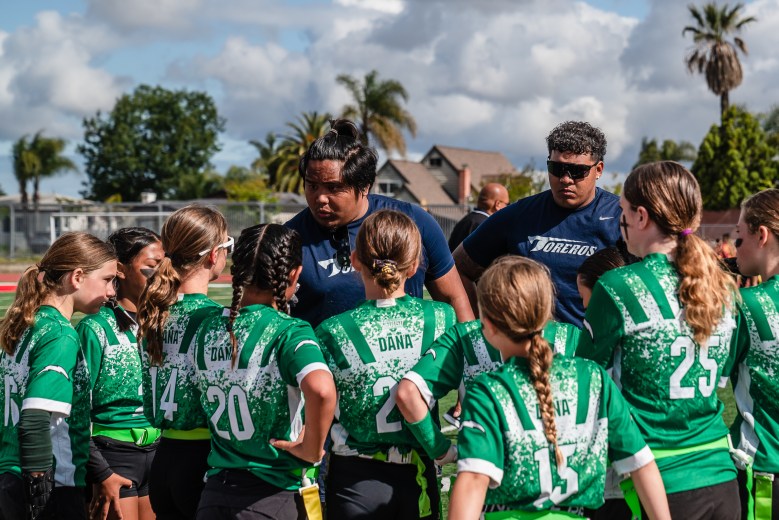
Courtney is a sixth-grade English Language Arts teacher ay Millennial Tech Middle School.
Jakob McWhinney, Voice of San Diego’s education reporter, recently called the after-school sports program here at Millennial Tech Middle School an “experiment.”
It isn’t.
McWhinney wrote that the program is “sticking around.”
In my view, that’s not exactly right either.
Let me explain. Last week, I sat on the bleachers next to Charles Trott, a teacher at Millennial Tech Middle School. Together, we cheered on several of our students, and we also cheered on one very special young man among them: Makaio Trott. In addition to being a great son, Makaio is an “A” student in my English Language Arts class. He is also one of the star players of our MTM basketball team.
Picture us, please. Mr. Trott, the teacher-dad, and Mr. Courtney, the teacher. Side by side on the bleachers of Hoover High. Picture us celebrating an MTM win and cheering for our students.
Now picture Levi’s mom, Cookie, asking Mr. Trott and I the question we had been thinking about ourselves: “Do you think this program will be around next year?”
That was a hard question to answer, but it shouldn’t be.
In 2020, San Diego Unified board leadership approved funding for our middle school sports because post-pandemic stimulus funds were available to do so. To educators like me, and to parents like Cookie, this was a breath of fresh air. After all, for decades before the pandemic, school funds had been tied like shoelaces solely to the improvement of test scores. Suddenly, in 2020, our district had money to consider what parents, kids and teachers wanted for years.
What did they want? You guessed it: extracurriculars, like sports.
Now, like McWhinney wrote, and countless others have witnessed, I’ve seen the benefits of this programming after school as well as in the classroom. In fact, it isn’t uncommon for me to see students like Makaio scoring on the court and in their grades.
But that wasn’t so before 2020. Prior to that, programs that our school community loved were simply and constantly not funded at all, or they were on the chopping block, even in strong economic times.
In my time teaching for the district, I saw it time and time again. Programs from an era when we valued diversity, which sent all fourth graders to Old Town for a week, gone. Programs that sent all fifth graders to Balboa Park museums for a week, gone. Programs when we valued nature conservancy, that sent every sixth grader to camp on Mt. Palomar for a week. Gone.
This lack of funding leaves school leadership in districts around the country constantly trying to justify robbing Peter to pay Paul so Makaio can play basketball. This has certainly been the case in SDUSD for nearly my entire 28-year career.
New board members, new superintendent, same issue.
We all want programs like middle school sports, but we, collectively, don’t receive the money for what our students deserve.
I think there’s a better way for Mr. McWhinney to phrase the issue.
School leadership making a tough decision does not make a sports program an “experiment” our board cooked up, lack of funding does. Lack of funding makes programs like middle school sports unreliable. Lack of funding makes them vulnerable.
And the “learning curve” is that this lack of funding is, in 2025, only the beginning of what is to come. There is a new assault on school districts like SDUSD right over the horizon. A sort of project that seems to be sticking around.
Like one of Makaio’s three-point shots, it’s coming in hot.
Perhaps a better way to phrase what is happening to programs like SDUSD’s middle school sports is that our entire district is in danger of losing tens of millions of dollars for programs like the one I attended last week. Students, and sons like Makaio, are about to lose opportunities in countless ways due to the withholding of congressionally approved funds by the Trump administration. And for a lot more than just sports.
I say it’s time to call the issue underlying it all what it actually is.
This is a failure to adequately fund what our San Diego’s public schools have always deserved, like our middle school sports program. The lack of funding is now the permanent “experiment” that the federal government wants to pursue.
This experiment, in my view, isn’t whether a school board decides to use money it doesn’t really have to save a program. The real experiment here is whether San Diegans will, collectively, allow programs like it to become so underfunded that they simply cease to exist.
Pandemic stimulus funds to schools were meant to help fund the additional costs related to elevated safety protocols/procedures due to the pandemic. It was NOT intended to be a slush fund to revive discontinued curriculum. Even if there was surplus money, it should have been allocated more responsibly to help fund the “critical repairs” and “deferred maintenance” elements that we constantly see on the ballots in the form of school bond measures. Lastly, it would have been naive to think that emergency pandemic stimulus funds would become a permanent source of additional school revenue to pay for ongoing activities that were not allocated in the budget immediately prior to the pandemic. Schools need to learn to operate within a budget and make those difficult decisions when necessary, the same way that all successful businesses and even private households do!
Yes, SDUSD does have a history of starting and discontinuing student services or programs using one-time funding, and it has also failed to reinstate student programs or services that were cut during the Great Recession (such as the off-campus learning experiences at Old Town and Balboa Park). But contrary to the author’s contention, this isn’t just a funding problem. In fact, per student funding for TK-12 at SDUSD is currently four times higher than it was during the Recession.
The primary reason student programs and services weren’t prioritized or reinstated is because SDUSD instead prioritized employee compensation: pay rose sequentially by more than 38%, contributions to retirement rose from 8.5% to an average of more than 20% of employee pay, and employer health & welfare benefits costs rose dramatically (more than 60%, without any employee contribution). The more than 24% in pay increases since January 2020 were funded in part using the one-time pandemic relief funds, and since employee pay increases are never rescinded, these have required cuts to programs and services to maintain.
I don’t understand the funding requirements for an afterschool sports program. Say for something like basketball, the school already has courts and balls, the students have gym clothes, what else is required that costs money?
@Sam — everybody wants to get paid for their time. You do, I do, sports coaches do. Teachers already a large number of unpaid hours. Extra basketballs get used up, nets get used up, transport to games costs extra, the list goes on.
Every unfunded mandate from the next level up costs the layer below. IEPs, for example, are incredibly expensive of staff time, and very important to that student. Yes, local schools “should be” paid from local funds. Prop 13, and its children, limit local funding streams.
As the opinion writer says: “And the ‘learning curve’ is that this lack of funding is, in 2025, only the beginning of what is to come.” Project 2025 is the culmination of choking off government and the sources of that funding; choking off the people and process that support education across the spectrum.
The Eisenhower administration had significantly higher taxes across the spectrum to support the US building out a solid infrastructure. We, as a society, have stepped away from such contributions to our collective future.
We have been paying those costs.
The one-time pandemic funding was supposed to pay for personal protective equipment, cleaning supplies and improve LEARNING LOSS, which was a result of closing schools and shifting to “distance learning.” Under the guise of “mental health,” which also suffered during the height of the pandemic, and to “make school fun,” SDUSD chose to spend a lot of those funds on extracurricular programs including summer school enrichment (in things like Visual and Performing Arts) and middle school athletics. Given that test scores show that fewer SDUSD students are meeting state standards now than before the pandemic, one could question whether that the was the best use of pandemic funds.