
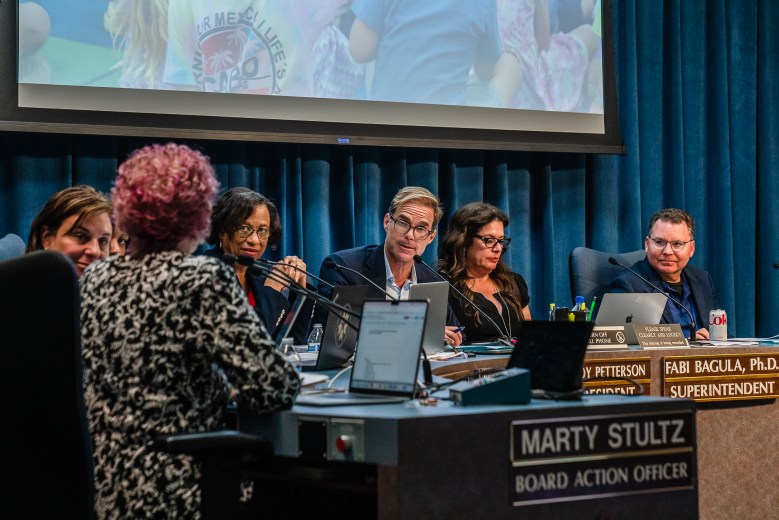
Earlier this month, longtime San Diego Unified board member Richard Barrera stunned some of his colleagues by torpedoing what would have been an historic vote to build more than 1,000 units of affordable workforce housing on district land – the largest project of its kind in California history.
As part of their public-private partnership approach, the district had received 15 proposals across five sites that varied wildly. It was the board’s job to choose which they were moving forward with. That decision set the stage for what was to be a tense meeting, wherein the board may have taken the unusual step of ignoring staff recommendations on projects.
Barrera’s move put a stop to that – at least for now.
His motion to punt a vote on the proposals passed by a vote of 3-2. It was one of only a small handful of non-unanimous votes the board has taken over the past five years. It also took some board members by surprise.
Trustee Cody Petterson had pledged the board would “land the plane,” that night. But by the end of the meeting, the final product felt more up in the air than before.
That was thanks not only to Barrera’s deferral of the vote, but also his laying out entirely new asks from developers not included in the original request for proposal. Petterson went so far as to call the move “stunning.”
So, what gives? I called Barrera to find out.
The Punt
Barrera’s reasoning for the delay is simple. The final decision was happening too quickly. While the plan has been in motion for a year, the proposals only became public on the Friday before the Wednesday board meeting. To him, that wasn’t enough time to consider the ins and outs of the very different visions for the projects.
“I think it’s important in this kind of situation that the public has a chance to see these different concepts and comment on them, and that the board has a chance to grapple with the fact that … the proposals are aiming to do some pretty different things,” Barrera said.
He’s not the only one who felt that way. Mark Singleton, the chair of the Uptown Community Planning Group, told Voice of San Diego before the vote that he was disappointed the district hadn’t brought the proposals to his group last week.
“We feel that we should have seen it and we would like a process that still allows some wiggle room for input on this – even if they just delay the decision or they take the top two, and then then you can kind of compare the pros and cons,” Singleton said.
District staff did not plan for a thorough consideration of each proposal on Wednesday. Instead, they’d only prepared presentations for the five projects its committee had recommended, meaning 10 of the 15 proposals could have gone undiscussed. That wasn’t ideal, Barrera said, because of just how different each project was.
“It became clear to me that these were very different concepts and especially on this big question of ‘What do we mean by affordability and for who?’” Barrera asked.
The Affordability Question
There was an answer to Barrera’s question. Sort of.
The district’s request for proposals defined affordable housing as housing that would cost renters no more than 30 percent of their income. The callout did not, however, include specific income bands developers should focus on.
That meant that housing that costs 30 percent of the income of a teacher making $120,000 a year was considered affordable. So was housing that cost 30 percent of the pay of a janitor making $70,000 a year.
The district committee in charge of making recommendations tended to select projects that contained fewer units that were cheaper, as opposed to projects with more units that were slightly more expensive. That seemed to contradict the district’s stated priority of maximizing the number of affordable units, something Trustees Petterson and Shana Hazan continually returned to during the meeting and in the days before.
But to Barrera, that definition didn’t make sense. Who were they supposed to prioritize? Early-career staff at the lower end of the salary scale? Or staff later in their careers who may not qualify for housing financed by low-income tax credits?
What he landed on was basically ‘Why not both?’
“I’m looking for a mix in the combination of projects. We want to support people in both of those broad categories,” Barrera said.
He noted other board agreements have more specifics. A memorandum of understanding signed with the district’s teachers union, for example, requires 50 percent of affordable housing units funded by the district’s latest bond measure to be designated for teachers.
That doesn’t matter here. Developers, not bond money, will finance these projects. Still, he’d like to see the district honor its agreement with teachers even if it doesn’t technically apply.
The (Wrench in the) Mix
Barrera laid out much of this out near the end of the recent meeting, when he described what he expected developers to present at the yet-to-be-scheduled workshop in January.
He wanted units for a mix of income levels. He wanted units big enough for staff and their families. He wanted units more affordable than those staff could get on the private market.
There was just one problem – this language wasn’t in the original request for proposals, so he was essentially creating a new request on the fly. It was one of the more chaotic and confusing moments of the night. Petterson was baffled by his requests.
“This is wild,” Petterson said.
Even Barrera acknowledged these criteria weren’t included in the original callout.
“They weren’t, which is why it’s good to come back and have this conversation,” he said.
Ultimately, the district’s legal counsel nixed Barrera’s guidance to developers to rework their proposals, telling them to simply present what they’d already submitted. But it hasn’t stopped Barrera from continuing to push for his vision.
His thinking is that no project will move forward exactly as proposed. There will be negotiations. So, what he’s looking for is developers to signal that, were they to be selected, they’re open to negotiating in the direction of Barrera’s goals.
“Obviously, our counsel would have to weigh in on this, but let’s say that in the public presentation, a developer says this is what’s in our written proposal (but) we want to make some changes, and they include the following,” Barrera said. “And the board says, ‘OK, we are approving you and moving forward with you, but one of the contingencies on that is that you are committing to what you just expressed.’ I think that’s fair for the board to do.”
One thing is certain, if the school board leaves it up to the developers, they’ll get
endless rows of highrise apartment buildings made as cheaply as possible. They will also face problems trying to match up individual families’ incomes and rental levels. The board needs staff to do a bit more homework. How about more clearly identifying the target renters and asking them what they want? Survey school employees to determine what kind of housing and neighborhoods they want to live in, then doing some additional design before sending the project out for bidding again? The goal should be to help school employees live in desirable homes and neighborhoods at an affordable price, not just stuffing them into sardine-can apartment complexes.
“Greedy developers” and “sardine-can apartments” – you’re filling up my NIMBY bingo card, Don.
With current tariff-inflated material and (justified) labor costs, I don’t think there’s anything cheap about building homes today. But the developer that would produce the most units has projects throughout San Diego, including just down El Cajon Blvd from the district site, so you can see what they’ve built: https://www.malickinfill.com/projects. These don’t look like “cheap” buildings to me.
You also mentioned asking employees what kind of housing/neighborhoods they want. This project has been going on for several years, so hasn’t this already happened? Your demands sound like the same “delay then deny” process that’s been used effectively throughout San Diego for decades, until the housing crisis it created forced us to end it. Given the size of the site, to build an impactful number of units, obviously there needs to be some taller buildings.
Oh, stop with the tariff nonsense. The cost of housing in CA was outrageously high long before 2025.
This project can be reduced to a math problem where respondents are being asked to “solve for x.” I am an employed by the school district, but given my circumstances I have no personal stake in board’s decision.
So what is the “x” that the board is trying to solve for? I watched the meeting and paid close attention to the public comment. Speakers during the meeting offered their opinion of what “x” should be:
• maximizing the number of units regardless of affordability to address the San Diego-wide housing shortage
• maximizing the number of units meeting affordability as defined by Area Median Income to benefit District employees
• constructing walkable neighborhoods and community amenities
• creating transit-oriented developments to encourage car-free living
• preservation of historic resources
• maximizing revenue to the district
Although the board instructed staff on its priorities in developing the request for proposals, evidently neither they nor staff anticipated how the respondents would interpret and weigh those priorities. So the board has pointed the decision until January.
Hopefully at that meeting the board will clearly articulate what “x” they are solving for (and the things they are not trying to solve) and make a choice that will allow this extraordinary initiative to proceed.
I, for one, appreciate the gravity of the decision the board members will be making and believe that this initiative will rightly cement their legacies for years to come.
This is comical. What about the software engineer making 125,000 per year? Where is the affordable housing for that person? This arbitrary formula of building something that costs 30% of the income of a worker will never work. The property tax system is part of the reason for this problem. The government has zero incentive to lower housing prices, and nearly every proposal by left wing politicians is to subsidize overpriced housing or to develop a nonsensical plan to have developers build something and sell it for less than current market value. Watching these people trip over their own feet is very entertaining.