
When budgets are tight, political promises that fight climate change or pollution tend to take a backseat.
That’s true nationally, as the climate news publication Heatmap explained last month, pointing out various Democrats in Congress who backed off policies to combat global warming out of concern for the high costs they could impose on voters. San Diego is no different.
What We Learned This Year is our annual reporting series where reporters reflect on some of the biggest stories of the year. Read more stories here.
What’s not being calculated in government financial departments run by elected decisionmakers is the future cost of climate change on its residents – the more frequent flooding, heat waves and depleted natural resources. But, as Heatmap aptly put it, voters don’t go to the polls for lower costs in 2075. Voters want lower bills now.
Here’s four examples of commitments that are losing ground to the affordability crisis.
Recycling Sewage so It Doesn’t Dump Into the Ocean
The city of San Diego is supposed to be spending $5 billion to recycle sewage from 3.1 million residents into drinking water. Without it, that sewage gets undertreated and dispensed into the Pacific Ocean by an old plant run by the city. Recycling that wastewater t means San Diego will be less reliable on the drought-stricken Colorado River – where the region gets most of its drinking water now.
But San Diego City Councilmembers got into heated debate over the cost of the project because it contributed to steeper, multiyear water bill hikes on residents. Pure Water’s opponents called the second, larger half of the project into question.
San Diego already has plenty of cheaper water from the Colorado River, wrote Jim Madaffer, a Water Authority board member who represents the city.
“Launching Pure Water Phase 2 without a clear affordability plan risks overburdening families and businesses,” Madaffer wrote in an Op-ed in Voice of San Diego.
The leader of the San Diego County Water Authority, the middleman agency which buys and sells the region’s imported and desalted ocean-water supplies, also thinks the city should hit pause.
“We can’t continue to build and build forever because there’s these environmental moral imperatives that have to be met or reliability at any cost?” Dan Denham told Voice.
Environmental attorney Marco Gonzalez, who helped sue the city to obligate it to build Pure Water, countered.
“With climate change intensifying drought cycles and threatening imported water supplies, local reuse and recycling are not luxuries — they are survival strategies,” he wrote in a warring Op-ed.
The city’s Public Utilities Department is reevaluating the size of its second Pure Water phase. A report on that should come out over the next year.
Keeping Food Waste Out of the Landfill
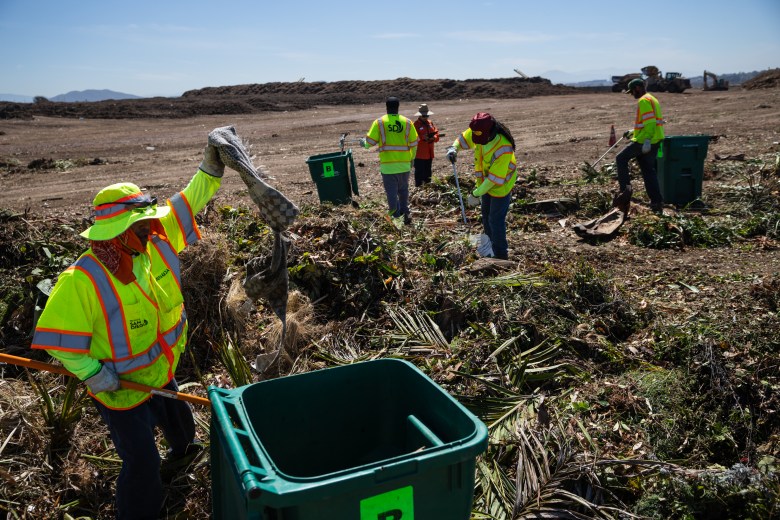
San Diego had to meet an unfunded mandate from the state to collect food waste from residents and businesses in the city in the name of climate change, called SB 1383. But a unique local law requiring the city provide trash pick up for homeowners without charging a fee meant the cost of collecting this brand new waste stream could push the city into deep debt. San Diego was successful in overturning that law, but some homeowners are fighting the city’s new trash fee in court.
The state mandated food waste be diverted from California landfills in an effort to cut down on the creation of planet-warming methane gas. San Diego complied by rolling out brand new green bins to every resident to collect that waste and convert it into compost. But the cost of that effort is monumental. The state didn’t chip in to help cities meet that goal.
San Diego had to clear a unique hurdle. It was the only city in California where residents who could roll their bins onto the street were entitled to trash collection. That meant, over half of San Diego’s homes paid nothing for trash collection, a right installed by San Diego voters in 1919 called the People’s Ordinance. Voters repealed that right in 2022. Providing that service cost the city over $50 million a year, a cost that sharply began to climb after the state mandated food waste recycling. The city had an $85 million compost facility it needed to build to handle all the new material plus the cost of the bins themselves and new collection trucks.
In June, San Diego City Council voted 6-3 to charge single-family homeowners for that trash collection. But the final monthly rate turned out to be much more than city officials estimated back in 2022 when they asked voters to support the ballot measure repealing the People’s Ordinance. That was part of the argument made by dozens of homeowners that sued the city for the new fee.
Those homeowners weren’t successful in halting trash fees on this year’s property tax bills. But the case in court isn’t over.
Getting Buses Off Fossil Fuels

North County Transit District is having trouble affording a California mandate that local transit districts transition buses off planet-warming fossil fuels. North County is investing heavily in hydrogen-powered transit, but securing that fuel costs so much that the district may have to cut back on its service.
The hydrogen North County uses isn’t totally carbon-free. Hydrogen, the most abundant element in the universe, can theoretically power a vehicle without producing planet-warming gases. But that’s only if the power that’s used to make it comes from renewable energy. The hydrogen the district uses is “gray,” in other words, it’s made by energy powered by natural gas and oil.
What’s more, the hydrogen has to be trucked in from a provider based in Ontario, California – almost 100 miles away on trucks that use fossil fuels. The district is building its own hydrogen fueling station – which will be able to gasify cheaper liquified hydrogen on site – but that liquid hydrogen will be shipped in from Las Vegas.
The district’s buses and hydrogen fueling station are being funded almost entirely by the federal and state governments. North County is responsible for purchasing the fuel. Without more support, Mary Dover, a spokesperson from the agency, said the district will have trouble balancing its budget and expects to be in a deficit by 2028 in part due to this program.
San Diego Committing Resources to Its Climate Promises
As the city of San Diego’s budget deficits grew, Mayor Todd Gloria’s climate promises shrank. In February, he announced the consolidation of the Sustainability and Mobility Department. The action broke up the team whose responsibility was executing Gloria’s own revamped Climate Action Plan, and spread those individuals across five other departments.
Gloria announced in a press release the move saved the city $914,000 – a small ding in the $258 million deficit.
In October, the administration fired the former Sustainability and Mobility Department’s leader, Shelby Buso, hired back in April of 2022. The city appointed Andrew Martin, whom Buso hired and worked as the city’s Climate Action program manager. Environment and climate activists bemoaned the move, saying it weakened the role Buso once held by moving leadership on all climate action planning underneath the city’s planning department.
It’s not the first time city leaders have put climate programs on the chopping block in budget crunches. Gloria’s proposed fiscal 2025 budget pulled $8.5 million meant for climate equity programs before councilmembers restored it.
The city’s already faced lawsuits for dragging its feet on implementing Gloria’s climate plan. He has yet to make any significant gains on his biggest climate promise – to transition all buildings off gas and onto electrical power.
In fact, the city produced more emissions than it cut between 2022 and 2023, city data shows.
Everything you need to know in the most comprehensive and voluminous SDCC candidate web site in history. Except, there exist so few voters, 28% to be exact of eligibles who cast a ballot. Americans are weird people. They line up at In n Out for burgers and wait for hours to catch a burger but it’s too hard to vote. GEEZ!!!!!!!! http://www.dannytri.org
Please quit lying that the San Diego trash pickup was “free.” It wasn’t a separate line item charge like other cities, but the workers were all paid for by city taxpayers, as was all the equipment and maintenance. By your logic, all police and fire protection in the city of San Diego is “free,” because it isn’t broken out on a separate line item for every taxpayer. Everyone knows that isn’t true – so why do you continue to spout the false claims made by the pro-fee supporters?