
I started as Voice of San Diego’s South County reporter a little more than a year ago.
As a reporter, I try not to make assumptions. But I did grow up in L.A., and I started my journalism career in Orange County.
Coming to San Diego, I allowed myself to assume I at least knew enough about Southern California to start my new beat with a basic understanding of the place I would be covering.
I was wrong.
South San Diego County does that. It defeats expectations and defies assumptions. It is one of those places in America (perhaps all places are like this?) that shows how wrong and simplistic conventional wisdom really is.
Pick a narrative from America’s politics-obsessed national conversation, and most likely South County will disprove it.
What We Learned This Year is our annual reporting series where reporters reflect on some of the biggest stories of the year. Read more stories here.
Coming here, I thought that because South County is a border region dominated by Latinos and Democrats, I could interpret local politics through the lens of other places I have lived and covered.
Wrong again.
I was even wrong about how South County feels about urban growth. It’s a suburban area with vast tracts of single-family homes. You’d think the occupants of those homes would observe the iron law of American politics that the almighty homeowner is king – and the king doesn’t want the neighborhood to change.
Nope.
In a little more than a year of reporting here, I have learned there is only one true thing you can say about South County and its politics.
This place is so diverse – demographically, geographically, economically and culturally – that it is a kind of world unto itself. And like any world, it is too big and complicated to reduce to political cliches.
Whatever your pet theory about American politics, South County likely will prove it wrong.
But that’s not all you can learn here.
Pay attention long enough, and with enough patience, and you will begin to see something far more interesting than whatever passes for conventional wisdom these days. Something harder but more rewarding to understand. Perhaps even something more hopeful.
I’ll have more to say about that later. But first, here are some of the ways my own theories have been defeated in the past year.
The border. South County is dominated by the U.S.-Mexico border. But the dominance is cultural, not political.
Though the border is an omnipresent geographic, economic, familial and cultural fact, South County political leaders almost never talk about border issues.
I wasn’t expecting that.
When the city of Chula Vista recently adopted an enhanced sanctuary city policy that further clarified the limits of city cooperation with federal immigration enforcement efforts, the measure drew just two – two! – public comments from residents.
Contrast that with the scene 50 miles north at Vista City Hall the same night, where more than 500 people packed the City Council chamber for a heated debate over a similar policy.
The border is such an accepted fact of life in South County, I think it doesn’t even register as a political issue. Local leaders seem to recognize the limits of their authority and focus on local issues – which, because of South County’s unique bi-national nature, inherently are border issues.
It is telling that the one border issue that does dominate local politics has little to do with America’s current debate over immigration.
I’m referring to the sewage crisis in the Tijuana River, which has united South County politicians and residents in a shared sense of environmental injustice.
It’s a problem that affects people’s health, livelihoods and the regional economy. Those are all things local politicians can do something about. And so, increasingly, they are trying. And voters are rewarding them.
Latino issues. There is one national political trend South County does embody. This region always has been an excellent place to learn a lesson the rest of America only now seems to be grasping: Latino voters are just as diverse and impossible to predict as every other kind of voter.
Long before Latinos nationwide took a step toward Donald Trump in the 2024 presidential election, generations of South County residents filled city halls with Republicans and sent a Republican to the County Board of Supervisors.
Some of that had to do with term limit policies and the ability of even a shrinking population of white voters to wield disproportionate economic and electoral clout.
But even now, with Latinos enjoying a clear numerical majority and maintaining a solid presence in most governmental organizations, the issues that rise to the top of South County’s political agenda have little to do with whatever political observers seem to mean by the term “Latino issues.”
Setting aside the sewage crisis, here’s a random assortment of high-profile issues I reported on this year: A Chula Vista ordinance regulating youth e-bike ridership; a tenant-protection ordinance in Imperial Beach; cannabis regulation in National City; a fight over a horse arena in Bonita; a massive new luxury hotel you can see from every part of South County.
Plenty of Latinos spoke out on those issues or authored policies addressing them. But you will notice that such issues would be equally relevant in any other American community.
All politics, they say, is local. In South County, that goes for Latino politics too.
Democratic dominance. Democrats outnumber Republicans two to one in South County. This year, those numbers did not translate into one-party rule.
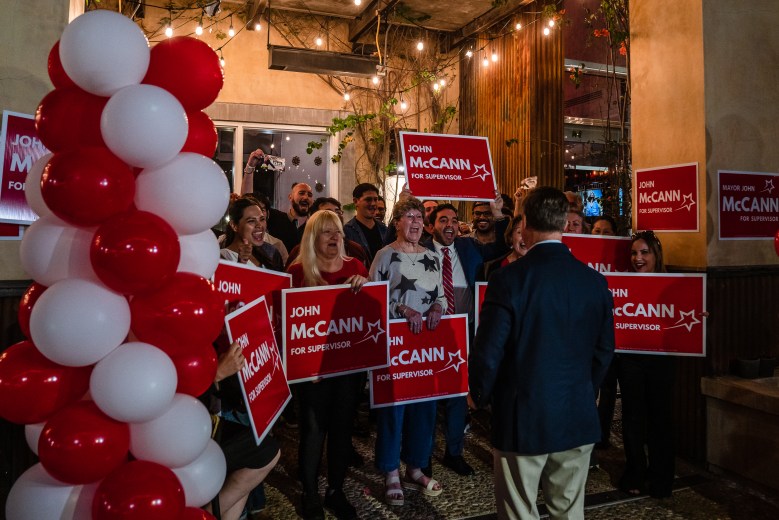
In fact, as I write, not a single South County city is governed by a Democratic mayor. Chula Vista’s John McCann is a Republican. He’s currently running unopposed for re-election next year.
Ron Morrison in National City is an independent who leans conservative. So is Imperial Beach’s Mitch McKay.
Some Imperial Beach Democrats accused the City Council of pulling a fast one by appointing McKay earlier this year without consulting voters.
But McKay, a low-key consensus-builder, is no one’s definition of a partisan pick. And he said he wasn’t even sure he’d run for a full term next year. Imperial Beach’s government is now led by two Republicans, a Democrat and an independent.
Democrats sometimes grumble to me about their current lack of mayoral power in South County. But I have noticed that South County Democrats often act like Republicans themselves.
In Chula Vista, especially, I see a majority-Democratic City Council united in its eagerness to greenlight splashy new development projects and keep their city on a sound financial footing.
Similar sentiments arise in National City.
In a recent conversation with National City Councilmember Jose Rodriguez, who has announced his intention to run for mayor next year, I listened as Rodriguez laid out a thorough, detailed list of plans to improve his city’s economy and quality of life.
Many of Rodriguez’s goals are wholly non-partisan: Pave streets and alleys; fix broken streetlights; use city-owned properties to promote residential and commercial development; improve public safety.
Only Rodriguez’s wholehearted and unapologetic commitment to enacting rent control and supporting labor unions marks him out as a Democrat.
“I try to focus on getting things done,” he told me.
The explanation for this pragmatic streak in South County politics is simple. Most South County residents are low- to middle-income. They are doing their best to get by and make life better for themselves and their families.
They don’t have room for what one political observer recently called “luxury beliefs” – the fixation on niche social issues that takes up so much room on America’s political extremes.
This past year, I talked to South County politicians of all stripes who spent their working days meeting with and listening to residents.
The top issues they reported hearing were all the same. Pave the streets. Improve the parks. Make things cheaper. Make neighborhoods safer.
Are those Democratic issues? Republican issues? South County voters don’t seem to care.
Growth. Late last year, as he was being sworn in as a new Chula Vista City Councilmember, Michael Inzunza gave a short speech that, in my view, perfectly encapsulated the actual driver of South County politics.
Why, Inzunza asked, can’t South County have the same amenities and opportunities other parts of San Diego enjoy?
The desire Inzunza expressed is a desire for improvement. South County residents see what their neighborhoods, cities and region could be. They are increasingly impatient to make their vision a reality.
In other parts of San Diego County, growth and new things are sources of controversy.
In South County, politicians say yes to just about everything.
In the past year, Chula Vista leaders gushed over their new high-rise waterfront hotel and voted for more waterfront development. The city is adding homes both at its periphery and right in its center, next door to a mall.
National City is eyeing new waterfront hotels and other developments following a crucial California Coastal Commission vote earlier this month. Imperial Beach is revamping streets with bicycle lanes and planning an overhaul of a key commercial corridor.
Through it all, South County residents are redefining what it means to be a California environmentalist.
The desire for improvement, in other words, transcends political divides.
Our region is a complex and unpredictable place. And for all that its political institutions are deeply flawed, I have found that South County’s elected leaders are remarkably responsive to what voters tell them.
And the voters do tell them. Public meetings are not sleepy here. They can get mean. Mostly they feel alive and full of expectation.
I heard lots of theories about South County politics when I arrived here. That it’s tribal. Corrupt. Like a knife fight. Like a family feud. Like Mexico. Like “The Godfather.”
It is like those things. But I see something deeper and more interesting too. Something everyone in America is longing for these days. Something I have not given up believing in.
In South County, I see voters demanding more and politicians scrambling to respond so they can stay in power.
In other words, American democracy in all its messy, imperfect, irreplaceable glory.