
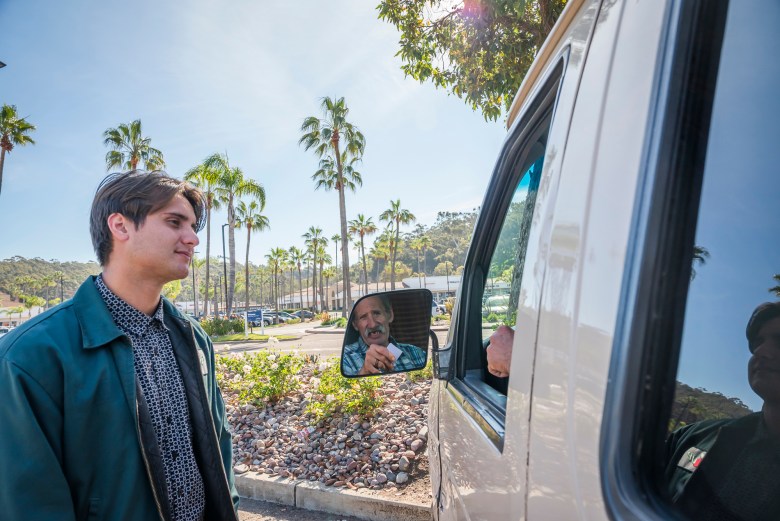
Six months ago, a portion of the Buena Vista Creek in Oceanside served as a large homeless encampment that had been growing since the early 2000s.
More than 70 people were living in the creek bed during this time last year. Some had been there for upwards of 10 years.
The encampment was sophisticated, intricate and largely hidden from view. It had an unofficial mayor and tax collector. There was infrastructure, an entry gate, a downtown and a trash area. One woman built a makeshift shower; another woman had her own garden; one man was in the process of erecting a cement wall—he was building himself a house.
Today, the encampment is clear for the first time in decades. Within a few months, various flowers, plants and animals have replaced people, tents, clothes, shopping carts and trash—30 tons of trash to be specific.
Sixty-five people once camped along the creek bed are now in long-term, stable housing because of an ambitious experiment by officials in Oceanside and Carlsbad. Now, the two cities are working on relocating more homeless people in the area into long-term housing as the model continues to prove effective.
The Experiment

In 2024, Oceanside and Carlsbad received a state grant to move unsheltered homeless people camped along state Route 78 and the Buena Vista Creek into long-term housing.
The goal is to move every person living in encampments around the nearly 4-mile shared border between the two cities into housing. The state gave them four years and $11.4 million to do it.
The money is part of a series of grants through a program called the Encampment Resolution Fund, first announced by Gov. Gavin Newsom in 2021. Cities are required to provide reports to the state to track spending and outcomes, Voice of San Diego previously reported.
The project is split into zones: Zone 1 was the creek bed area, the largest zone, which officials completed last July. Zone 2 in Carlsbad was much smaller and concluded near the end of last year. Now, officials are working on Zone 3, which is in Oceanside and is about half the size of Zone 1, Sofia Hughes, management analyst for Oceanside, told Voice.
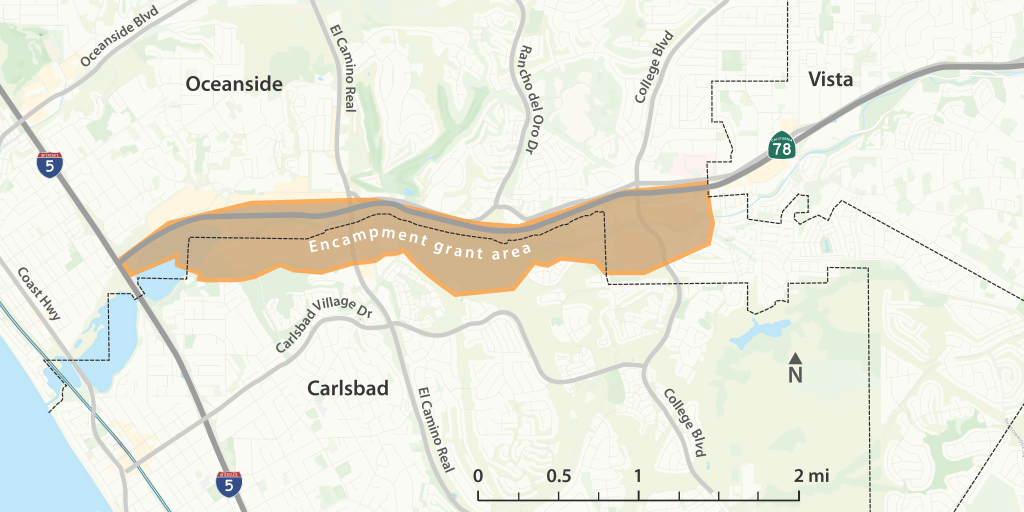
Zones 2 and 3 are different than Zone 1 in that, instead of a concentrated area like a creek bed, they involve more outreach by connecting with people living on the streets.
A team of Oceanside and Carlsbad staff members, homeless outreach workers and local nonprofit organizations (Interfaith Community Services, Community Resource Center, Catholic Charities’ La Posada de Guadalupe homeless shelter in Carlsbad and Whole Person Care Clinic) are working together in each zone. The team engages with residents and offers wrap-around services like housing navigation, medical care, case management, substance abuse treatment, mental health services and more.
In each zone, the team first creates a by-name list of each person living there, which includes details about their situation, housing status and any needed supportive services. Case managers then help clients become “document ready,” Isaiah Chavira, a housing navigator with Interfaith told Voice. That means helping them obtain a driver’s license or ID card, a social security card, etc.

Finally, they use rapid re-housing, which is rental assistance and other supportive services, to place individuals and families living in encampments or on the street into their own apartments.
Clients receive a rental subsidy for their apartment based on their income, and those who don’t have any income have their entire rent subsidized. Housing navigators also help with car payments, storage bills, utilities, food, clothes and more while clients work with case managers to find stable employment and slowly achieve self-sufficiency.
“It’s a weight lifted off their shoulders,” Chavira said. “The program gets them into a safe environment, relieves their stress and makes them feel like they’re capable enough to eventually do it on their own.”
The Outcomes

So far, officials have placed 75 people into long-term housing from the first two zones. They’ll start working on getting almost 30 people housed from Zone 3 in the coming weeks. After completing Zone 3, they expect to work in one or two additional areas of the cities.
What program leaders are continuing to notice from the project so far is it’s working, Hughes said.
“We noticed in the first zone that a lot more people were willing to accept our help than we initially expected,” Hughes said. “And that’s something we’re still seeing as we continue the work.”
She added that almost every single person who was housed in the first two zones has remained housed and continues to participate in the program.
“We’ve seen a lot of success with the clients; we have one client who just celebrated three months of sobriety, one client recently regained custody of her kids now that she’s housed,” Hughes said. “A lot of people from Zones 1 and 2 have become employed and reconnected with their family members since becoming housed.”
As for the first creek bed encampment zone, outreach workers continue to monitor it multiple times a week to make sure it remains clear, but no one has tried to go back into the encampment.
“They’re housed now, so they don’t have to come back—they don’t want to come back,” Hughes said.
The businesses and residents surrounding the first two zones are also happy with the results. The two cities have seen a drastic reduction in calls to police and fire agencies related to homelessness in the first two zones, said Jessica Klein, senior program manager for Carlsbad. Feedback from businesses and residents in the area has also been very positive.

“We are all committed to seeing this project through and trying to reduce overall homelessness, not just for those who need housing, but for the overall community,” Klein said. “We’re continuing to see this be a really effective model in our communities with so many people receiving help who previously didn’t think they had many options.”
After completing the first encampment zone, Oceanside’s unsheltered homeless population decreased by 17 percent, Hughes told Voice. Now, other jurisdictions are considering replicating the model to reduce homelessness in their cities.
And after the term of the grant ends, the team is planning on seeking more state funding to continue these efforts in other areas of the two cities.
“When you offer people housing, they say ‘yes.’ People get well when they get indoors,” said Kris Freed, a consultant with the Regional Task Force on Homelessness. “And the community gets their community back.”
Vague misleading wording is still further away from the truth than ever before
And the profiteering off homelessness continues as (working while procrastinating as usual)
Vague misleading wording
Most of the funding doesn’t even reach the homeless
It reaches people profiting by using the homeless (that’s some expensive coffee and hotdogs and eggs)
Chasing people around and telling them they don’t deserve to be here is just another social cleansing tool ….
Threatening tickets, jail, and dragging them from place to place and “oh well” if violence happens to them is still called displacement and hides actual people and not some fabricated number
(0 homeless people remain in the area)
(Doesn’t mean all them got a home)
If anything the fear is real
And how does hiding people help with getting them into housing
Displacement doesn’t mean homelessness went down a number
(But for some this is called “progress” and an actual number shifting downward, even though it really didn’t.)
The possibility of injury is way higher when constantly forced to move from place to place
If there are so many mental people on the streets, as the fraudulent information claims, then why are they being forced to move around from place to place to place, while sane and down to earth people make decisions to keep money away from them and just have the libraries shout out commands “not here you ain’t”
Maybe the homeless people can watch out for which ones are really sick and get violent from being sick and that information can be relayed to the family members, so that the family members can call 911 to tell the police and then the 911 officers can effectively tell the judge what happened, without ever being there, and then effectively get that information to the nurses, so that other mentally ill people can watch them for the nurses. We could also make another police unit called the fire department to take on the crazy calls because the equality needs to be one sided or the police could get sued for misusing the proper tools. Or they could make police nurses and give them double payments for misusing every tool available with the judicial system, supporting the misuse and misappropriating of emergency calls from family members and just say equality means “we don’t know how”
Your response to the article is so incoherent and so poorly written it’s sad , and it says one thing about YOU , you’re part of that wretched group. You people aren’t owed a thing. We tax payers are though..😉
Your response shows how callous and blind you are to the situation!
Placing “positively definite” violent 5250’s out in public with “Just get a an eviction” and just “get a restraining order” while someone is going mental and “already known ” to get violent “every-time” while mental ISN’T ENOUGH TO CALL 911 OR THE POLICE and STILL GOOF UP AFTER SOMETHING DOES HAPPEN!
****with easily getting the two years in prison over nothing****
Then taking other people with mental health conditions (THAT AREN’T EVEN DANGEROUS OR A THREAT) AND THEN JUST KEEPING THEM THERE
RAN BACKWARDS FOR DECADES!!
Chasing homeless people around is just another abused tool for the severe poverty level
And adding 20x times the amount of false diagnosis and fluff criminal records doesn’t help either the homeless or severely mentally ill
Why would anyone push an unstable person around to begin with while adding “extra heavy loaded stress” in an environment that is already harsh
Just mostly Racidivism and greed with corrupt injustice
Wowww housing first works I’m shocked.
Let’s put non-dangerous mentally ill people in the 5250+ pile
and put the dangerous mentally ill people in the 5150 – 3 day holding pile -and tell the people calling emergency numbers that were not sure if their condition is known to be violent or dangerous because that wouldn’t be equal
Let’s have a random person from out of state, look at the paperwork and decide if they have a severe mental illness and completely ignore the severity of the person’s mental state with the “exact same person ” with the exact same condition and pretend their is some sort of equality in the decision
(Without ever looking past the courthouse doors)
Just find a public defender who will go along with the corrupt judge and call it an experiment for safety
Then block out all emergency calls from family members because there is a system with “equality”
“We can’t just go around locking people up when they haven’t done anything!”(Completely ignoring a dangerous condition with real severity)(what 5150 tool)(the mental health facility is down there!)
(Just continue to wait for something to happen again . . Wait for something to happen again the next time around ….
How about we take you both to jail and call it a domestic violence fight when you’re the one being attacked, even though you haven’t done anything and the mentally ill person is clearly going mental ….
You should just get an eviction! So they can attack someone in public WHILE BEING KNOWN TO BE SEVERELY MENTAL AND DO SUCH THINGS WHILE MENTAL!
(oh – they’re not mental enough)
We can’t just 5150 them while dangerously mental THAT WOULD BE DISCRIMINATION
“Oh they appear mental but I don’t think they are going to harm anyone (while known to do so)”
“You can get an eviction!”
….. Until the calls stop coming in
Let’s get an ignorant judge to never look past the door and command the dangerous mentally unstable person to stay quiet or sedate them right before the hearing
Let’s get another psychiatrist to confirm that this person is clearly mental and “ignore the dangerous severity” part with THE EXACT SAME PERSON becomes it might lead to unequal justice
Let’s have homeless people make the emergency calls when they get attacked by someone already known to get violent WHILE THEY ARE MENTAL “RIGHT IN FRONT OF YOU” AND KNOWN TO DO SUCH THINGS “WHILE MENTAL”
Then you can stick a non-violent mentally ill person in with the one known to get violent WHILE MENTAL and you can stack the charges to keep everyone safe.
Then you can medicate them so much that they become completely unrecognizable and pretend it was a successful procedure and add a parole officer to barely just miss the medication wearing off on so that they can continue in their violent HAY-WIRE mental state the next 20+ times around while ignoring the severity of THE EXACT SAME PERSON
That is the furthest thing from SAFETY or proper handling of the situation
Just use “equality” and say “we can’t get them all right” and have people move in with them because they appear “SAFE” for now “WHILE KNOWN TO BECOME VIOLENT WHILE MENTAL”
must be really dangerous for the nurses to have non-dangerous people with partial mental conditions, that should even be considered mental conditions, to stay in the same room with complete strangers, against their will. And call a few second glance in the room “keeping it real”
A lot like the parole officer who just says “oh they are becoming mental again and there is “great equality” and to have them check themselves into the mental hospital down there while on foot or bus WHILE KNOWN TO BE UNPREDICTABLE AND DANGEROUS WHILE MENTAL
(Hurry get out the two years in prison for a one week sentence)
Want some help?
Another homeless person with a long, incoherent response lmao.
THEY REALLY NEED TO GO TO THE AREA BEHIND THE FIRE STATION ON EL CAMINO REAL AND OCEANSIDE BLVD LOTS OF PEOPLE BACK THERE
Did you contact someone capable of doing something about the situation? Here, your post does nothing. Sending a quick email to those with the power to act could make a difference.
It will fail.
That’s because they “only” received $100,000 per homeless person ($11.4M / 105 homeless)! Taxpayers need to work additional hours or more jobs in order to generate more tax revenue to better support these unemployed homeless people. That’s the only solution dumbocrats can come up with… throw more money at them!
Really great post, thank you for sharing!
I’m homeless in San diego county. I was in Rachel’s womens shelter for over a year. they did not help me getting to housing because I have no income. can you help me? babysledgegoddess@gmail.com
Why would anybody help you? Why don’t you go back to your home state? why don’t you go to a cheaper state? You’re not owed anything.
So I worked for an organization that manages affordable housing buildings, and I can honestly say these people are the lowest of the low. They are the filthiest among us ,whether you give them a home or not ( they are just losers ) these units were brand new two years ago now they are roach infested because rats are living there not humans. These so called people refuse to follow the rules of course we have security downstairs if they bring a guest, they have to sign them in. They try to get around the rules all the time ,they try to bring homeless people in to the unit when it’s not allowed they are just wretched lawbreakers who don’t deserve anything. Animals