

Things are moving fast between Palomar Health and UC San Diego Health since the hospitals teamed up to create the Palomar UCSD Health Authority.
Hospital leaders have emphasized that this is not a merger. Each hospital will remain independent, they say, and the opportunity allows Palomar to climb out of its financial hole and gives UCSD Health a larger footprint in North County.
The new entity they created, though, will operate both Palomar Medical Centers in Escondido and Poway under their own licenses, while UCSD Health and its facilities will remain separate. And by the time everything is finalized, Palomar Health will have transferred 100 percent of its assets to the Health Authority.
It also has a new board of directors, separate from Palomar Health’s elected board. And Palomar CEO Diane Hansen is now CEO of the Health Authority, too.
The partnership is taking the form of a joint powers authority, a public entity created when two or more agencies agree to share power, roll out new programs, build facilities or provide services together.
I’m Trying to Get the State to Weigh In
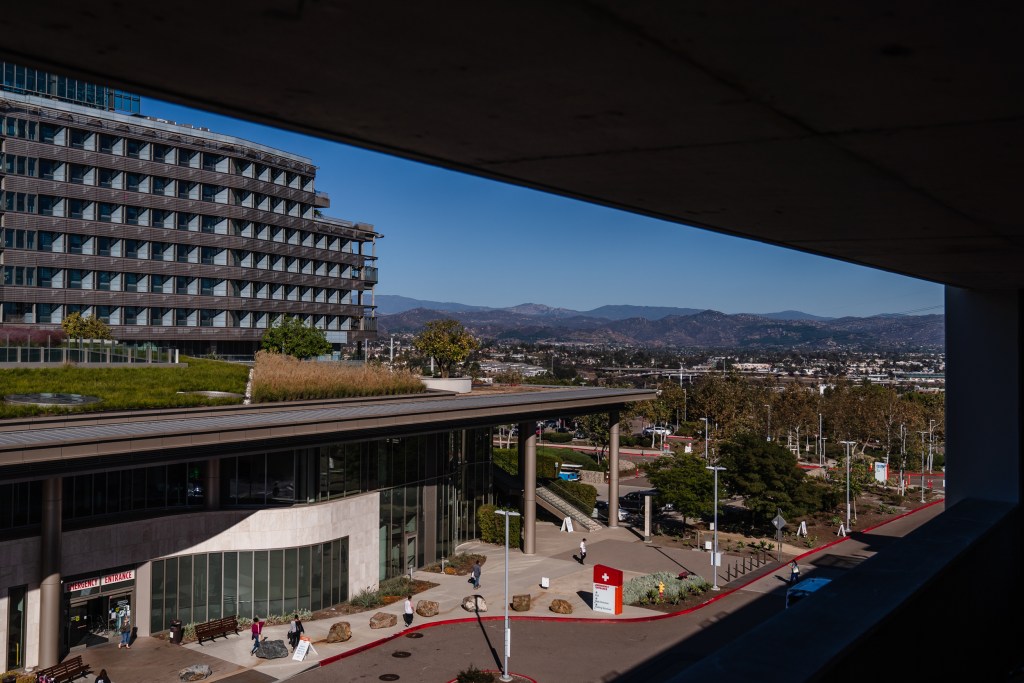
The new Palomar UCSD Health Authority will be governed by a new six-member board that will run operations of Palomar’s hospitals in Escondido and Poway. The new board is itself a public entity and will hold public meetings.
But that means the Palomar Health District Board, whose board members were elected by the public, will remain in place, but will no longer manage operations of Palomar’s hospitals.
Some people, including at least one Palomar Health board member, aren’t happy with the new board structure.
Because Palomar Health is a public institution, each of its board members is elected by voters who live in the Palomar Health district. The new structure eliminates that direct voter representation.
I have questions: Palomar Health is a public healthcare district — a type of local government known as a special district. Special districts operate independently from city and county governments and are governed by a board of directors elected by the public.
Healthcare districts were created by the state in the 1940s. All of them, including Palomar Health, are required to submit annual financial reports to the California State Controller and comply with state laws governing public records, record keeping, elections and public access to documents.
That’s because they are public entities created by voters, governed by elected boards and partially funded with public dollars. (Most healthcare districts receive a share of local property taxes. Palomar Health, for example, receives millions of dollars in property tax revenue each year.)
So, what does the state think about the Palomar UCSD Health Authority shifting management of Palomar’s hospitals away from Palomar Health’s elected board and to an appointed board?
So far, no state agency has weighed in. I’ve reached out to both the state Controller’s office and the state Attorney General’s office, but haven’t received a substantive response.
Things are moving quickly: Earlier this month Palomar UCSD Health Authority seated its first six-member board of directors, with each hospital system appointing three members.
Palomar Health’s picks:
- Edward Prunchunas, who is a retired healthcare executive at Cedars-Sinai Medical Center in Los Angeles. He is the new board’s president.
- Pauline Gourdie, the CEO of CSL Staffing, a company she established in 2016. She is also a member of the Escondido Chamber of Commerce and of Palomar Health’s charitable foundation.
- Charlene Zettel, who is currently serving as a commissioner of the California Fair Political Practices Commission.
UCSD Health’s picks:
- Margarita Baggett, who serves as chief clinical officer at UCSD Health and is a registered nurse. She is the board’s new vice president.
- Dr. John Carethers, vice chancellor for health sciences at UCSD. He leads the university’s medical, pharmacy and public health schools on campus.
- Dr. Ehtisham Mahmud, who is a board-certified interventional cardiologist specializing in complex coronary procedures at UCSD Health.
The Health Authority also affirmed Hansen, Palomar Health’s CEO, as the CEO of the Health Authority. And earlier this week, the Palomar Health board approved a four-year contract extension for Hansen, in which she agreed to cancel all future annual performance incentive payments, which are typically between 10 and 30 percent per year, “for the remainder of her employment as president/CEO of Palomar Health,” according to her new employment agreement. She is also taking a 5 percent annual raise year over year for the next four years instead of her usual 20 percent annual raise, the agreement says.
In 2024, Hansen’s total wages were around $2.3 million, according to a government compensation site published online by the California State Controller’s office.
On Feb. 4, UCSD Health officials told Becker’s Hospital Review that final documents for the new Palomar UCSD Health Authority are in the process of being signed, with an anticipated closing date in spring 2026 pending approvals from a state agency called the Office of Healthcare Affordability, which has to approve the transaction.
Reader Question: Oceanside & Carlsbad Encampment Grant

I recently wrote an update on an ambitious experiment by officials in Oceanside and Carlsbad to move hundreds of unsheltered homeless people living on the streets and in various encampments into long-term housing.
In 2024, the two cities received a state grant to move people camped along state Route 78 and the Buena Vista Creek into housing, and the state gave them four years and $11.4 million to do it.
So far, it’s going well. You can read about its progress here.
But today, I wanted to address a question from one of our readers who asked how much of that $11.4 million has been spent so far.
As of Dec. 31, 2025, they’ve spent a total of $8,260,299. Here’s the breakdown:
- Rapid Rehousing – $4,670,382: Rapid rehousing, including housing identification services, rental subsidies, security deposits, incentives to landlords, and holding fees for eligible persons, housing search assistance, case management, and facilitating access to other community-based services.
- Street Outreach – $1,988,750: Street outreach to assist eligible persons to access crisis services, interim housing options, and permanent housing and services.
- Services Coordination – $148,403: Services coordination, including access to workforce, education, and training programs or other services needed to improve and promote housing stability for eligible persons, as well as direct case management services being provided to persons.
- Systems Support – $391,441: Systems support for activities that improve, strengthen, augment, complement, and/or are necessary to create regional partnerships and a homeless services and housing delivery system that resolves persons’ experiences of unsheltered homelessness.
- Interim Sheltering – $491,400: Interim sheltering, including operations of existing navigation centers and shelters based on demonstrated need that are well suited for eligible persons.
- Administrative Costs – $569,923: Administrative costs incurred to administer the program allocation.
Officials are currently working on the third project area or “zone.” After completing this one, they expect to work on one or two more areas before the funding runs out.
After the term of the grant ends, the team is planning on seeking more state funding to continue these efforts in other areas of the two cities, officials told me last month.
In Other News
- The California Coastal Commission has officially approved short-term rental regulations proposed in the cities of Del Mar and Encinitas, creating caps on the number of short-term rentals allowed in each city, setting lengths of minimum stay and more. (Coast News) Related: I wrote about Del Mar’s short-term rental rules when the City Council first adopted them in 2024. Read about the changes here. (Voice of San Diego)
- There’s a new candidate for Encinitas mayor – San Dieguito Union High School District Trustee Rimga Viskanta is seeking the top seat in Encinitas in the November election, challenging the city’s current mayor, Bruce Ehlers. (Coast News)
- Oceanside has created a new annual parking fee for oversized work vehicles parked overnight on the street. (Union-Tribune)