
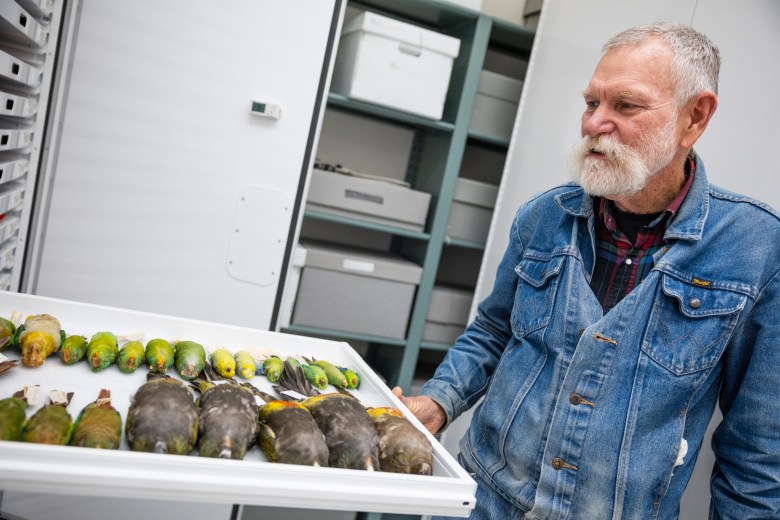
Phil Unitt can tell you which bird is flying overhead anywhere in San Diego just using his ears.
Half a century working at the San Diego Natural History Museum will do that to a man. Unitt began volunteering for the museum at age 17 and never left, eventually earning the department’s top role as curator of birds and mammals and chair of ornithology.
He has a message for generations choosing smartphone over their brain: Your AI-powered birdsong identifier, like Merlin ID, isn’t always correct, Unitt said with a laugh.
“Sometimes it will pick up a bird I just didn’t hear. Other times, people will show me what the app identified by recording its song, and it’s just nonsense,” Unitt said.
Unitt retired from the museum where he began as a volunteer in 1974.
He can trace his San Diego roots back to the 1890s when his great-great-grandfather moved here from Minnesota. His grandfather struggled through the Great Depression, moving his family to a shack in Descanso, as Unitt tells it. But growing up so exposed to the natural world inspired his mother.
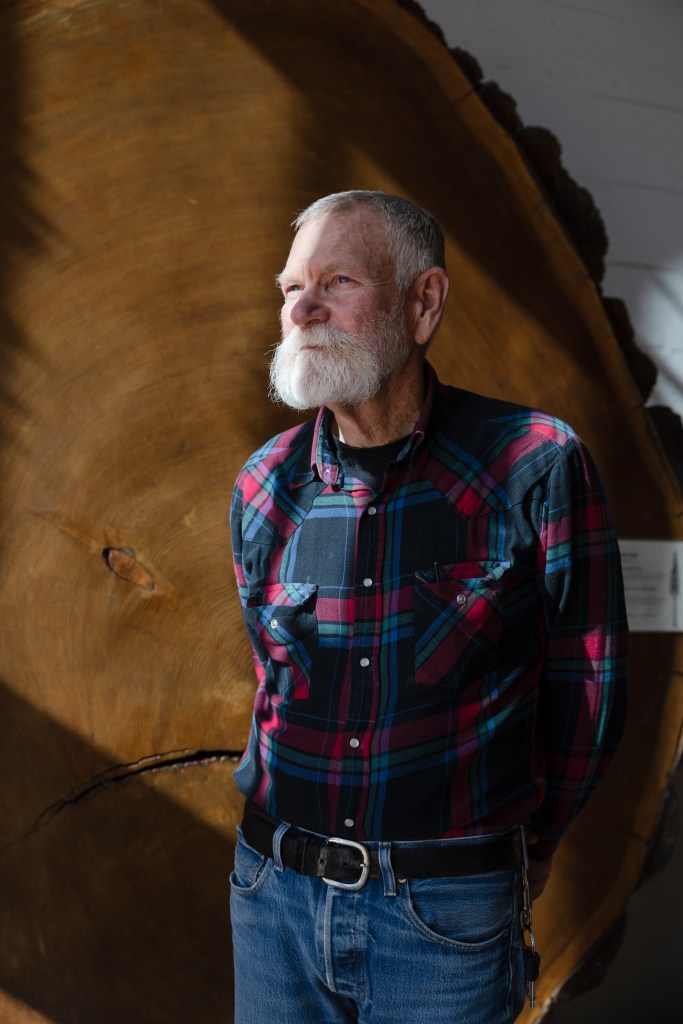
“She had the Cuyamaca Mountains and the Sweetwater River as my boundless playground,” Unitt said in an interview.
He’s an inner-city kid who grew up in City Heights. But Unitt’s mother took him camping all over the county. Around age 12, he began flipping through her old bird book wondering how many species he had seen during those trips. What hooked him on birds in particular?
“They are accessible to anybody,” said Unitt. “You don’t have to use a microscope… or a lot of expensive equipment… That’s why they’re a gateway to nature for so many people.”
He studied zoology in college and took a job zigzagging across the Eastern Tropical Pacific Ocean scanning the sea for marine mammals with the National Oceanic and Atmospheric Administration. Birds, which flock near swarms of fish, were often their first sign other mammals might be near.
Unitt took an ornithology class at San Diego State University from a pelican egg expert and his predecessor, Joe Jehl, who introduced him to the art of specimen preparation – stuffing and preserving birds, in rough terms.
“I was completely hooked,” Unitt said.
Where Unitt spends his days at the Natural History Museum is a harsh place. Fumes from preserved bird bodies invade my nostrils for several minutes before the brain acclimates to the smell. Like a morgue, fluorescent light blares down on a long series of tall, white cabinets or specimen cases. But inside, the cases drawers are full of colorful, preserved bird bodies that glint like jeweled treasures.
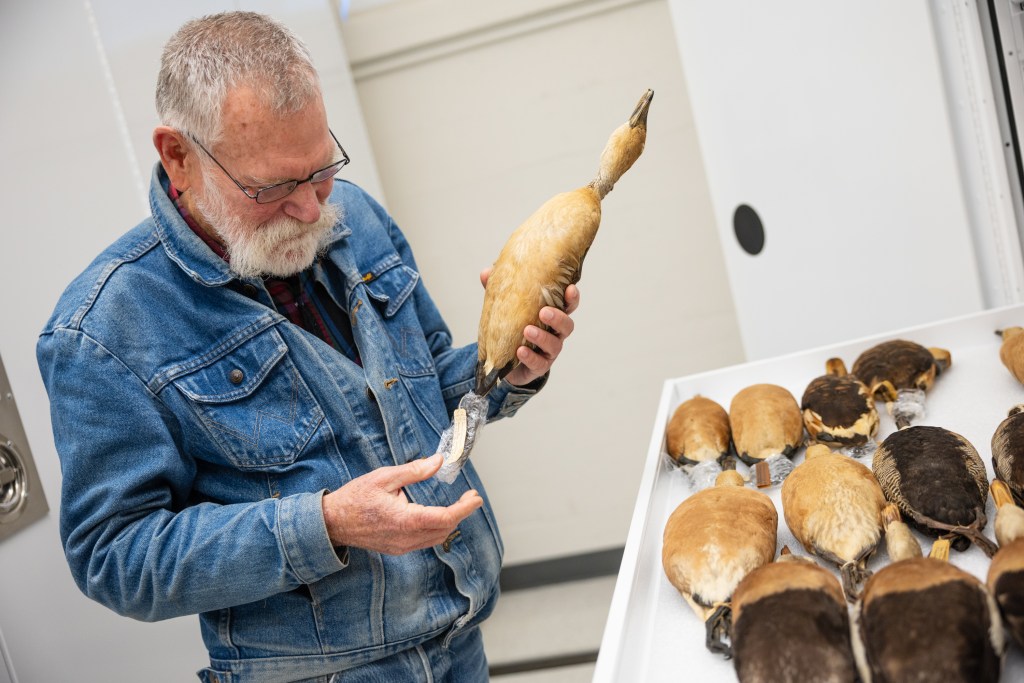
It’s clear Unitt has committed every corner of this room to memory. First he pulled specimens of whistling ducks, a now extirpated bird from California which once roamed the wetlands of Mission Bay. Then he turned on his heels, remarking that ducks aren’t actually his favorites.
“They’re actually the hardest to prepare the skins of,” Unitt said.
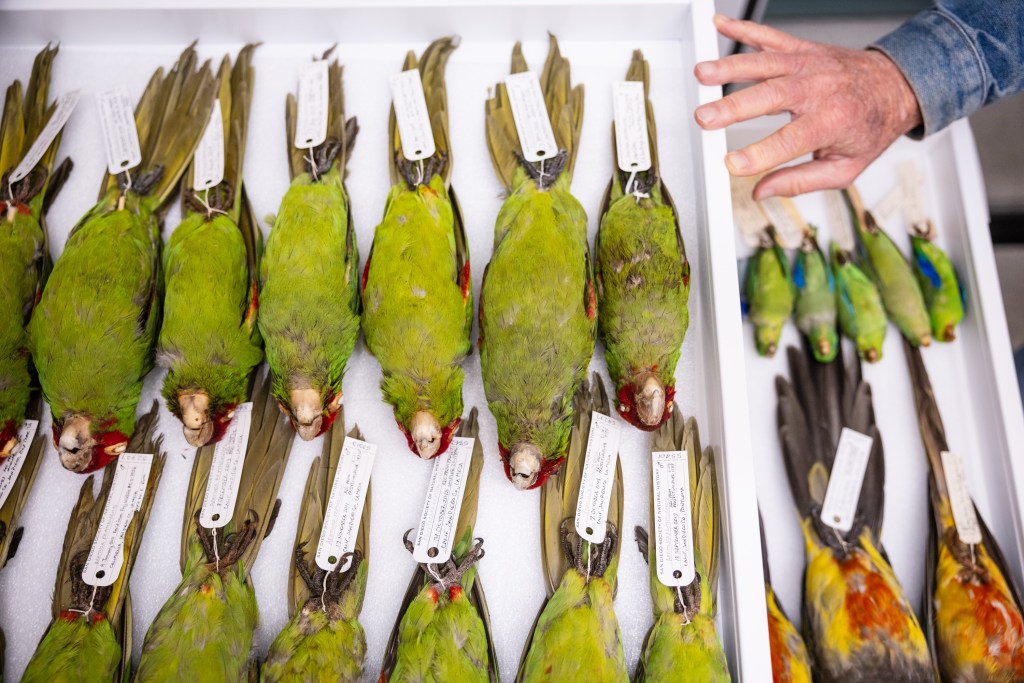
Instead he rolled back a cabinet with a large winding handle and opened a drawer full of neon-green plumage. I recognized them at once: red-masked parakeets. Their croaking squawk has undoubtedly awakened many a hungover surfer in San Diego, as they flit between palm trees screeching their maddening song. Native to Ecuador, the species settled along the California coast after escaping the caged-bird animal trade, the source of many non-native birds here.
He pulled out a longer green parrot, the burrowing kind from southern Argentina. They nest in banks in the treeless ranges of Patagonia, which is unusual behavior for a parrot, Unitt said. In San Diego, they concentrate in South Bay, excavating dead Canary Island date palms destroyed by the South American Palm Weevil a decade ago. If you see rows of decapitated palms in Barrio Logan or National City, chances are a burrowing parrot has made it home.
“That’s a new adaptation completely unknown before in this species’ biology,” Unitt said.
Unitt is a notable specimen himself. He wears a striking white handlebar moustache carved over a trim beard. He paused thoughtfully before replying to my questions, and spoke in an unhurried cadence with crisp, punctuated words. In his signature jean jacket and matching pants, I felt like I was interviewing a steampunk wizard.
I ask whether his facial hair is an ode to his grandfather, whom, he said, owned a lot of motorcycles. No, in fact, it’s what’s fashionable in the gay men’s community, Unitt replies, remarking that he’s fine with me sharing this in my story.
“It is only by being ourselves authentically that our society has evolved as far as it has,” Unitt said, a supremely scientific and endearing response.
Unitt doesn’t hold a PhD, a fact which makes him unique in the modern curating world. This appears to be something Unitt is less comfortable sharing.
“I tell people I’m the worst possible one to use as a model for your career,” Unitt said.
These days PhDs tend to be obligatory in academia and scientific careers. Whether they’re always necessary is a larger question. But Unitt’s legacy resembles that of keystone naturalists throughout history who made themselves into experts through hard work, dedication and years of practice: Charles Darwin, Jane Goodall, Rachel Carson and John Muir.
“Phil was so inspirational to me that I went back to graduate school and got a PhD,” said Lori Hargrove, an ecologist at the San Diego Natural History Museum. (She apparently believed the PhD was obligatory.)
Unitt said he has a photographic memory, with a particular knack for reproducing maps he’s reviewed. That likely aided him in his creation of San Diego County’s first “Bird Atlas.” The 600-plus-page book required hundreds of volunteers traversing almost every inch of San Diego County recording over 500 bird species. The state of California is now undertaking a similar endeavor for the whole state, Unitt said.
The years-long process began in 1997, with much of the data being recorded by hand. Because Unitt and Hargrove trekked into some of the most remote areas of San Diego County, they discovered a never-before-seen species of bird dining on the fruits of elephant trees.
“The scientific legacy of this is huge, but the human legacy is just as important,” Unitt said. “All the people who participated strengthened their skills and made connections with each other. They looked at birds in a different way than they had before.”
That more humans share in the adoration of birds seems most important to Unitt. For a man who spent just as much of his life listening for and spotting them in branches, he’s concerned that the digital age is gnawing away at the connection between man and beast.
AI-powered bird identification apps like Merlin ID, he said, often get birdsongs wrong. And he’s worried computer-powered animal observation will hurt our ability to think analytically.
“Physical objects…things that you experience through multiple senses… that grabs people emotionally,” Unitt said.
While I didn’t get the chance to watch him prepare a bird specimen, I learned it involved a lot of precision cutting, scraping of fat and handling of their delicate, hollow bones. In fact, the museum employs an army of dermestid beetles that dine on the carcasses to remove much of the flesh that might otherwise trip up human hands.
Unitt is both a sort of carpenter – building and maintaining his collection – and a scholar. He came from modest means and lived through undue grant rejections from scientific foundations because he lacked a few letters after his name.
I asked him what in his life experience could be of value in 2026.
Keep in touch with your history and your roots, he said.
“And things you can do with your hands,” said Unitt.
Around Your Environment:
- Mexican farmers gave up their water to help protect the drying Colorado River. But they claim they still haven’t been paid in full. (Voice of San Diego)
- Tammy Murga from KPBS hopped in a plane recently to learn how the U.S.-Mexico border wall is preventing bighorn sheep and other animals from reaching food sources.
- Del Mar City Council recently banned the public from digging holes at the beach deeper than two feet and burying another person in the sand. The holes are dangerous for beach walkers and officials are concerned holes could collapse or trap people in rising tides. (CBS 8)
- The city of Coronado took steps to join San Diego Community Power, a government-owned power provider which aims to provide cheaper and cleaner energy than its competitor, San Diego Gas and Electric. (Union-Tribune)
- San Diego’s infrastructure needs – which are largely stormwater – top $7.8 billion now. That doesn’t include costs to retrofit the city’s coastal area against sea level rise. (Union-Tribune)