
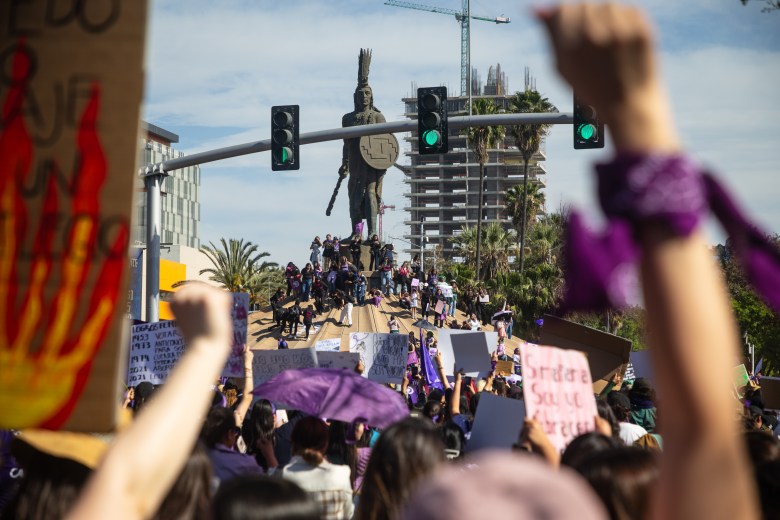
Hundreds of Tijuana women marched on Sunday in this year’s continuation of the 8M movement, which calls for greater protection of women’s rights and an end to femicide.
The annual demonstration on March 8, International Women’s Day, brings together women of all ages — along with children and pets — to share their stories of abuse, demand justice for their loved ones and to shout what has become one of the march’s main slogans: Ni una mas. Not one more.
Women are killed in Mexico at a rate of about 10 per day, according to a 2022 United Nations report. Globally, more than half of the killers of women are intimate partners or family members.
Advocacy groups in Mexico have long called out government officials for misclassifying killings of women as accidents rather than femicide. They say violence against women often goes uninvestigated and unpunished.
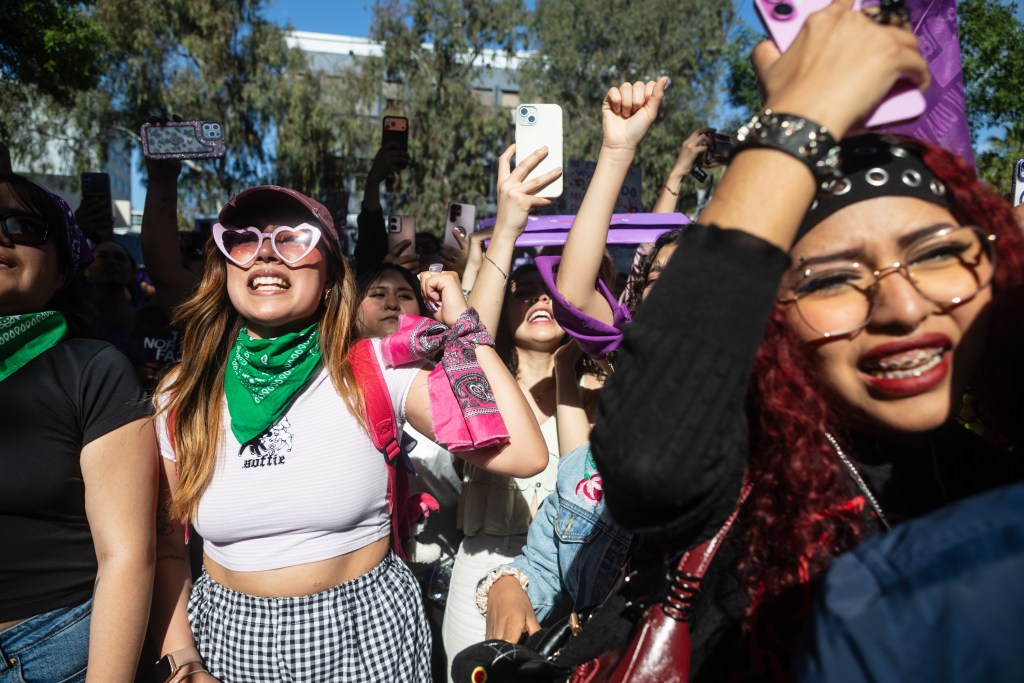
In Sunday’s crowd, Sara, who declined to provide her last name, said she brought her 9-year-old daughter with her to the march for the third year in a row so that the girl would know that she’s not alone.
“Above all, I want her to know it’s not normal to grow up with fear,” Sara said in Spanish.
Another mother chanted loudly with her 22-year-old daughter, bouncing up the street with the crowd as they collectively yelled, “El que no brinque es macho!” He who doesn’t jump is a macho man.
Men mostly avoided the march. The paramedics and most of the police that I saw working the areas where the march passed by on Sunday were women. The few male delivery drivers who had to move through the march’s path to pick up or hand off food did so quickly, quietly and generally without making eye contact. Most of the journalists covering the march were women, and the few male photographers kept their distance as they worked.
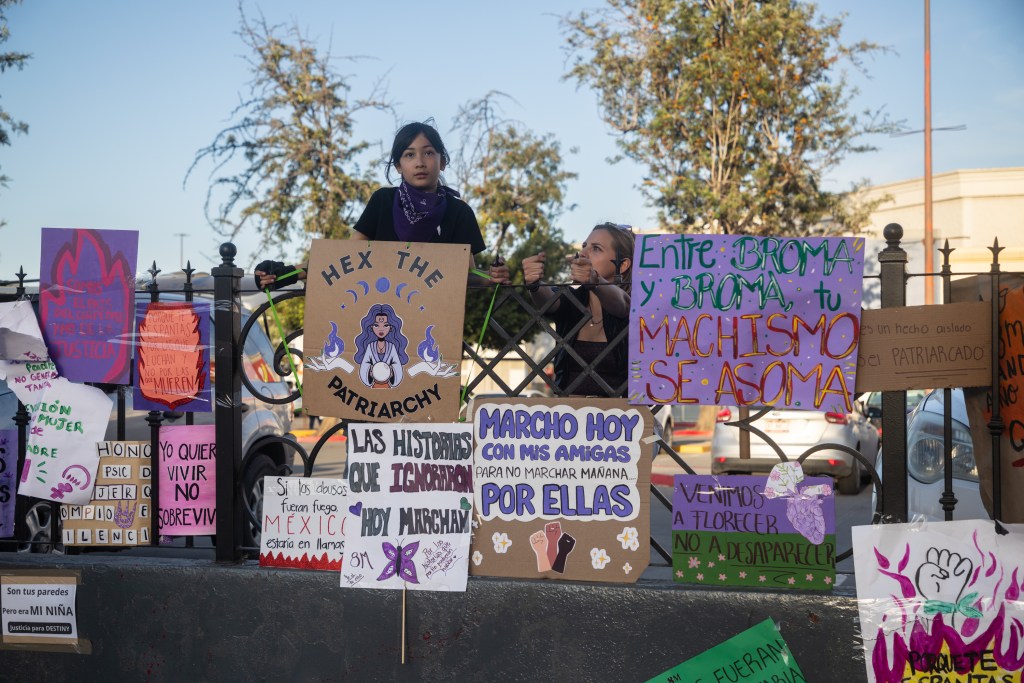
Near the front of the demonstration, one woman carried a sign that read: “Por qué te espantas por las que marchan y no por las que mueren?” Why are you frightened by those who march and not those who die?
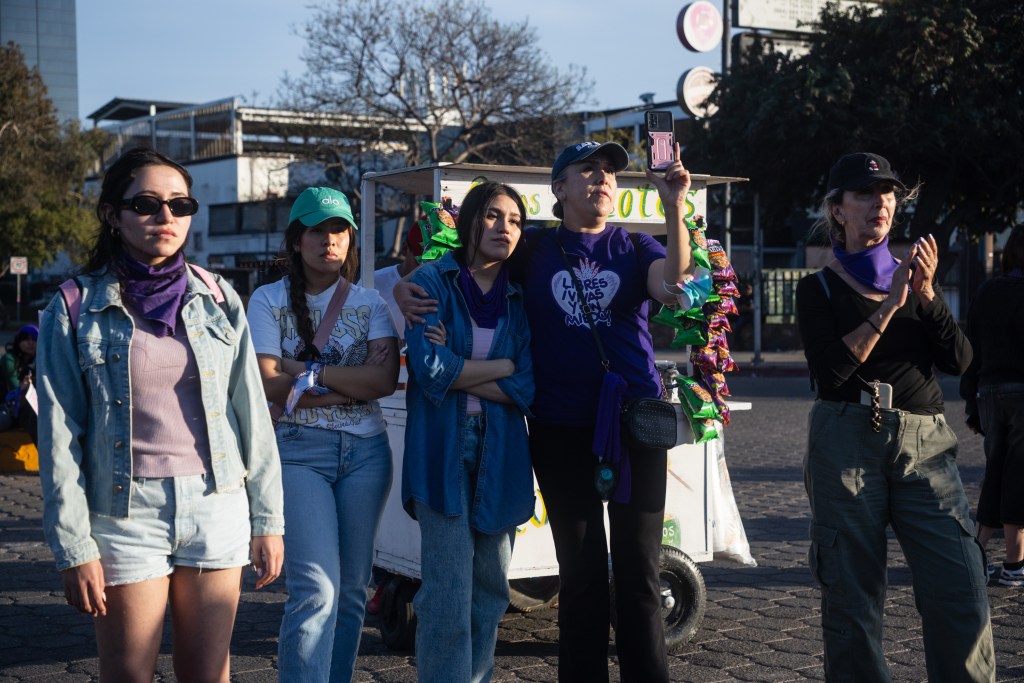
Most attendees wore purple, representing feminism. Several people carried flags that were purple, green and pink. Someone had painted a version of that flag on the base of the statue where the march began, Monumento México, a statue known to most Tijuanenses as las tijeras or the scissors. It stands in the middle of a traffic circle next to Centro Cultural Tijuana.
The paint of the flag was still wet when I walked by.
Several women with Frontera Violeta, an intersectional feminist collective, who were sitting near the painted flag, explained to me those colors are the intersectional feminism flag. They said pink represents the fight for trans women’s rights, green is the fight for legalized abortion and purple is for feminism.
A small group of women wore costumes from the series “The Handmaid’s Tale,” which tells the story of women forced to live as concubines under an oppressive dictatorship.
Mariela Medina said that the group felt a lot of what happened in the show reflects what is happening currently to women’s rights.
More than a dozen women wore all black, including ski masks and goggles accented with pink, and carried bats and spray paint canisters. Walking with their arms linked, this group led the march in some moments while disappearing into the belly of the crowd in others.
To the beats of a group of drummers called Las Tamboreñas, the march headed down Paseo de los Héroes, pausing at the statue called Monumento al Emperador Cuauhtémoc before continuing to the statue of Abraham Lincoln, where the demonstrators turned right to stop outside the state prosecutor’s office.
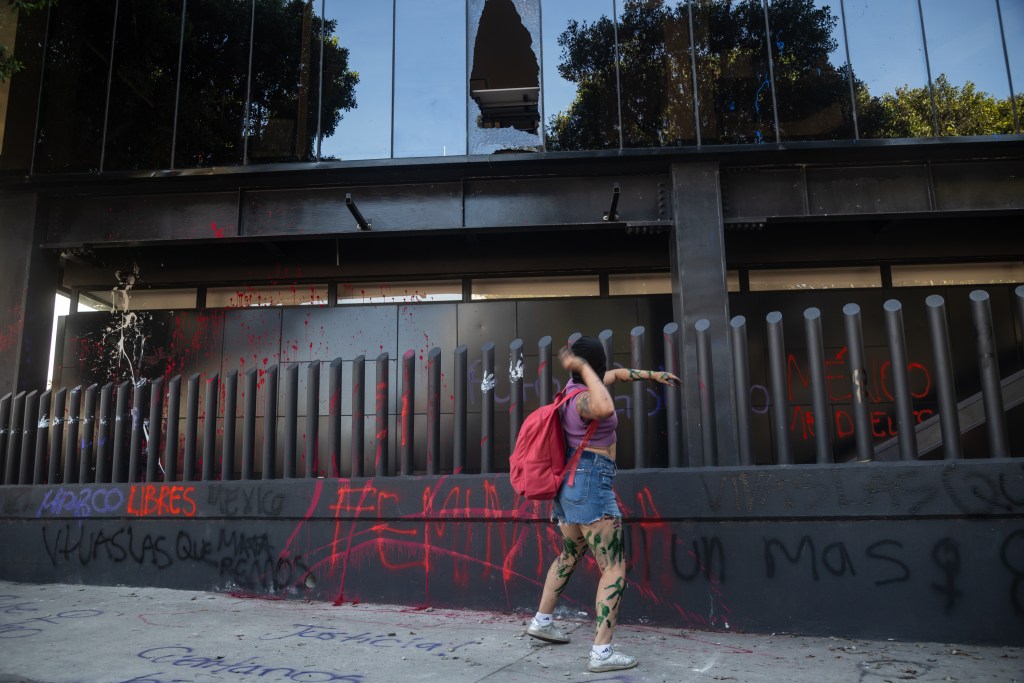
With their identities hidden, the group in black left messages about their cause on statues, bus stations and buildings.
“No más silencio,” one woman painted at the Lincoln statue. No more silence.
There, a woman with a megaphone told the crowd that they needed to remember what women were going through in the United States, particularly undocumented immigrant women. She said women needed to develop a sisterhood between the two countries.
“Our fights are the same,” she told the demonstration, which filled four traffic lanes and stretched back to the roundabout containing Cuauhtémoc.
The women in black pasted up flyers denouncing specific men as rapists, abusers or aggressors, with photos of the men’s faces and sometimes even their social media handles. And, they smashed public property with the bats, including the state prosecutor’s office.
There, they brought down a sign and broke open a glass wall. Some went inside and threw folders of documents into the street. One handed an older woman a hammer. Her sadness and trauma visibly moved through her body as she swung the hammer at a window.
While they worked, the crowd cheered, “Esas morras, sí me representan.” Yes, those girls represent me.
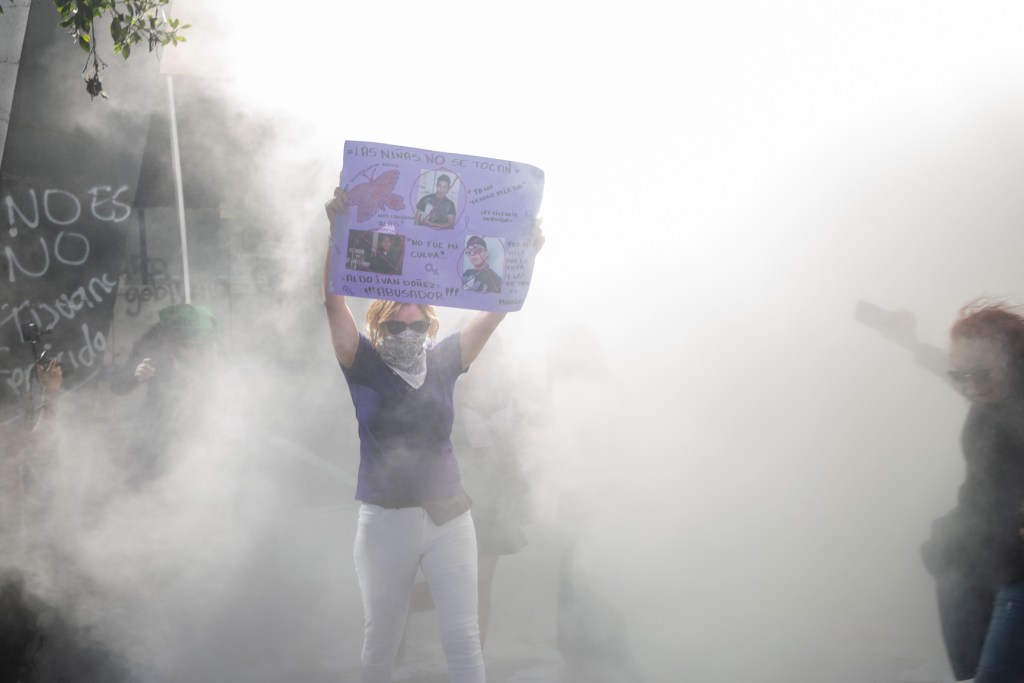
Eventually, police at the building released tear gas, but not before the women with bats had broken the glass doors as well.
Many in the crowd said they felt the criminal justice system in Mexico does not do enough to seek justice for women, that the system is often rigged against them.
The family of Paula Jerenia Osuna Lopez stood at the front of the march — the group had some of the only men in the crowd. Paula Patricia Lopez Torres, the mother of Osuna Lopez, said Osuna Lopez had disappeared in December in Tijuana. Lopez Torres said the government had briefly detained a man related to her daughter’s killing, but the family still did not know where to find her body.
“We want her to be able to rest,” Lopez Torres said.
The march continued, circling back to Cuauhtémoc before crossing the Tijuana river and moving north to the Palacio Municipal, a city government building that includes the mayor’s office, where women police circled the building. The officers were not wearing riot gear or helmets or face coverings. They were in their normal police uniforms.
“La policía no me cuida. Me cuidan mis amigas,” the crowd chanted. The police don’t take care of me. My (female) friends take care of me.
There, the women with bats attacked a large tent set up next to the building, first painting messages on it and then tearing it. On the building’s flagpole, a group hoisted a purple flag with the symbol for women on it. The police stood watching them.
As we walked, one woman who identified herself as Libertad approached me and asked if we could have this kind of movement in the United States. She said she thought we needed it with what was happening to our rights.
The women made their way back to the scissors statue, where they sang songs and offered an open mic for women to share their stories of abuse and assault.
Samantha, the first woman to speak during the open mic, told the crowd seated in the street around the statue that her ex-boyfriend had manipulated and physically abused her. When she tried to leave him, he threatened to kill himself, she said.
She paused in moments to collect herself emotionally, and the crowd cheered for her, assuring her that she was not alone.
Samantha said that when she finally left her ex, he attacked her, and she defended herself. He tried to press charges against her for hitting him back even though she was the one with bruises on her neck and arms.
She said her ex kept harassing her to the point that she had to move. She thanked Tijuanense women who had befriended her after she arrived in her new city.
“I want you to know it’s not your fault,” Samantha said. “Don’t listen when society tells you otherwise.”
A line of at least a dozen women waited to speak after her.
As I walked back to my car and the sun moved lower in the sky, the purple flag still fluttered at the top of the pole outside the city government building.
Thank you for reading. I’m open for tips, suggestions and feedback on Instagram @katemorrisseyjournalist and on Bluesky @bgirledukate.
In Other News
Arrested children: Gustavo Solis reported for KPBS that Immigration and Customs Enforcement officials are increasingly arresting children in San Diego.
Impunity: For Capital & Main, I wrote about the similarities between the killings of Renee Good and Alex Pretti and two killings by immigration officials in the San Diego region more than a decade ago.
Corrupt cops: Salvador Rivera reported in the Border Report that the Baja California State Attorney General’s Office arrested 30 police officers accused of having ties to the heads of the Sinaloa Cartel in Tijuana.
El Mencho: After the killing of a cartel leader in Mexico, Alexandra Mendoza and Alex Riggins of The San Diego Union-Tribune asked whether his death might lead to more violence in Tijuana.