
Schools in South County are under unprecedented stress.
Mirroring statewide trends, enrollment is down. Budgets are in the red. And post-pandemic discipline problems continue to upend classrooms.
In the Chula Vista Elementary School District, a handful of schools are trying a novel solution to public education’s post-pandemic struggles.
The schools are part of a statewide effort to transform schools in high-needs areas into one-stop shops for everything from academics to groceries, after-school childcare and even dental checkups.
Earlier this week, I visited Lilian J. Rice Elementary School in southwest Chula Vista, one of 13 so-called community schools in the district. Like other community schools, Rice uses state grant funds to meet an array of needs that often prevent kids from attending or succeeding in school.
With South County families facing economic pressures and a pervading anxiety about the United States’ shifting political climate, I wanted to see how a key local school district is working to maintain its role as an anchor of its community.
‘It’s Hard Times’
Rice’s roughly 630 students face all the problems you might expect in a lower income community. In the census tract surrounding the 88-year-old school, a third of residents have a high school education or less. One-fifth moved within the past year. Nearly two-thirds speak a language other than English at home.
Veronica Delgado, Rice’s principal, said many families live in crowded conditions, sometimes doubling or tripling up with other families in rental units. The pandemic cut enrollment by 100 students, she said.
“We have students with gaps in their education,” Delgado said. “It’s hard times right now. There’s a lot of uncertainty. There’s financial instability. There are fears in our community because of what’s happening politically.”
Community schools receive extra money from the state to hire a dedicated staff member who assesses local families’ needs and arranges for academic, economic and social services to meet those needs.
Chula Vista Elementary was an early adopter of the program and now has 13 community schools, most of them on the city’s less affluent west side. Each school receives up to $1.4 million in state grant funds, spread over five years. Grant amounts vary according to school size.
Since the community schools program began in 2021, California has awarded $3.4 billion in grant funds to 2,495 schools. Originally conceived as a five-year experiment, the program recently granted schools the option to extend grants for two years. Gov. Gavin Newsom has proposed making the program permanent.
The Goal: Relationships and Larger Needs
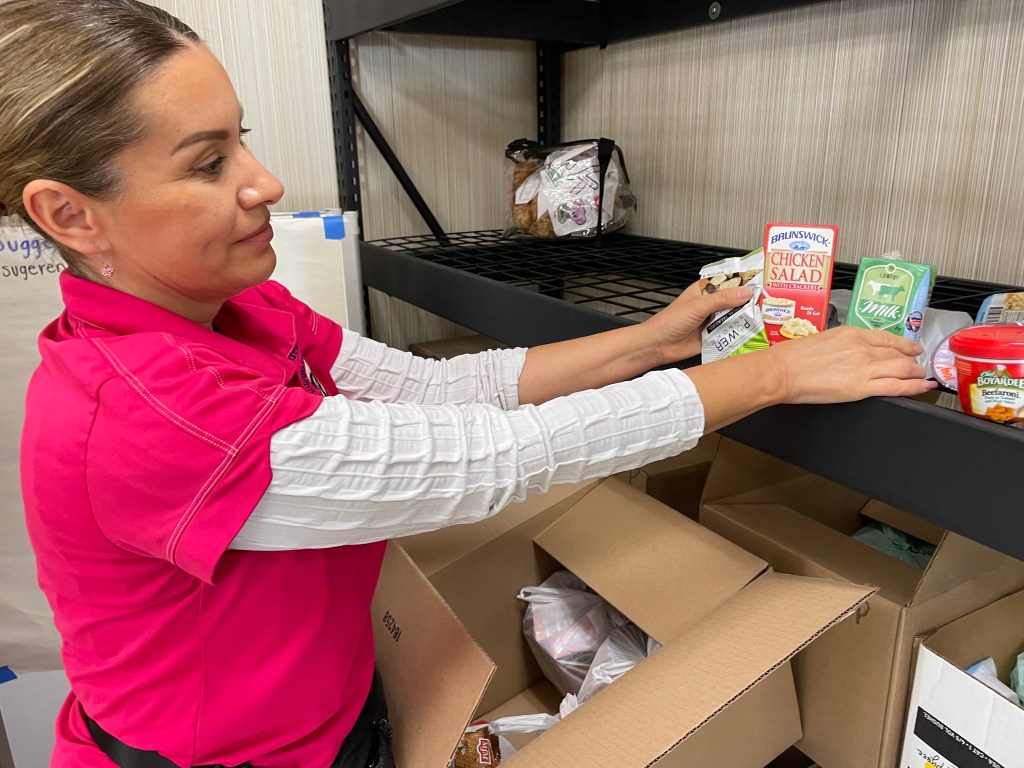
Rice became a community school in the 2024-25 school year. When I visited the campus on Monday, I found Adriana Gutierrez, the community schools coordinator, in the cafeteria preparing to hand out grocery bags of food to local families.
“This is what I love,” said Gutierrez, who previously worked as a community liaison in the Calexico Unified School District before coming to Chula Vista last year. “I love working with the families.”
Each week, Gutierrez arranges for donations from the San Diego Food Bank and distributes them to more than 60 students’ families.
She opened one of the boxes arranged on wire racks in the cafeteria and pulled out packages of rice, beans, tuna, spaghetti sauce, juice, cereal, beef jerky and apple sauce.
“The kids love it,” she said. “Especially the apple sauce.”
Help with food was one of several needs named by Rice families, Gutierrez said. Others included help with reading skills, more after-school athletic opportunities and help with mental health issues, such as anxiety and depression, for both students and their parents.
“We saw many domestic issues during the pandemic,” Delgado said of the glimpse into students’ home lives teachers gained during months of online learning.
Previously, Delgado said, parents were reluctant to open up about such problems. But Gutierrez makes a point of getting to know as many families as possible. She makes herself visible at the start and end of every school day and mingles with parents at events.
The goal is to “build relationships and move up to larger needs,” Delgado said.
Rising Test Scores
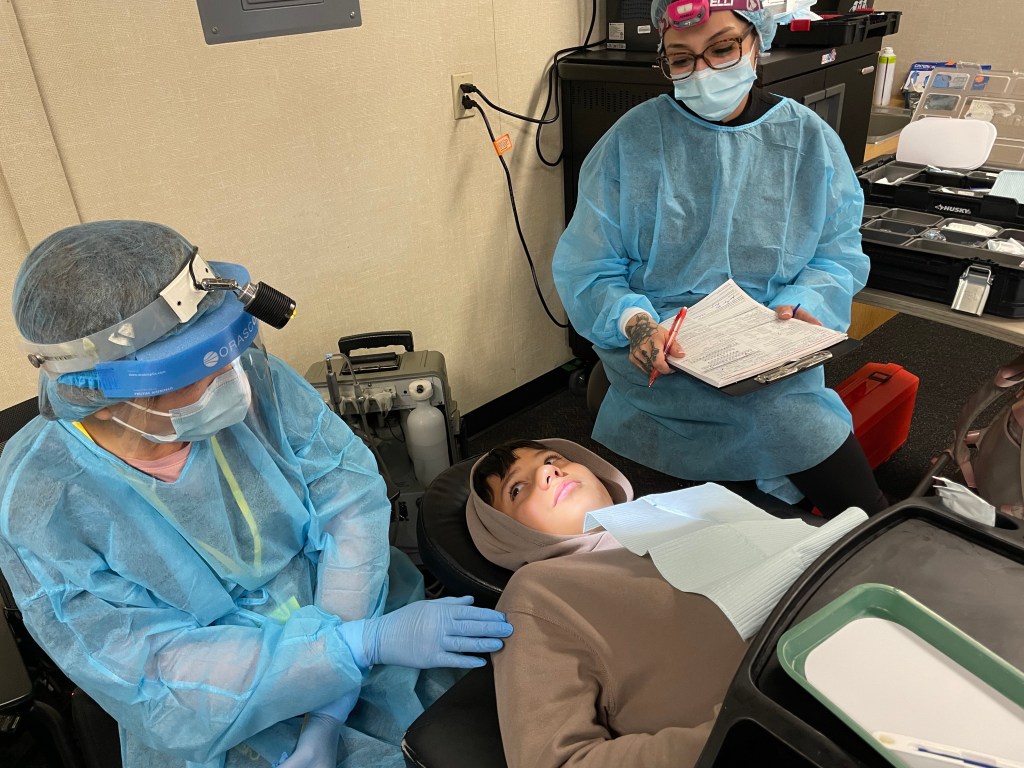
Since receiving its first grant installment in 2024, Rice has boosted the hours of a resource teacher who helps other teachers improve their skills; hired a reading specialist to work with struggling readers; brought in a coaching organization to supervise recess soccer games; boosted the hours of the school’s onsite social worker; expanded after-school programs and brought in dentists and eyeglasses providers to address students’ health needs.
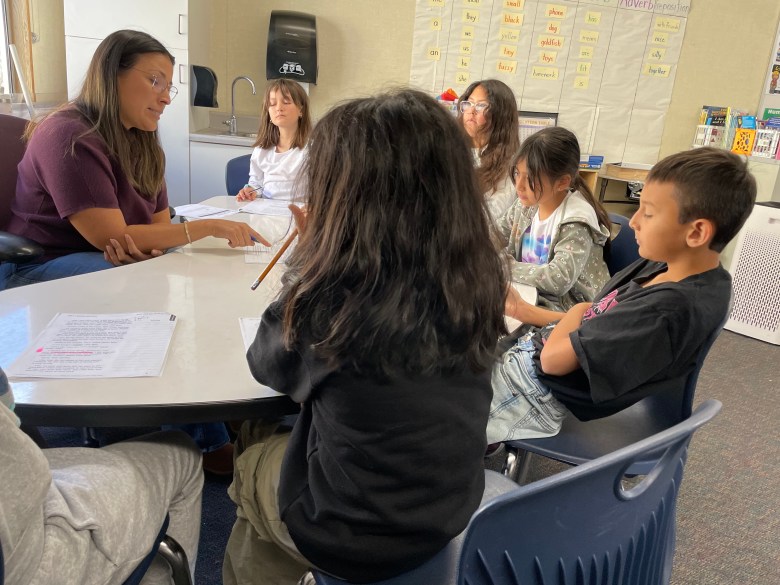
On Monday, half a dozen third graders sat around a table with reading specialist Melissa Luna. The students took turns reading aloud a story about bears.
“What does ‘wailed’ mean?” Luna cut in. “Anyone?”
“Whined?” one student said.
“Good!” Luna said. “Keep going.”
Later, Luna told me she already has seen readers she works with improve since the start of this school year. “They are able to recognize more [words] and blend [letters] without as much modeling,” she said. “I see more comfort and confidence in their skills.”
Though just 46 percent of Rice’s students meet or exceed state reading standards, Delgado said scores are rising faster at the school than the districtwide average. Last year, more than 80 percent of students boosted their reading skills, according to state test results. An even higher percentage of students improved in math.
Joshua Kohler, Chula Vista Elementary’s director of community schools, said other community schools also have shown higher than average improvement in test scores. The schools also notched improvements in rates of chronic absenteeism and suspensions.
Kohler said Chula Vista’s 13 community schools had an average absenteeism rate of more than 50 percent at the height of the pandemic. Since then, the rate has dropped by more than half, he said.
“That’s literally hundreds of students attending school more regularly,” Kohler said.
The benefits of such improvements feed on each other. At Rice on Monday, I watched groups of kindergartners gather excitedly around poster boards of blank paper. They were helping each other solve a math problem about crayons.
Teacher Ofelia Cortez moved from group to group then called the class to one side of the room where the group who’d solved the problem first showed everyone else how to do it.
Associate Principal Jose Villegas said Cortez’s classroom showed the benefits of maximizing opportunities for students of all ability levels. He pointed out that Cortez had purposefully divided her students into random groups to ensure struggling students could learn from their more advanced classmates.
“You let kids collaborate with one another so you’re not separating students by level,” he said.
‘We Want the School to Be That Hub’
Delgado said when families realize schools are a place where basic needs such as food, counseling and kids’ insatiable appetite for outside play can be met, they are more likely to stay involved – which in turn boosts students’ academic skills and raises kids’ confidence.
It’s a virtuous circle, she said. “We want the school to be that hub.”
In the Rice cafeteria on Monday, school parent – and grandparent – Angeles Martinez waited to pick up her weekly groceries.
Martinez, 57, is the parent of five children, all but one of them out of high school. She also cares for one of her grown daughters’ two children, a kindergartner and second grader at Rice.
“I’m the legal guardian,” Martinez said of the two younger children. “My daughter and her husband had domestic violence issues.”
Martinez’s husband of four decades died two years ago of brain cancer. Her mother died a year after that. She relies on Social Security for income.
“I don’t know how I do it, but I do it,” she said. “It’s been a lot of help with this program.”
Martinez said her two grandchildren eat breakfast and lunch at Rice and participate in after-school activities until 6 p.m. That enables Martinez to tend to her 14-year-old and household tasks.
She gets a weekly bag of groceries from the school and occasional vouchers for Northgate Market and other local stores. She applied for a job at the school as a playground supervisor.
“I feel blessed,” she said. “I can absorb the positive energy here. I’m a very positive person.”
As we talked, students on the other side of the campus were in an outbuilding receiving free dental checkups. On the playground, students ran around a field in an organized soccer game and competed in relays. Later that day, roughly half the student body would stay after school to participate in more than 40 activity clubs.
“Our parents are trying their hardest and we’re encouraging them to reach out to us for help,” Delgado said. “If they don’t know where to go for resources, they can start with us.”