

Alan Berube is senior vice president at the Policy & Innovation Center (PIC), a think tank and social impact incubator headquartered in San Diego. In his column, DC Explained, Berube provides insights to help residents understand the fast-moving national economic and policy dynamics affecting San Diego County.
The lack of affordable, available housing in the San Diego area is a widely acknowledged problem. Census Bureau data show that a staggering 56 percent of our region’s renter households are cost-burdened—meaning they spend more than 30 percent of their income on rent. The San Diego Regional EDC recently found that local households need an income of at least $235,000 to purchase the typical home, the price for which now exceeds $1 million. And while the pace of homebuilding has begun to accelerate, inewsource reports that most local jurisdictions aren’t keeping pace with regional housing targets, especially for households in lower income brackets.
Against that backdrop, what’s happening now on Capitol Hill might pique San Diegans’ interest. Over the past few weeks, bills have passed the U.S. House and Senate that could add up to the most consequential federal action on housing policy since at least the 1990s. The legislation’s purpose, “to increase the supply of housing in America,” earned it rare bipartisan support in both chambers.

As the bill awaits final approval in the House and consideration by President Donald Trump, here’s a look at what the legislation would do, and what it could mean for San Diego, one of the nation’s least affordable housing markets.
What the Bill Does
Across hundreds of individual provisions, the Senate-passed 21st Century Road to Housing Act would do three basic things to improve housing availability and affordability.
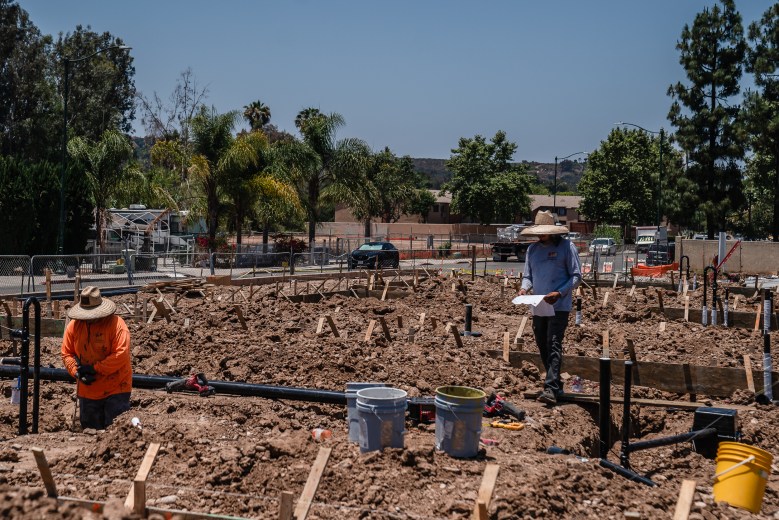
First, the bill aims to make it easier to build housing. It would streamline federal environmental review of housing projects that receive funding from the Department of Housing and Urban Development (HUD). It would incentivize state and local governments to use more of their HUD funding to build new affordable housing. And it would loosen federal rules around manufactured housing—homes that are built in a factory and transported to a site for installation—to permit a greater range of designs and, hopefully, expand their production.
Second, the bill seeks to unlock more financing to build affordable housing. It would encourage banks to invest more capital in smaller community lenders that finance affordable housing projects. It would also expand local public housing authorities’ ability to tap into private capital to build and modernize affordable units.
Third, the bill restricts large institutional investors from purchasing new single-family homes. These companies hold significant inventories of properties they largely acquired after the foreclosure crisis of the late 2000s. Supporters of the bill’s restrictions argue that these firms bid up prices for homes and squeeze out individual buyers, although evidence is mixed.
What the Bill Might Mean for San Diego
Affordability-challenged markets like Greater San Diego could certainly benefit from federal actions to spur more homebuilding. But how much?
For starters, several local cities and the County of San Diego receive HUD funding through the Community Development Block Grant (CDBG) and other programs. Under the bill, local officials could direct more of these funds—roughly $23 million from CDBG alone last year—toward financing the construction of affordable units.
Streamlining federal environmental permitting might help locally as well. At any given time, there are at least a dozen HUD-supported affordable housing construction projects underway in San Diego County. Exempting at least some of these projects from multi-month federal reviews could speed the delivery and lower the cost of these units.
Encouraging banks to invest more in affordable housing lenders couldn’t hurt either. Financing affordable housing in California typically involves stacking many different forms of public and private capital. More bank capital flowing into projects like Hillside Apartments and 12th and Imperial, which both employ federal tax credits expanded under H.R. 1 last summer, could help bring other developments online faster.
On the other hand, barring institutional investors from buying single-family homes might not matter much in San Diego. Late last year, investors accounted for about 25 percent of home sales in San Diego County, above the national average of 18 percent, according to a Redfin analysis. Yet most local investors are smaller “mom and pop landlords” who would not face these new restrictions anyway. (The County Board of Supervisors also weighed in on this issue a couple years ago.)
Similarly, changes to manufactured housing rules could expand options in the county’s unincorporated areas, which today contain about one-third of the county’s total manufactured housing units. But the overall impact on affordability would be modest at best.
Notably, the federal bill creates several new funding programs to expand housing supply, yet doesn’t appropriate any dollars to bring them into effect.
State and Local Actions Matter More
These federal changes would layer onto a complex panoply of state and local policies that ultimately matter more for housing affordability.
Foremost among these is zoning. The federal proposals seek to tweak, but fall well short of fundamentally reforming, state and local zoning laws that specify where housing can be built, its size, and its uses. By contrast, last fall’s adoption of California Senate Bill 79, which overrides local zoning rules to permit dense housing development near transit stations, could have a much bigger impact in San Diego. So too could local initiatives, such as San Diego’s Neighborhood Homes for All of Us program, which seeks to integrate more duplexes and townhomes into the city’s single-family neighborhoods.
Meanwhile, the state’s move last summer to suspend California Environmental Quality Act (CEQA) reviews for urban “infill” projects arguably offers a larger boost to San Diego housing development than proposals to streamline federal environmental reviews, which would apply only to HUD-funded projects.
Fixing San Diego’s Housing Plumbing
As noted above, the House must still pass the Senate version of the bill, or negotiate further around potential sticking points like the investor ownership restrictions. President Trump must then sign the bill, although he remains more focused on urging Congress to pass the highly controversial SAVE America Act.
Building more housing in San Diego is sort of like trying to fill a bathtub. The federal bill’s new rules and small incentives may help turn up the water pressure a bit. But state and local policies determine the size of the pipe. Solving the region’s affordability challenges will take a lot more pipe-widening before higher pressure can meaningfully raise the water level.