
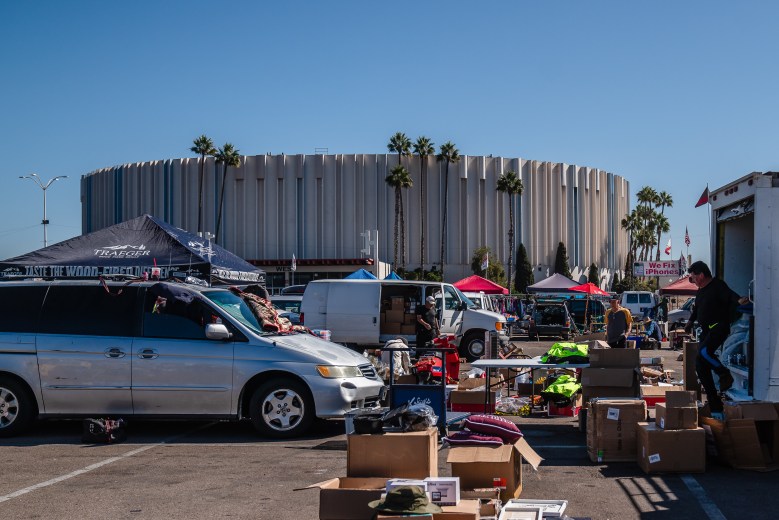
The Midway Rising project may not create 2,000 “net-new” affordable housing units, as city staff wanted from developers.
As the nearly four-year negotiation with the Midway Rising team came to an end recently, city of San Diego staff insisted the final agreement require them to build new affordable housing and not become a so-called “receiver” site that would accept the housing other developers are required to build because of their own nearby projects.
The final deal, though, now heading to the City Council with a committee hearing Friday, does not include that requirement. As the proposal stands, developers of projects within a three-mile radius could pay the Midway Rising team to build the affordable housing the city requires them to build.
The three-mile radius stretches into Mission Hills and even Bankers Hill and north into Clairemont.
City staff now believe that could jeopardize the project. State housing officials may raise red flags if the project does not create “net-new” affordable housing above and beyond what other projects are required to build.
“City operations does support putting clarifying language in the final agreement,” said Christina Bibler, the director of real estate and airport management for the city. “The city is very interested in these being net-new affordable housing units and we want to meet the City Council’s desires to ensure we receive 2,000 new affordable units.”
The proposed development and lease agreement with Midway Rising is not ambiguous: The developer will build 2,000 units of affordable housing which will make it the largest affordable housing development in the state of California. The documents are exhaustive in how many milestones and minimums the developer must meet before moving on to profit-making construction.
That is one of the three main selling points of the deal: In exchange for low-rent and rent that is deferred, the developers will provide the city a new arena, infrastructure with the potential to help revitalize the entire neighborhood and thousands of units of affordable housing – some built especially for families.
Opponents are insistent the affordable housing component is a mirage. Danna Givot, from the group Neighbors for a Better San Diego, decried the lack of penalties in the plan if the developer does not deliver new housing. The proposed agreement is specific on how much of the total housing must be affordable and the project will halt or fall apart if the developer doesn’t build them.
“There are no penalties for failure to produce 2,000 units of affordable housing at any point in time. It is unclear who would be responsible for completing those 2,000 units if the developer fails to do so,” she said.
But the incentive to build the affordable housing is that they don’t get to build the profit-making things they want to build. That’s not enough, Givot said, and she worried about a future where the city is left with a half-completed project and none of the promised benefits.
Bibler said the negotiations produced an airtight agreement, reflected in the Disposition and Development Agreement, or DDA: The developer will not be able to move along to profitable housing without meeting minimum affordable housing targets along the way.
She said they had the state Housing and Community Development Department, or HCD, review that section and they signed off on it.
“It was a criteria to add to the conversation that helped to validate that at no point can you go below bare minimum of (Surplus Lands Act) minimum affordable housing targets,” she said.
The Surplus Lands Act has loomed over the project from the very beginning. After a legislative amendment, it forced cities to require significant affordable housing on land they sell or lease. HCD, enforcing the Surplus Lands Act, scuttled the first exclusive negotiating agreement the city forged with a developer and then oversaw the new process that culminated in 2022.
That’s when Midway Rising won the bid to become the exclusive negotiating partner with the city because of its promises about affordable housing. And there was a widespread assumption that the project would deliver new units.
But that is diluted if other developers pay Midway Rising to build the affordable housing they’re required to build.
When city staff insisted that the agreement with Midway Rising prevent that and assure the public it won’t be used as a receiver site for other developers, they were told it wouldn’t fly. It may come up as an issue with the City Council.
And then the question goes to the Midway Rising team: Would they still want the deal?
The Midway Rising partnership includes affordable housing developer Chelsea Investment Corp. Leaders there believe not allowing developers to put their affordable housing at Midway Rising removes a valuable way to pay for it. It’s notoriously difficult to cobble together the many different affordable housing financing tools.
“Midway Rising is unequivocally committed and bound to deliver all 2,000 affordable housing units on-site, and it’s important to explore all available tools to expedite their construction,” Charles Schmid from Chelsea said in a written statement. “The City will consider the first wave of project agreements over the next few weeks with the affordable housing documents to be approved later. We will continue working closely with the City and the California Department of Housing and Community Development to deliver this much-needed housing for working families.”
In all of this, what is the need for a 16K replacement arena? With all the other venues available in the county, this has never been explained. From now til April 10, about 6 months, 55 events are scheduled, most of them being the Gulls. And I doubt any of these events would be sold out now. The deal tosses out ticket sales, but what of maintenance and operational costs? The city gives up 2 mil a year for 20 years to get back 2 mil later. The IBA’s office also estimates the city will collect between $38.1 and $68.5 million in combined arena and development revenue over the life of the 105-year deal. There’s a lot that can go wrong over 105 years while dealing with the Ash St and homeless shelter brainlessness group running the city who will be long gone.
I think this entire project should be canned. The road layout in that area is terribly designed. Unless they have a trolley connecting it to downtown and radically improve the current street layout, there is no point in building anything. Also, do not let developers off the hook for anything. They’ll find a way to fail to meet their side of the bargain.
We’ve lost over 2,000 beach housing units to Airbnb conversions. The majority of them were cottages and apartments – i.e. naturally occurring affordable housing. Reforming our vacation rental ordinance to meaningfully limit the number of vacation rentals allowed per landlord would be a very cheap way to gain nearly 2,000 housing units.
Minor correction. Christina Bibler is not the director of “real estate and airport management.” That name died after the merger of two departments. She’s the director of the Economic Development Department. Real Estate is just a division of that department.