

What We Learned This Year is a reporting series about some of the biggest stories of 2023. Read more here.
This year, many California cities began the monumental task of rolling green plastic bins to every door within their boundaries. Except, they started too late.
The state now requires that the amount of organic food waste being thrown into landfills drop by half come 2020. Most California cities would get there by convincing residents to separate and dispose banana peels, meat bones and coffee grinds into food waste recycling bins.
Rotting organics trapped in landfills is a top source of methane gas in California and usually accounts for over half of total landfill waste. Methane has potent planet-warming power once it accumulates in the atmosphere, even more — in the short term — than carbon dioxide from tailpipes, public enemy number one in the climate change. But San Diego’s landfills leak methane on the regular. It’s not an easy gas to catch.
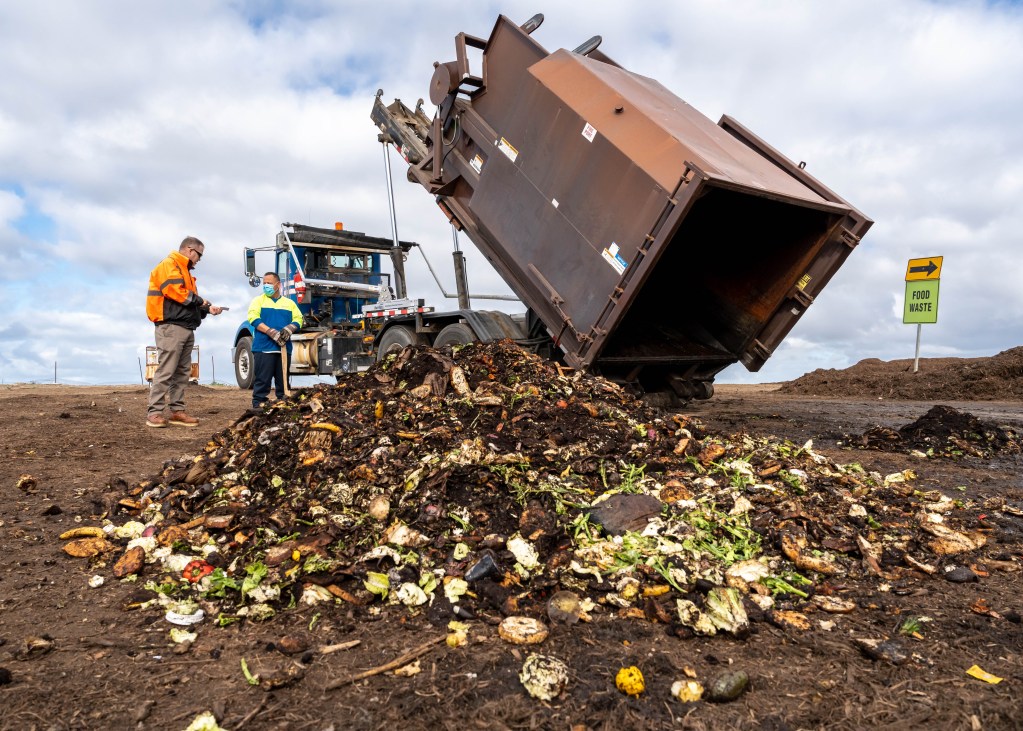
California already blew past its 2020 target date without reaching that goal. In fact, the amount of organics going into landfills by 2020 was increasing, a state oversight commission found. The state’s poised to blow past its next target in 2025, when 75 percent of organics must diverted from landfills.
Part of the reason is that the state didn’t start cracking down on cities until 2022. And by that time, over 100 cities still asked the state for an extension to get their food waste recycling program started.
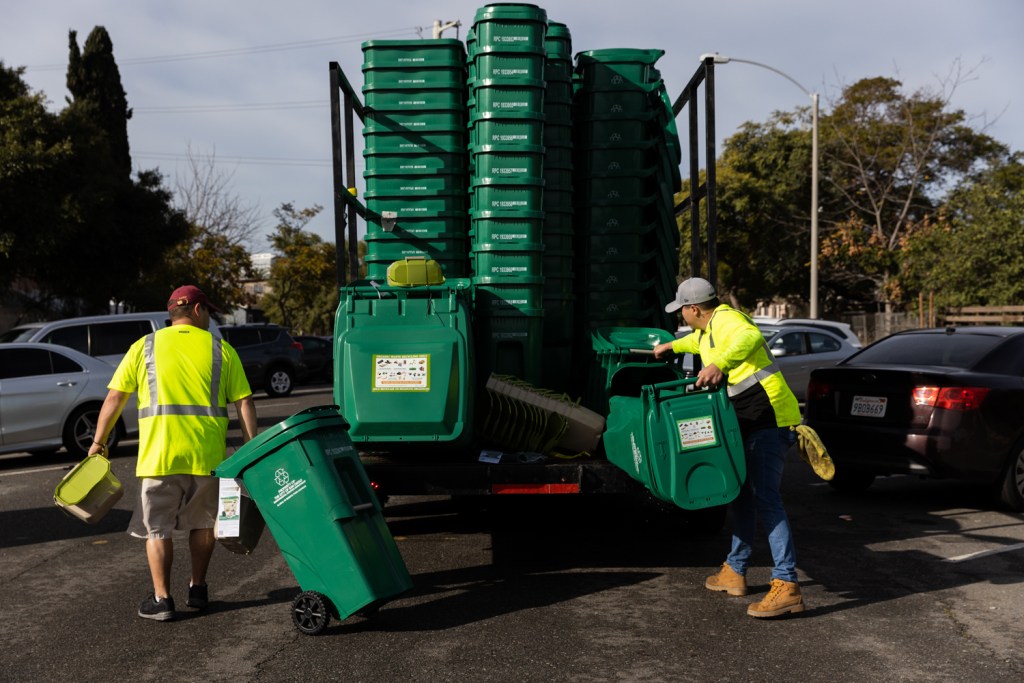
The city of San Diego didn’t begin rolling out green bins until January of this year. The Environmental Services Department blamed some of that on difficulties securing new garbage trucks, plastic pails and receptacles due to lagging supply chains, a byproduct of the COVID-19 pandemic.
But the department also needed to hire 100 more people for the department, including 40 sanitation workers, and take out debt to cover over $100 million in costs that come with the unfunded mandate by the state. Plus, the city is planning to build a food waste recycling facility at the Miramar Landfill to handle all the new material.
Then there’s the task of teaching residents to rethink how they generate waste. It was clear to me, after following the first green bin distribution truck through the Grant Hill neighborhood in January, that many residents had little clue how to fill a green bin. No one seemed upset to receive one, however. Many neighbors thought the city was doling out new trash cans – they were half right. I found myself educating the people I interviewed about how they should separate and store food waste in their kitchens.
Then the cost of composting really began to crystallize.
By February, the city raised “tipping” fees at the Miramar landfill to help cover the costs of the program. Dozens of private trash haulers across San Diego, like Republic Services or EDCO, which serve most of the apartment complexes and businesses in town must comply with this law too. If you’re a renter, the landlord probably raised your trash bill to cover the cost of the new green bin collection service. (If you wonder how that’s possible, read my story on ratio utility billing and junk fees at rental properties.)
San Diego Mayor Todd Gloria set even loftier waste goals than the state, but he gave the city a bit more time to reach them. By 2035, the city should be diverting 90 percent of waste at the landfill – that’s trash, organics, couches, mattresses, Amazon packaging. All that.
The city reported it diverted 71 percent of its waste from landfills in 2022. But it was supposed to have already been diverting 75 percent by 2020, under so-called zero waste goals set in 2015. Gloria’s updated Climate Action Plan says the city should be diverting 90 percent by 2035. So, we’ll see how that goes.
Then, there’s the enforcement piece of all this. The state is reluctant to fine cities that aren’t complying with the food waste recycling law. And the city of San Diego hasn’t been cracking down on people who fill their green bins with trash.
I tried to get an end-of-the year update on the green bin program from the Environmental Services Department, but the department declined my request for an interview with its leader, Renee Robertson.
So all we know is what the city released in October: that San Diego collected 71,318 tons of organic and yard waste since January. I have no datapoint to compare that against. But from the monthly tonnage breakdown on a city factsheet, it looks like organics collection ebbs and flows month-to-month with August being its highest collection month at almost 9,000 tons. That may be due to the summer months producing more yard waste than winter months when collection tonnage dropped to 6,843 tons in November.
Data from the inaugural year of the green bin roll out will be complete come 2024. I’m looking forward to seeing the data.
Correction: This story has been updated to reflect that organics waste accounts for half of total landfill waste. And that the city of San Diego’s organics recycling program falls under the Environmental Services Department.
Nobody cares. Homeless don’t belong in public spaces, solve that and I will care about recycling.
In 2020, construction and demolition debris was estimated to generate more than a third of San Diego’s waste. The plan was for 75% of that waste to be diverted by 2025. How well has that diversion been faring?
https://www.sandiegocounty.gov/content/sdc/sustainability/news/ConstructionDebris.html
Honestly I never heard of this. I live in National City And I never heard of the green bins. Our building doesn’t have a green bin to begin with. I’m sure I’m not the only one that doesn’t know what’s going on in the city. How are people supposed to recycle correctly when there’s no easy access Information about it. Can’t help if we don’t know.
This program doubled the cost of trash hauling at multi family buildings. The new green plastic bins are made of oil based materials. There are twice as many refuse trucks on the road as before the program was started. The only bright spot I can see is additional hiring at private haulers and an increase in city sanitation workers.
EDCO claims to convert the green and food waste into natural gas that powers their trucks. That sounds like a wonderful and clever solution. I’d like to see a report on how that works and perhaps take a tour of the EDCO plant that converts compost to natural gas. We were concerned that mixing the greens and food waste would attract insects and other critters, but those fears never materialized. It took us a little time to get organized but now the food waste disposal is easy and just part of our routine.
Google Online Work is a popular term that refers to remote work opportunities offered by Google. Here 900$ In 5HR. This type of work can be done from anywhere in the world, as long as you have a reliable internet connection. ww While working for Google online can be an attractive option for many people, there are both advantages and disadvantages to consider.
Here see ………. https://GooglerefersWork.blogspot.com
Re: Green bins/ food waste.
Law of unintended consequences?
“Since 2012 MCAS Miramar has used methane gas produced by the San Diego Landfill to create renewable electricity. Seeing the potential to enhance their use of renewable energy sources, the air station partnered with the Department of Energy’s National Renewable Energy Lab in 2011 to create a microgrid design concept, which was ultimately awarded, designed and built by Schneider Electric and Black & Veatch.”
https://www.marines.mil/News/News-Display/Article/2677033/microgrid-at-marine-corps-air-station-miramar/
Methane from the Miramar landfill should plumment?
I’m always pretty stunned at how disengaged and oblivious people can be for something so simple and beneficial. Composting prevents methane formation, a greenhouse gas that is 80x as potent as CO2. I even see a “Meh, who cares” here. How hard is it? Put the food waste and yard greens in the green bin. You can put the food waste in a paper bag if you want to keep it contained in the bins you don’t have to rinse it.
I would use a green bin if we had one! I live in an apartment complex in Chula Vista and have been waiting and waiting to get some information and a notice that we will be starting the program… still nothing! I really want to contribute, but I don’t even know who to contact and ask about it. My rent keeps going up every 6 months, though… >:-(
It would help GREATLY if there was a way to include restaurants in this program. I work at a small (8 table) restaurant one day a week, and in that one day we throw as much organic matter into the trash as my house puts in our green bin over the course of three months. And I’m diligent about separating things at home.
The state made the decision to make waste handling more difficult for it’s residents AND making us pay for the new responsibility. If you want to change the landfill F’ing pay your residents or give us tax credits for doing the additional work at home. How is anyone confused the state raised the prices and put the responsibility on us. How about the state sort our trash, these green bins smell like hell in the summer and we are not incentivized to do anything extra
Thank you, MacKenzie. Reducing food waste and diverting organics from the landfills is the low hanging fruit of climate change remediation and getting people on board and educated is an important step in the right direction.