
We’re officially down to three possible route options for the proposed Del Mar train tunnel, and North County leaders and stakeholders are making it known which options they love and which ones they hate.
Earlier this month, the San Diego Association of Governments, the region’s transportation agency better known as SANDAG, released three route alternatives for the tunnel, narrowing the choices down from more than a dozen options.
The plan is to move about 1.7 miles of the train tracks that run along the edge of the Del Mar bluffs into an underground tunnel. It’s called the LOSSAN Rail Realignment project.
Right now, the project has an estimated price tag of about $4 billion, and that’s only a small piece of SANDAG’s larger 40-year, $160-billion regional transportation plan.
Most elected officials agree that SANDAG eventually must move the tracks. The bluffs recede at a rate of 6 inches annually, and in some spots in Del Mar the rails are just a few feet from the eroding cliff.
But what some elected officials and many residents can’t seem to agree on is where the train tracks should be moved.
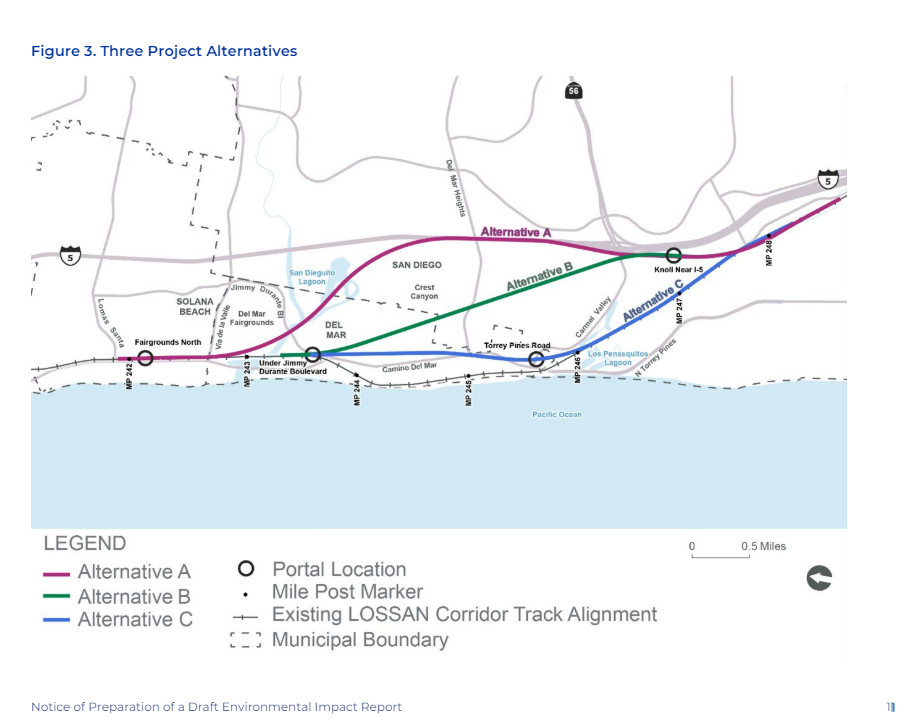
These are the three route options being considered:
- Alternative A, which starts from a north portal in Solana Beach at the edge of the Del Mar Fairgrounds, goes under the San Dieguito Lagoon, then along Interstate 5 to a south portal near I-5 at the edge of San Diego.
- Alternative B, which goes from a north portal at Jimmy Durante Boulevard under Crest Canyon to the same south portal near I-5.
- Alternative C, which also would go from the Jimmy Durante portal, roughly along the line of Camino Del Mar, to a south portal at Torrey Pines Road.
Del Mar
Most Del Mar residents and some Del Mar elected officials are leaning toward Alternative A.
The Del Mar City Council discussed the route alternatives on Monday with some members, including Deputy Mayor Terry Gaasterland and Councilmember Tracy Martinez, indicating a preference for Alternative A because it would impact the fewest number of homes and may not require eminent domain.
In California, eminent domain gives the government the power to take property and use it for public use, even if owners don’t want to sell. SANDAG officials have said that some properties near the portals may need to be acquired through eminent domain, the Union-Tribune reported.
“I don’t support eminent domain, I don’t support a tunnel going in our cliff side, I think it would be just devastating,” Martinez said. “Even if it isn’t exactly A, but a portal that goes underground that doesn’t take homes would be beneficial.”
Alternative A is also most Del Mar residents’ preferred choice. It’s an option most residents proposed in past community meetings. That’s because it runs near the I-5 and would keep the tunnel away from most homes.
But as Danny Veeh, a rail planning program manager for SANDAG told the U-T, this route would require the longest tunnel and, as a result, would cost nearly twice as much as either of the other two routes.
Councilmember Dan Quirk, who has consistently been the dissenting voice when it comes to the train tunnel and San Diego’s rail line, said he is opposed to all the route options and doesn’t “believe that any tunnel is justified.”
Solana Beach
Just north of Del Mar is another small coastal city that’s now entering the chat.
After SANDAG released the three route alternatives, leaders of Solana Beach were surprised to find out that one of the options would extend into Solana Beach. That option happens to be Alternative A, Del Mar residents’ favorite.
Solana Beach Mayor Lesa Heebner told Voice of San Diego she was aware this was one of the earlier options, but she was not expecting it to be one of the final three alternatives.
“They held probably four or five workshops or council meetings in Del Mar and had office hours in Del Mar, but our community certainly was not communicated with at all,” Heebner said. “I knew that this was an idea that was out there … the fact that it was included at this level of study was what was shocking.”
She said this option could destroy hundreds of millions of dollars in infrastructure investments that were made years ago and that are planned and funded for the future. These include homes, a bridge and previous projects that upgraded the tracks in Solana Beach.
Heebner sent an email to Solana Beach residents urging them to participate in SANDAG’s 45-day public comment period to help “shut down” this route alternative.
Del Mar Fairgrounds
There’s another entity that could be heavily impacted by SANDAG’S Alternative A option: the Del Mar Fairgrounds.
The 22nd District Agricultural Association board, which runs the Del Mar Fairgrounds, previously made it clear in a statement that it strongly opposes the idea of a tunnel running underneath the Fairgrounds property, especially if it “impacts operational, economic, environmental, and planning needs at the Del Mar Fairgrounds.”
If Alternative A is chosen, there’s also a possibility it could impact the city of Del Mar’s efforts to build an affordable housing project on the Fairgrounds property.
Let me explain: The city of Del Mar has been banking on a proposed affordable housing project on the Del Mar Fairgrounds property to fulfill its state-mandated affordable housing requirements.
Del Mar has to accommodate 113 affordable housing units to meet its Housing Element goals. A Housing Element is a state-required plan outlining how a city can accommodate enough new housing to meet its population’s needs.
The city has been working with the 22nd District Agricultural Association for more than a year, and the two parties entered negotiations in February to build an affordable housing project on the Fairgrounds that would yield 61 lower income units.
But according to a statement from the 22nd District board, the “property may be unable to serve as an affordable housing site for the city of Del Mar should a plan move forward to run train tracks through or across District property.”
Tristan Hallman, chief communications officer for the Fairgrounds, told Voice via email that the Fairgrounds fully depends on revenue from its events and activities, so having two massive construction projects on the property at the same time would not be feasible.
“The San Diego County Fair and other beloved events would be radically altered by the construction of a train, which appears to involve the digging of massive trenches on a critical part of the Del Mar Fairgrounds property,” Hallman said. “That would almost certainly eliminate any ability for the district to plan for the construction of affordable housing, which would already be a complex undertaking without a billion-dollar construction project in the Fair’s midway area.”
In Other News
- ICYMI: 75th Assembly Candidate Carl DeMaio submitted zero signatures for five previous statewide ballot initiatives to the Secretary of State, automatically disqualifying them from election ballots. (Voice of San Diego)
- Results from a community survey of Escondido residents showed 57 percent of voters would be OK with regulated cannabis businesses, including dispensaries, operating within the city. (Coast News)
- Carlsbad’s desalination plant, which provides 10 percent of San Diego County’s drinking water, will get $19.4 million for the construction of its new seawater intakes as part of $142 million in federal grants for water projects throughout the West. (Union-Tribune)
VERY WELL; I like it !
Alternate A is honestly the only one that makes sense. the fairgrounds is exaggerating. they can tunnel without trenching a large section as they claim. The hole is normally just wide enough to fit the TBM. heck, there are specialized rectangular tunnel-boring machines that avoid the issues of normal TBM’s have. Even so, if push comes to shove, the fairgrounds can be moved and the tracks can be above ground
The California Coastal Commission has told all coastal cities to make a plan for managed retreat. In response, some local governments have so far rejected the strategy in their adaptation plans. Those include Imperial Beach and Del Mar in San Diego County. This is not a matter of if, it is just when this will happen to ocean view homes up and down the coast.
“The region’s coast is eroding at 6 inches annually.” equates to 5 feet every decade. Generations of armoring and sand replenishment paid by California taxpayers have kept homes from falling off the cliffs for now (numerous backyards have already collapsed) and flooding in Del Mar, Solana Beach, Leucadia & Oceanside.
https://law.lclark.edu/live/blogs/228-rising-sea-levels-and-california-coastal