

Local officials scrambled over the last few days to assure the public that a fire at San Diego Gas and Electric’s energy storage facility in Escondido was not harmful despite the city’s evacuation orders and a torrent of panic on social media.
Escondido Battalion Chief Tyler Batson told me air monitors brought to the scene never picked up any dangerous levels of harmful pollutants one might worry about during a chemical fire of this kind.
Mayor Dane White, who is in favor of a battery ban, raised doubt.
“My question is WHAT is SAFE and What is NORMAL – I have requested the official data to be shared with the public who can determine for themselves what is safe and what is not,” White wrote in a Facebook post. “Many residents as far away as coastal cities have reported headaches, nausea, dizziness and a handful of other symptoms.”
The Air Pollution Control District, which investigates odor complaints and monitors air quality for the region, disputed those claims. It said any odors in North County weren’t linked to the battery fire.
“Honestly a car fire is more toxic,” said Rob Rezende, the region’s alternative energy emergency response expert. “There are additional chemicals in batteries that add to its toxicity, but they don’t travel that far.”
Even during the multi-day burn of a fire at an Otay Mesa battery facility, air monitoring instruments never reported any elevated air toxicity more than 15 feet away from the burn, Rezende said. That’s because the chemicals that burn from lithium-ion fires become lighter than air and float vertically into the atmosphere before dissipating, he confirmed.
About the evacuations: The Escondido Fire Department initially issued a mandatory evacuation order on a 300-foot radius from the battery site. The batteries are built on a parking lot next to landscaping, towing and automotive companies in an industrial part of town. The department later said anyone in a three to four block radius east of the battery site (due to the wind direction) should shelter in place, including around 500 businesses and 1,500 customers and employees.
The handful of schools at Escondido School District that canceled classes Friday did so on their own accord, fire officials said. The district never responded to a request for comment.
Anyone beyond that range that got an automated call from the Escondido Police Department – some as far as Fallbrook, 26 miles away, received one – that was a mistake, confirmed Ryan Hicks, a lieutenant with Escondido police. Something went wrong with their automatic notification system and an emergency evacuation order went out over an overly-broad area, he said.
Bad timing: We don’t yet know why SDG&E’s facility caught fire, but it couldn’t have come at a worse time for supporters of the facilities and those who think they are vital to a clean energy future. The county Board of Supervisors discusses whether to ban batteries at its Wednesday meeting.
The 30-megawatt facility was built in an industrial part of Escondido next to a substation, its connection to California’s power grid.
By coincidence, I toured the facility just hours before it ignited. The day I visited, the outside temperature surpassed 100 degrees Fahrenheit. The first thing I noticed, upon descending from my air-conditioned car to the scorching pavement of the battery site, was the din.
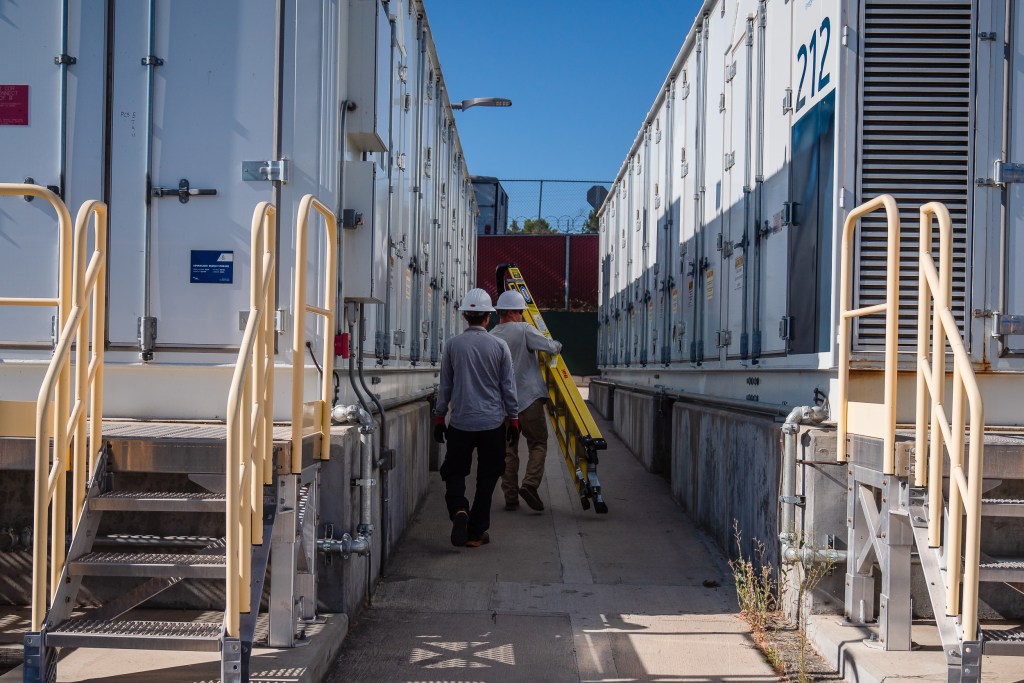
It was a deafening whirr roaring from 24 mega-air conditioners sitting atop the 24 lithium-ion filled shipping containers. My SDG&E escorts swung open the doors on one container revealing what looked like stacks of black VCRs, each a block of lithium-ion battery that can suck energy off California’s electric grid and store it for later use. The A/C units run non-stop to cool the air inside the containers so the battery doesn’t overheat.
These batteries already generate a small amount of heat by doing what it’s supposed to do: store and discharge electricity. But if the batteries heat up too much, either because they’re overcharged, or are in too hot of an environment, or get damaged – a fire can start.
Worst case scenario, a burning battery is next to another (be it stacked within a large scale storage container or two iPhones charging next to each other) triggering a chain reaction called thermal runaway. That’s what happened in Otay Mesa where a fire took several days to put out.
Conventional firefighting methods – dousing fire with water or covering it – don’t work. Traditional fire needs oxygen to survive. Cut off the oxygen source, and bye-bye fire. Battery fires are chemical fires. The fire is a result of that chemical reaction; so firefighters have to wait for that reaction to end.
SDG&E built the facility in 2017 – that makes it an old battery storage site compared to technology available now. When it opened, it was the largest facility of its kind in the world, soon to be beaten by one opened in Australia six months later, SDG&E officials told me.
They’ve become a lot safer.
A May report from the Electric Power Research Institute tracking battery failures worldwide showed the rate of battery fires or explosions dropped considerably given the enormous amount of batteries being built in recent years to support renewable energy demand. Between 2018 and 2023, failures of grid-scale batteries (the kind we’re talking about in this article) dropped by 97 percent.
While these large battery storage facility fires are dramatic and attention-grabbing, they occur less frequently than fires started by lithium-ion batteries in cellphones, electric scooters and bicycles and electric vehicles.

Batson, from Escondido fire, said the department had been keeping their eye on the SDG&E facility because it was considered “old” by technological advancement standards in the battery industry.
“But all the (battery) fires we’ve seen here before have been vehicles and bicycles lighting something else on fire,” he said.
Californians with solar on their rooftops are adding batteries inside their homes more and more. It helps those homes go off-grid, save on electric bills and reduce demand on the energy grid in general – which can get over-energized when demand is high (during the summer heat waves). That’s when utilities shut down parts of the power grid, called brown or blackouts, to prevent fires.
SDG&E doesn’t control when their battery charges and dispenses power back onto the grid. CAISO, California’s state grid operator, does. I reached out to CAISO about what this battery was doing, charging or discharging, around 12 p.m. when it caught fire.
The SDG&E reps told me the battery was probably charging, as most do during the day when the sun is shining and California’s vast amount of solar arrays are generating more power than the state can store. CAISO wouldn’t confirm for me either way.
All the assurances don’t matter. What the public is seeing is multiple fires at battery storage sites that burn for days. Politics is a game of perceptions, the public perception is that battery storage sites are dangerous, I don’t want them in my community. I want them banned!
The assurances don’t matter. Politics is a game of perceptions. What the public is seeing is that battery storage site catch on fire and burn for days. Everyone knows smoke is bad. The public is not going to want any battery storage site in their community because they are dangerous. They are going to want them banned.
Why didn’t the writer state the battery chemistry? This is the most important detail in any case of battery fire. There are 7 different commercially available lithium battery chemistries 5 of which are a fire hazard in thermal runaway. Lithium Iron Phosphate and Lithium Titanate, are not. If you allow blanketing all lithium-ion batteries as being a fire just waiting to happen, you do a a great disservices to products that are trading off energy density for safety and reduced toxicity.
Lithium Iron Phosphate is definitely NOT immune to thermal runaway and when it is in thermal runaway it burns hotter and toxic. Given this was built in 2017, and Samsung SDI supplied the batteries, I’d guess it is NCM.
https://youtu.be/YvQ9NEw76G8?si=Q4eUMBQ7029uhTjh
The last report I saw said that the Escondido battery fire was not the cause of the extremely noxious smell that fell over most of western North County on Friday afternoon (9/6/2024), but that they didn’t know what caused San Marcos, Carlsbad, Vista, Encinitas (the cities that I know of based on reports) to experience a dense smokey haze and a foul chemical smell. They still haven’t reported what that smell was.
Based on this article, a lithium fire burnt chemicals up in the the atmosphere on a Thursday. So, couldn’t it come back down to earth the following day?
NAME THE SMELL! If it was a car fire, or some warehouse or something, fine, but put a name on it. It covered dozens of square miles. It was horrible and toxic, and it was around for hours. I was reminded of when that Navy ship burned down in South Bay.
Always amazing that those who are such proponents and, in some case, profiting, with these installations never seem to live in the affected areas. Not unlike our California politicians pushing laws, regulations and mandates, but who live far away in their ivory towers. Then when the unthinkable happens they quickly shy away from any responsibility and accountability.
VOSD misses the mark every single time lol