
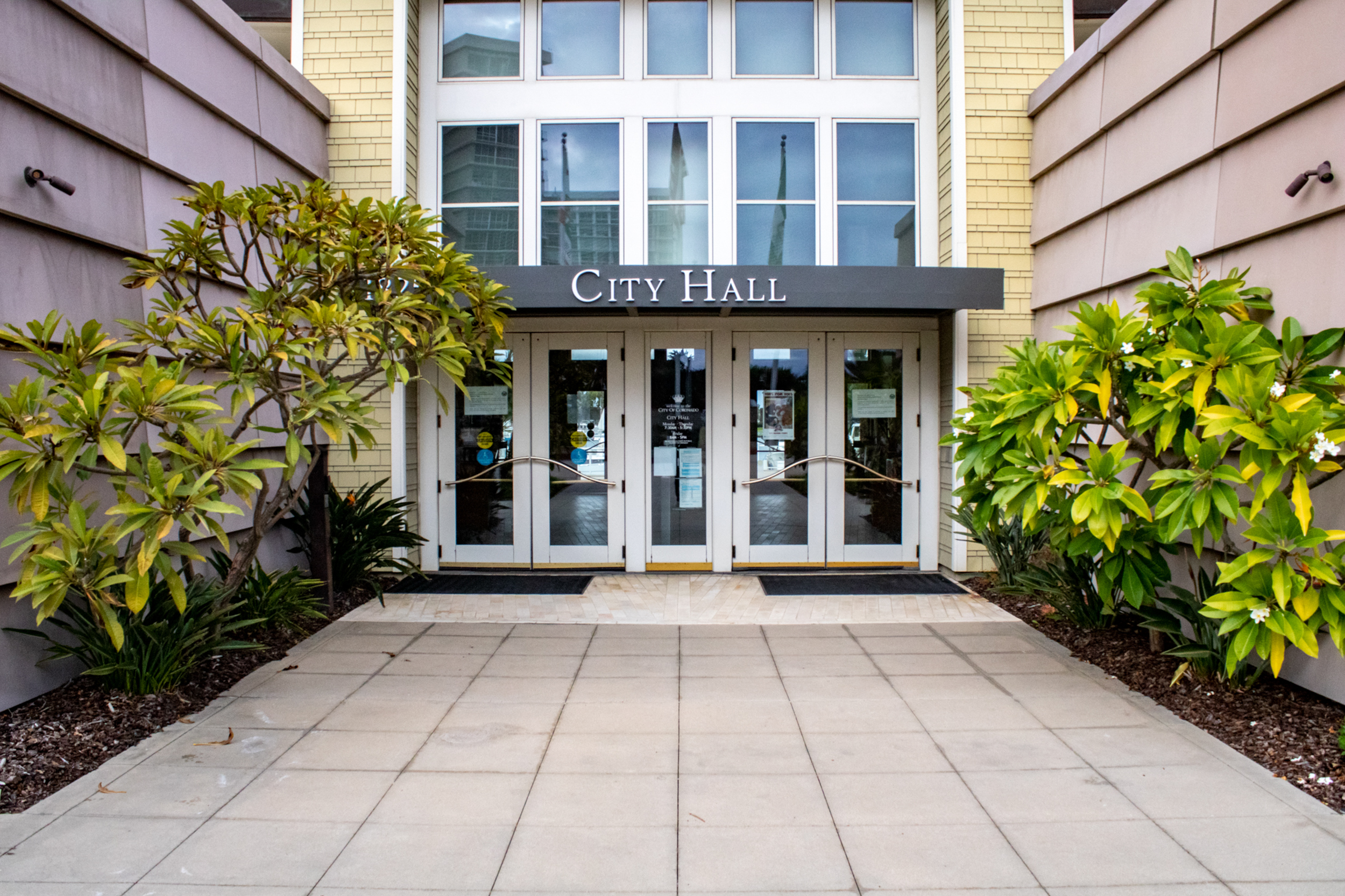
Less than three months after a contentious City Council election that roiled the outwardly placid city of Coronado, residents once again are up in arms about choosing a city leader.
Last week, the City Council appointed a city employee with a long resume of community service to fill the Council seat vacated by newly elected Mayor John Duncan. Kelly Purvis, who oversees arts and culture programs in the city, will serve the remaining two years of Duncan’s four-year Council term.
Purvis, who also has worked for the city’s historical association and participated in the Rotary Club and other community organizations, was approved unanimously out of a field of nine applicants for the vacant seat.
The outcry over her appointment stems not from Purvis herself but from the process by which she was selected. Facebook groups and other community forums are lighting up with outrage that, following a close and bitterly fought election, the Council chose to appoint a replacement for Duncan rather than scheduling a new citywide vote.
Background: At stake in November was partisan control of the five-member City Council. Though Councilmembers are officially non-partisan, the once solidly Republican city has grown increasingly divided in recent years as the number of Democratic voters increases. Those Democrats say Republicans refuse to cede power.
Duncan beat a Democratic opponent in the November mayor’s race, while a Republican and a Democrat split two open Council seats. Critics accuse the Council of using the appointment process to ensure that one of the other Democratic Council candidates — local environmentalist and cannabis entrepreneur Laura Wilkinson Sinton — doesn’t get another opportunity to run. Wilkinson Sinton came in third in the November race, trailing the top two finishers by just 80 votes.
Debate has raged online over whether the Council’s actions constitute a power grab or, as Councilmembers themselves insist, are simply an effort to save the city money and get back to business as soon as possible. Residents point darkly to the city of Poway, where a series of City Council appointments in recent years has led critics to accuse city leaders of using the appointment process to thwart the will of voters.
Duncan and Purvis did not immediately return calls seeking comment.
Much of the ire focuses on comments made at last week’s Council meeting by a local business owner and Republican activist named Brad Gerbel. In a PowerPoint presentation delivered at the meeting via Zoom, Gerbel, who did campaign work for Coronado’s outgoing Republican mayor, accused Wilkinson Sinton, who applied for the vacant seat, of being a repeat liar who “should be disqualified from consideration” for the position.
“The town is pretty upset,” Wilkinson Sinton said. “Brad Gerbel is a known Republican operative” with a record of “attacking me.” Wilkinson Sinton said Gerbel collaborated with Duncan to sabotage her application for the vacant Council seat by presenting the PowerPoint at a time in the meeting when Wilkinson Sinton, as an applicant, was unable to respond.
In the PowerPoint, Gerbel accused Wilkinson Sinton of falsely claiming she owns no cannabis businesses and trying to circumvent the appointment process by delivering a letter to Duncan urging him to appoint her to the vacant Council seat before the Council had even decided whether to hold an election or fill the seat via an appointment.
Asked about those accusations, Wilkinson Sinton insisted she owns no cannabis dispensaries, though she conceded she had applied to open three dispensaries in Chula Vista and National City.
As for the Nov. 26 letter to Duncan, Gerbel included a photo of the letter in his PowerPoint presentation, which he said he obtained via a public records request. In the letter, Wilkinson Sinton says Duncan should appoint her because it would be a “savvy move” that would ratify the will of voters in November and avoid “the impression of cronyism and back-room deals.”
Asked why she urged Duncan to appoint her even though she considers appointments undemocratic, Wilkinson Sinton said, “I knew they wouldn’t” hold a special election. “They would have said it would cost too much.”
In an interview with Voice of San Diego, Gerbel denied he colluded with Duncan or sought to defame Wilkinson Sinton. “I never talked to John Duncan,” he said. “When I caught Laura Wilkinson Sinton being untruthful with the people of Coronado, I called that to voters’ attention…The heart of the issue with Laura Sinton is trust.”
Wilkinson Sinton praised Purvis as a well-liked community leader and said, “She’ll do a fine job. Shes a good choice. She’s just not the people’s choice. She’s the Council’s choice.”
Border Fire Rattles Community
For about 36 hours, life stood still on the eastern urban edge of South County as a fast-moving wildfire that ignited Thursday in the Otay Mountain Wilderness raced toward petrified residents in communities near the Otay Reservoir.
Crowds gathered last week at Mountain Hawk Park adjacent to the reservoir to watch nervously as flames advanced through brush a few miles away and plumes of black smoke billowed into the sky.
The Border 2 fire, whose cause remains under investigation, grew in just 24 hours to more than 6,000 acres. Fanned by hot, dry winds from the east, the fire at first appeared as if it could advance beyond the reservoir and burn neighborhoods in southeastern Chula Vista, which is home not only to several master-planned communities but also numerous schools, the main campus of Southwestern Community College and an Olympic athlete training center.
Residents were warned they could be asked to evacuate and several schools in the area were closed Friday as a precaution.
Ultimately, a combination of changing winds, rain and the efforts of hundreds of state and local firefighters kept the flames at bay. There were no reported injuries or structure fires. As of today, the fire was close to three-quarters contained.
“Thankfully, the winds did an about-face,” said Chula Vista City Councilmember Michael Inzunza, whose district includes neighborhoods threatened by the fire. Inzunza said he spent Thursday evening and the entire day Friday at Mountain Hawk Park, where he answered residents’ questions, spoke to television news crews and received updates from city fire officials.
Chula Vista Mayor John McCann also dedicated much of his day Friday to the fire, issuing updates and visiting a staging area at the Olympic training center. “The fire department did a stellar job,” McCann said. “We were better prepared than Los Angeles.”
Big Dreams for Little Corner
More than two dozen local residents gathered on Monday at the Lincoln Acres Community Center to envision a new future for a vacant lot that, in recent months, has generated far more controversy than its small size might seem to justify.
Calling themselves “Neighborhood United,” the residents turned out to share their hopes for what might become of a .68-acre patch of grass and dirt at the corner of Orange Street and Sweetwater Road in National City. The lot, which has seen development proposals come and go over the years, is “a huge eyesore,” said Luisa McCarthy, a member of the group and executive director of nearby La Vista Memorial Park cemetery.
Late last year, many of the same residents packed a National City planning commission meeting to protest the latest development proposal for the site: A combined car wash, gas station, liquor store, drive-through restaurant and apartment complex.
The somewhat unconventional combination — the apartments would sit above the drive-through and adjacent to the car wash — was denounced by residents as too big, too unsightly and too likely to increase traffic congestion in an area that already slows down for funeral processions and a nearby onramp to Interstate 805.
A divided planning commission ultimately voted the project down in December, a vote confirmed by the City Council later that month.
McCarthy called the failed proposal “freaking outrageous,” the latest in a series of such proposals that she said fail to consider what neighborhood residents want in the area. “Nothing has been done for so many years,” she said.
McCarthy and her neighbors recently took things into their own hands, commissioning an architect to draw up a conceptual plan for the site. The plan includes a compact three-story building with housing units on the top floors and room on the ground floor for a cafe, a market, a gymnasium or some other use more in tune with community preferences. That’s what Monday’s meeting was for—to solicit neighborhood ideas for the building’s ultimate occupants.
“Everyone loved it,” McCarthy said of the concept plan. And everyone had ideas. Several spoke of a lack of services for older residents. Others said they wanted a place to buy fresh food, “not vapes and alcohol,” McCarthy said. Speakers at the event included representatives from a local service provider to seniors and a representative from Olivewood Gardens, a historic home in National City that has been converted into a nutrition education center.
One notable absence: Developer Adeeb “Eddy” Brikho, a local gas station entrepreneur who proposed the project nixed by the planning commission last year. Brikho said he had shelved his proposal and did not plan to submit another one.
“I’m very disappointed that they didn’t like the project,” Brikho said. “The corner is there, and it’s been sitting empty, and hopefully someone can come by and develop a vision for it. At the end of the day, we were just trying to make the corner a better corner. If the community is not happy with it, so be it.”
If Neighbors United succeed in their goal of finding a developer for their concept and persuading the property owner to go along with it, their effort will represent a remarkable instance of community-powered development at a time when most development projects often seem disconnected from the preferences of nearby residents.
“It was really nice to see the engagement of the residents,” McCarthy said. “It’s about the people.”
If you have any ideas or feedback for the South County Report, send them to jim.hinch@voiceofsandiego.org.