
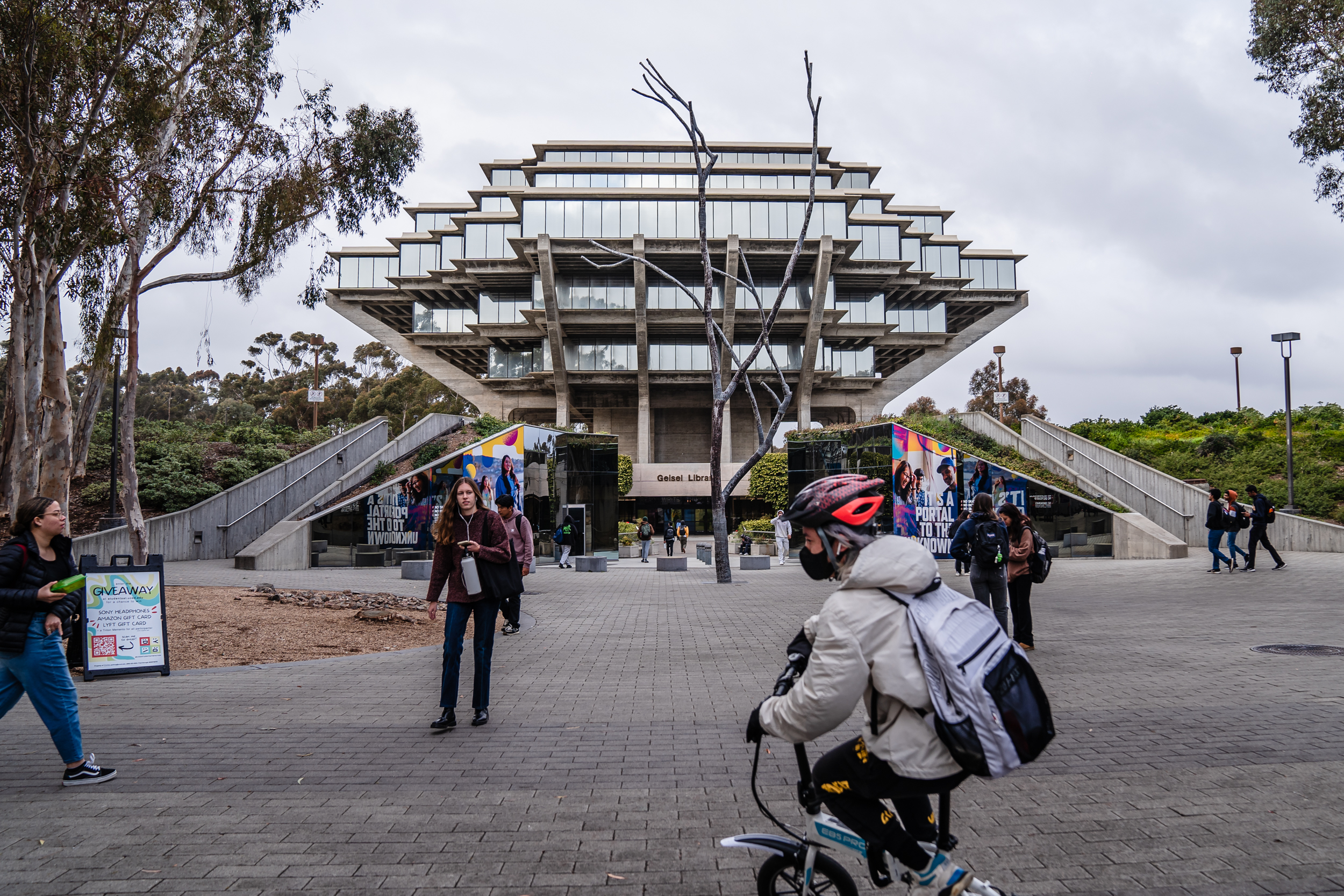
As President Donald Trump has torn through higher education cutting budgets, issuing layoffs, executive orders and grant cancellations, universities have been reeling. Research-focused universities like UC San Diego, that employ thousands of scientists who rely on federal grant funds have been particularly hard hit.
Already, UCSD has seen a slew of funding cuts or pauses. Among them, the Union-Tribune recently reported that the Trump administration ordered more than a dozen clinical trials focused on treating HIV and AIDS to pause and axed a grant that would have funded research into domestic violence inflicted on pregnant women.
Most experts agree the impacts will be significant, but exactly what they will mean is something of a question. An email sent to staff by UCSD Chancellor Pradeep Khosla on Tuesday underscored just how impactful – and how much of a wild card – they were.
In the email, Khosla wrote university officials had received notices of the disruption of funding sources to around 50 UCSD researchers. The university has also seen a “concerning rise,” in delayed payments for projects not paused or cut.
The actions pose a “significant financial risk to the university,” Khosla wrote. Still, they were “unable to predict exactly what the losses will be,” he continued.
“Our initial scenario planning models indicate possible reductions ranging from $75 million to more than $500 million annually. In preparation, I have asked budget offices to model a 2.5% to 12.5% budget reduction based on these initial scenarios,” Khosla wrote.
Those estimates included prospective losses due to the impact of an 8 percent cut in state funding for the entire UC system.
Khosla outlined a series of actions the university was taking in the face of the shortfall, like a hiring pause for the university and its network of hospitals and indefinitely delaying multiple construction projects.
But the wild range of the estimates reflects a grim reality at research institutions: that the mess of unknowns may be doing just as much damage as the confirmed cuts. And while grant cancellations will have some very direct impacts, the chaos could produce a whole set of downstream ones.
Among the myriad potential impacts:
- Fewer graduate students are being accepted to universities like UCSD, choking the supply of future scientists. Some of those who have been accepted were offered only conditional acceptance, meaning they’re being asked to move across the country without the guarantee that funds to support them will be there.
- Because of the cautionary hiring freeze issued by UCSD, researchers may be unable to replace staff in labs, which could lead to research grinding to a halt even if grants remain intact.
- Researchers and graduate students aren’t the only ones hit by freezes, everyone who works in proximity to the industries is impacted. That includes private companies whose access to highly trained employees may be starved. For a biotech hub like San Diego, that could be catastrophic.
- A reduction in foreign researchers coming to America to work, both because of a reduced number of research positions and the Trump administration’s draconian approach to immigration enforcement.
Kina Thackray, is a professor of Obstetrics, Gynecology and Reproductive sciences at UC San Diego. She has been involved in the Stand Up for Science advocacy movement which is focused on pushing back against the large-scale cuts.
To her, the chaos produced by these actions feels like a watershed moment not only for UCSD, but the future of research in America. Post-World War II, the U.S. government invested heavily in research and science, making our universities ground zero for innovation. But that could easily change.
“Our universities will be shaken to their core if these cuts continue,” Thackray said. “And the longer this lasts, the more dramatic the impact will be.”
Thus far, Thackray’s research lab at UCSD hasn’t been directly impacted by the cuts, but she hasn’t made it out unscathed. She found out Wednesday that NIH funding for a postdoctoral training program had been cancelled.
She’s also been hit by the unknowns plaguing many others in the field. Thackray’s lab partnered with researchers at the University of Pennsylvania on a clinical trial to study the effects of dietary fiber on various bodily systems.
But unfortunately for the researchers, UPenn has become a culture war target. Earlier, this month the Trump administration announced it would be freezing $175 million of the $1 billion in federal funds the university receives because one transgender student had been a member of the college’s swimming team years ago.
It’s still unclear if that grant will be impacted, but the ordeal highlights the corrosive nature of the chaos – and the potential spillover from Trump’s culture war crusade.
“How do you start recruiting patients for a clinical trial if you’re not even sure if the grant is going to continue?” Thackray asked.
What’s made it all the more difficult is the radio silence from officials at the NIH, the federal agency responsible for administering many research grants used by universities. That silence and the chaos of the past few months have sent a deep chill through the research community. For many, the moment feels existential – like the work they’ve devoted their lives to hangs in the balance.
“The emotional toll is quite real,” Thackray said. “It’s like having a hanging sword over your head, wondering what is going to be canceled.”
Content Bouncing Around My Mind Palace
Even given the charged political rhetoric surrounding trans issues, California Democrats rejected multiple bills that would, among other things, restrict trans students from school sports. Strange bedfellows: Some of the conservative lawmakers in favor of the bills quoted Gov. Gavin Newsom, whose anti-trans comments in a recent episode of his podcast has enraged activists and allies.
What We’re Writing
Santee School District is one of just 100 districts nationwide whose students are performing better now than they were before the pandemic, according to a recently released report. Some of the strategies district staff have implemented look similar to those common at high performing schools. But Santee also stands out in one notable way: it was one of the first local districts to reopen after shuttering its doors during the pandemic.
Reporter Will Huntsberry recently dug into dueling corruption allegations at the Chula Vista Elementary School District. The district’s former COO was accused of having an unusually close relationship with a company seeking to do work in the district. That former administrator, however, claims the investigation against him is retaliatory and that it’s really a board member for the district and its superintendent who are embroiled in shady dealings.
Leave a comment