
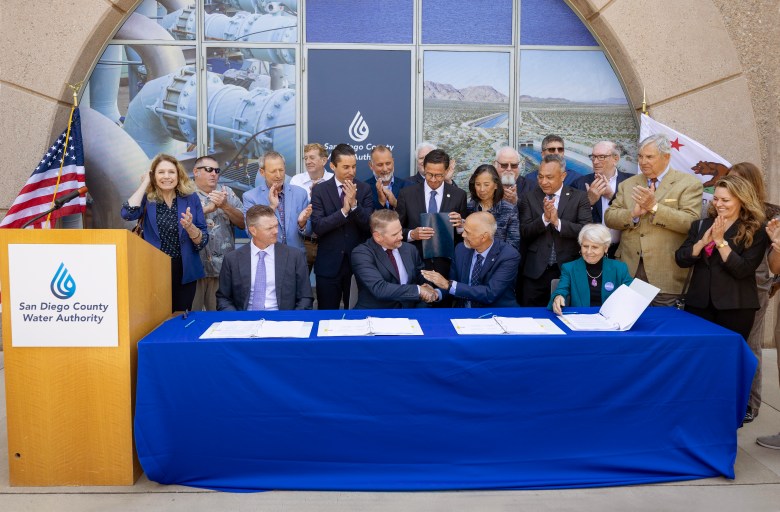
We had a line in this weekend’s post about the big Southern California water legal settlement signed yesterday that got some attention and may actually be a story itself.
I reported that the settlement had laid the groundwork to allow the San Diego County Water Authority to sell some of its abundance of water to other agencies the Metropolitan Water District serves. If San Diego doesn’t have any buyers among them, Met itself could buy the water. And if Met doesn’t want it, then something really interesting could happen.
“Metropolitan has agreed to even allow the Water Authority to sell water out of state, if it’s not needed here,” I wrote.
That was my takeaway from the language of the settlement and from talking to people. That seemed fascinating: Could San Diego someday soon begin selling some of that expensive water we’re pulling from the sea to Arizona? Had we just taken a big step to do that?
No, said Deven Upadhyay, the general manager at Met, who called yesterday afternoon. He wanted me to strike that line and correct it. Met had not agreed to allow the Water Authority to sell water out of state, he said.
He ackowledged that if the settlement hadn’t happened, they couldn’t make any deals to sell water to other states. And he agreed that the settlement made clear there was nothing preventing San Diego from pursuing deals outside the state. But he said Met has not agreed to that yet.
“What we were trying to do with this settlement will allow that but we haven’t agreed to it yet,” he said. “We want to get there. But we would have to approve a deal like that.”
He pointed out that for San Diego or Met to sell water to another state, the list of people and agencies that would need to sign off on it is very long.
San Diego County Water Authority General Manager Daniel Denham doesn’t think the line is incorrect.
What it matters: This could be the beginning of a new era where agencies in places like Nevada and Arizona invest in infrastructure in California – things like desalination plants and wastewater recycling facilities. San Diego already has a desalination plant and it has too much water. And we’re building wastewater recycling plants. Met is also building a wastewater recycling system and it probably could use some investors.
Without doing something radical like declaring insolvency and backing out of agreements to buy water, selling water to other places in Southern California or out of state is the only way to relieve San Diego ratepayers of the burden of paying for these big investments with higher and higher water bills.
So do we strike the line and run a correction? I decided yes. The original post implied the Metropolitan Water District had agreed to do out-of-state transfers of water. It has not yet. The language of the story has been updated.
– Scott Lewis
San Diego’s New Street Parking Rules Are Here
The San Diego City Council on Monday approved a package of new parking reforms that will mean more parking fees.
The package will implement dynamic pricing at parking meters during special events, make it easier for the city to create new meter zones and residential parking permit zones and – drumroll, please – allow the city to charge for parking on Sundays.
The parking reform package is a way to raise revenue for the city of San Diego as it continues to grapple with its $260 million budget deficit
The council voted 5-2 with Councilmembers Marni Von Wilpert and Vivian Moreno opposed. Plans to implement paid parking at Balboa Park were not included in this package.
Border Report: Baja Governor’s Canceled U.S. Visa Raises Eyebrows

It’s been more than three weeks since the U.S. government revoked Baja California Gov. Marina del Pilar Avila Olmeda’s tourist visa, and there’s still no explanation as to why.
In the meantime, speculation about the incident has only grown louder, and so has public criticism of the governor.
Avila and her husband, Carlos Torres, said on social media that they don’t know why the U.S. revoked their visas. The Trump administration has put travel restrictions on some Mexican politicians it suspects are connected to drug corruption, according to a report by ProPublica. But there’s no evidence so far to suggest that is why Avila’s visa was revoked.
Torres is under investigation in both Mexico and the U.S. for alleged corruption, tax evasion and more. Avila has maintained her innocence, Voice contributor Sandra Dibble writes.
“It was an administrative decision, not an accusation,” Avila said in a statement. But many residents aren’t convinced – and at the very least, they want answers.
Meet the Beat: Have you met Deborah Brennan, our Sacramento Reporter, yet?
Join us at our office building on Tuesday, June 17 at 9 a.m. for coffee and a conversation with Deborah about how lawmakers in Sacramento are tackling San Diego’s biggest issues.
This free event is open to everyone. You can RSVP here.
In Other News
- A group of San Diego Democratic lawmakers held a press conference Monday denouncing a surprise raid by immigration officials at a Buona Forchetta restaurant in South Park last Friday. Officials included Rep. Scott Peters, Rep. Sara Jacobs, Rep. Mike Levin, Rep. Juan Vargas and San Diego Mayor Todd Gloria. (KPBS)
- Cuts to the federal Environmental Protection Agency are impacting funding for San Diego’s environmental groups and nonprofits, some of which have had to cut staff, pay and services. (Union-Tribune)
- Early voting begins this week in the runoff election for San Diego County District 1 Supervisor. (KPBS)
- The Headquarters in downtown San Diego is set to be sold to a new owner for $34.9 million, pending approval from the Port of San Diego. (Union-Tribune)
The Morning Report was written by Tigist Layne and Scott Lewis. It was edited by Scott Lewis.
Leave a comment