
This piece was submitted by 16 past chairs of the San Diego Regional Chamber of Commerce: Phil Blair, Nikki Clay, Stephen P. Cushman, William K. Geppert, Benjamin A. Haddad, Robert Horsman, Mel Katz, Lisa Kay, Michael Madigan, Neil Mohr, Vincent E. Mudd, Michael Murphy, Ted Roth, Brian T. Seltzer, Caroline Winn and Thomas V. Wornham.
In late 2024, the U.S. Bureau of Economic Analysis produced some eye-catching numbers about our region. It found our gross domestic product (GDP) had reached roughly $262 billion. That’s bigger than 25 U.S. states and countries like Greece, Hungary and Morocco. It’s proof the path San Diego has been on over the last 30 years – a diversified economy that supports entrepreneurs and working families alike – has had positive results.
Yet that success was not always a given. In the early 1990s, historic drought conditions pushed San Diego’s economy and quality of life to the brink of collapse because of record cuts to our water supply from the Metropolitan Water District, or MWD. We depended on MWD for almost all our water and those cuts were devastating.
San Diego receives less average annual rainfall than Tucson, Arizona and hasn’t had enough local water to support itself since the 1940s.
The water restrictions had impacts beyond shorter showers and brown lawns. Researchers in the biotech space couldn’t clean their equipment. Businesses put bricks in their toilets to lower water use. We were on a path to ruin.
That’s when we said, “never again.” The San Diego County Water Authority brought together a coalition of San Diego’s business, community and government leaders to build the most reliable and drought-resilient water supply in the western United States.
Now, our impressive economy runs on the water the San Diego County Water Authority imports. The security and reliability it provided have allowed our county to flourish across a wide range of industries. Drinking an IPA. Enjoying a strawberry. A staycation at a nearby hotel. A career in biotech. These San Diego experiences are the outcome of the monumental work our region has done over the past 30 years and with an eye toward the next 30.
Once more, our region is facing strong headwinds, this time not from having too little water but too much. The costs of the investments that brought us so much abundance have led some to call for the dissolution of the agency – the San Diego County Water Authority — that our county’s success is built on. This would be a shortsighted mistake that would drag us back to the uncertainty and volatility of the past.
It would be counterproductive as well, raising rates faster than we’d see otherwise.
The lessons learned 30 years ago remain true. As former Chairs of the Regional Chamber of Commerce, we know organizations that innovate, organizations that look to the future and say “why not?” instead of “why?”, are the kind that succeed.
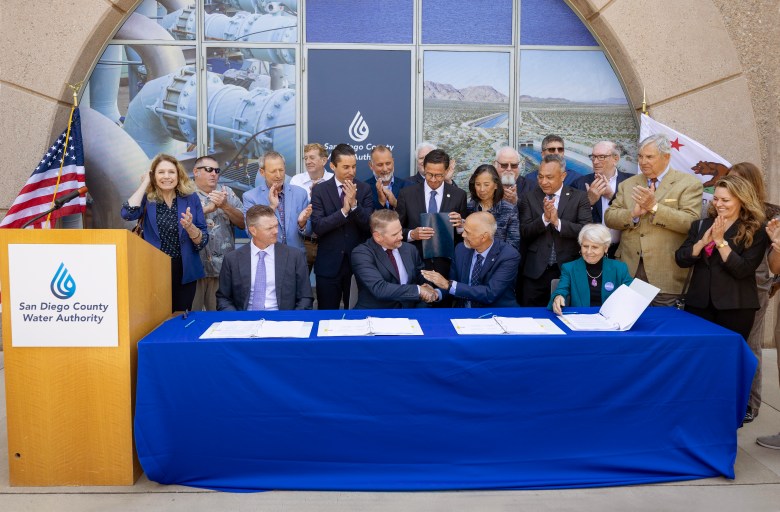
The Water Authority is innovating in a way we can all applaud. Over the last two years, they’ve signed two different water transfer agreements saving ratepayers $40 million. Now they have successfully resolved litigation with the Metropolitan Water District and we can see a future where these kinds of water transfers in California, and potentially across the southwest, are more common. That would be a win for ratepayers and the region.
As supplies are offloaded to the benefit of the balance sheet, we must also pay attention to the other side of the equation: containing costs. We know from experience that we work better together than in silos.
To identify more ways to save money, to help our families struggling with San Diego’s cost of living and water bills and to ensure all our businesses – from farmers to biotech – are able to thrive, we’re calling on a new group of leaders to recreate the coalition that helped San Diego emerge from the early 90s better than ever. As we’ve gone from too little to too much, let’s take a holistic approach to our regional water infrastructure to determine if it’s meeting not only the needs of today but of tomorrow too.
When we are all rowing in the same direction, with input and ideas from across sectors and across the county, we make better decisions with more impactful outcomes. Without the Water Authority, 22 member agencies would be headed in 22 different directions, turning the strength they’ve built together into a weakness.
Our economy didn’t outpace Ecuador or Louisiana through happenstance. It did so because we worked collaboratively. Let’s renew that spirit of community to help the Water Authority chart a better future for all of us.
we conserved when called upon and what was our reward? higher rates because of lower revenues. and it continues. hike after hike now because we have too much water? it’s been upside down for a long time.
Want ? Online jobs that can be done from home. Within a week of applying, I was accepted, and in my first week on the site, I earned almost $7,000. I felt prepared for success because the onboarding evaluations provided me with a clear sense of what to expect.
navigate to My User Name <<<
The costs of the “too large” portion of infrastructure are surely more fairly recovered in proportion to potential demand measured by property value (which is preserved by a resilient supply and delivery system) rather than overcharging/taxing current usage. Charging current users for capacity they do not actually use is the underlying cause of the pricing “death spiral” business model imposed by the short-sighted City.
The San Diego City Council Monday unanimously approved the Residential Tenant Utility Charges Ordinance in a move aimed at protecting renters from unfair utility billing practices.
The new measure prohibits landlords from overcharging tenants for essential city-provided utilities including water, wastewater and waste management services.
The ordinance was introduced and championed by Councilmember Sean Elo-Rivera, who has emphasized tenant protections as part of a broader push for economic justice and housing equity.
Ego-Rivera says don’t cheat us on water when we need it for inflated trash fees.