
Standalove had an appointment scheduled to request asylum in the United States on Jan. 22, two days after President Donald Trump took office.
The Haitian woman had waited in Tapachula, a city in southern Mexico, for the CBP One phone application created by the Biden administration to select her for an entry appointment. She flew to Tijuana in preparation for her scheduled date, and then on Jan. 20, Trump canceled all remaining appointments — roughly 30,000 — and shut down asylum processing at the U.S.-Mexico border.
Since then, she and thousands of other asylum seekers who fled potentially life-and-death situations back home have had to readjust plans as hopes of entering the United States at a port of entry anytime soon vanished. While some have stayed in Tijuana, many have left.
“We have seen people who are not Mexican citizens decide to return to their home country with the thought, ‘If I’m going to die, at least let me die at home in a place that’s familiar with the people that I love,’” said Nicole Elizabeth Ramos, director of the border rights project at Al Otro Lado. “We have seen similarly Mexican citizens, some of them, return to their hometowns for that same reason.”
Many of those who stay are either waiting to see if policies at the border change or if Mexico will recognize them as refugees, Ramos said. She said the process for getting refugee status in Mexico is complicated because many of the people who were waiting for CBP One appointments missed the 30-day window after they entered Mexico to apply for asylum there.
Mexico’s refugee agency, known by the abbreviation COMAR, has a backlog for cases of non-Spanish speakers, Ramos said, due to limited funding for interpreters.
Still other asylum seekers have tried to cross without permission into the United States, putting their lives at risk to sneak into the country or turning themselves in and facing an increasingly opaque system that likely results in deportation.
Ramos said the people who were waiting for appointments were punished for following the U.S. government’s rules.
“You can’t insist so vehemently that migrants follow a set of rules when administrations are constantly changing the rules to the detriment of migrants,” Ramos said. “That is not a system in which migrants or the public in general can have confidence, so promoting respect for the rule of law begins at home with the officers who are required to uphold it.”
People have experienced assaults and attempted kidnappings as well as medical complications because they were unable to seek asylum at ports of entry, Ramos said.
Al Otro Lado, a legal services organization that supports migrants in Tijuana, recently sued the Trump administration over its shut down of the asylum system. The organization has won lawsuits over other policies that restricted asylum access to people arriving at the border.
The plaintiffs include people from Mexico, Colombia, Venezuela, Afghanistan, Haiti, Russia, Guatemala and Ecuador.
“Beginning in 2016, the Executive Branch concocted one policy experiment after another to curtail access to asylum for people coming to the United States at (ports of entry) along the southern border,” the complaint says. “When courts have reviewed the merits of these policies, they have generally concluded that ending access to asylum at the border, in whole or even in part, is beyond Defendants’ authority.”
The case asks the court to restore access to the asylum system at ports of entry.
Tijuana shelters are not as full as they used to be, but some migrants still remain as they try to figure out next steps.
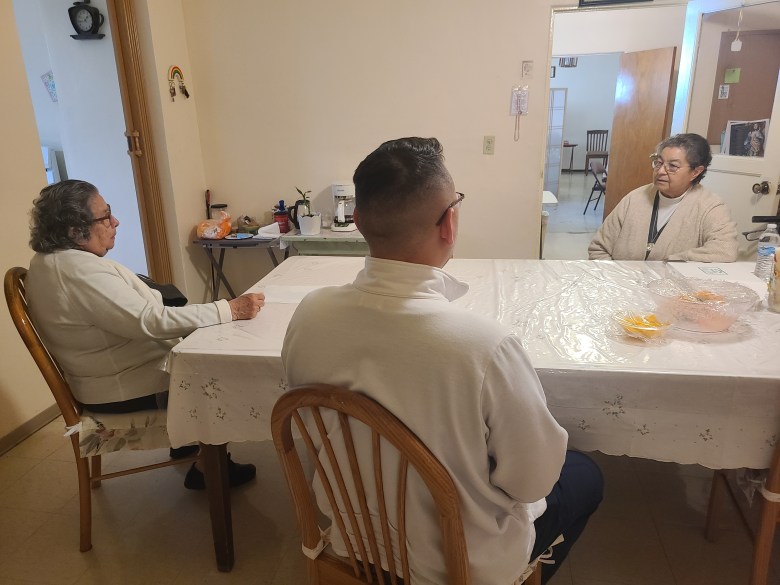
At Casa de los Pobres, a Catholic center that provides meals and health care to people in Tijuana who can’t afford them, about nine migrants remain in its small migrant shelter section, according to Sister Armida Andrade, one of the nuns who runs Casa.
Recently two Russian speakers left the shelter, one to Germany and the other to Serbia, Andrade said.
Among the people that remain at the shelter is Max, who still dreams of reaching the United States. Voice of San Diego is not fully identifying him due to concerns about safety and retaliation.
Max said he escaped political persecution in his country. He reached Tijuana last fall and waited for an appointment with CBP One, living first in a hotel and then moving to Casa de los Pobres in January.
He’s been looking into whether he could apply for a student visa to either the United States or Canada. He already has a college degree from his home country, and he’s interested in studying cybersecurity, he said.
He said he wouldn’t feel safe in Europe because it’s too accessible to his home country’s intelligence forces, and because he has a friend in the U.S. willing to help him, that’s still his top choice.
Max said he understands why the United States is careful about who it allows in, and that’s what makes the country feel like a safe option for him.
“I hope I will have a regular life,” he said. “I hope I will get back to my normal job.”
He also plans to seek treatment for the trauma he experienced back home once he reaches a country where he can resettle.
In the meantime, he’s planning to stay at the Tijuana shelter, he said.
“Actually, I don’t have any other choice,” he said.
In a group chat of Colombian migrants, many have expressed interest in trying to get to Canada. A lawyer told some of them that they would have to return to Colombia first to request visas to Canada, and several have gone back to try to follow that process. They said they had to pay fines when they left Mexico because they had stayed longer than allowed.
Ramos said many asylum seekers express interest in trying to reach further away countries, but the route is expensive and difficult.
“America is not the choice because we are the best country in the world,” Ramos said. “America is the choice because we are one of the safest countries that people can access in this hemisphere through a land border.”
Ramos said her organization is assisting one trans woman who hopes to seek refuge in Spain.
When Trump canceled their appointments, Standalove, her husband and their 4-year-old daughter lived on the street for a time before finding shelter in a Haitian community supported by the nuns who run Casa de los Pobres.
Now she and her family are waiting for Mexico to process their refugee case.
“I know it’s difficult, but with faith we will get ahead,” Standalove said in Spanish.
In Other News
Travel ban: Protesters at the San Diego airport denounced Trump’s latest travel ban on Tuesday, Alexander Nguyen reported for KPBS. The ban blocks travelers from 12 countries — Afghanistan, Myanmar, Chad, the Republic of Congo, Equatorial Guinea, Eritrea, Haiti, Iran, Libya, Somalia, Sudan and Yemen — and it places limitations on people from six other nations.
Court arrests: Immigration and Customs Enforcement officers began arresting people after their immigration court hearings in May. I reported on the second day of arrests in San Diego for Beyond the Border and Capital & Main.
License plate surveillance: For KPBS, Gustavo Solis looked into the city of San Diego’s budget and how advocates are concerned that money for license plate readers will ultimately end up aiding ICE in making immigration arrests. An investigation from Calmatters’ reporters Khari Johnson and Mohamed Al Elew found that police departments have been illegally sharing license plate data with ICE and Border Patrol.
Family separation: A San Diego federal judge ruled that the Trump administration is violating a court settlement made with families whose parents and children were separated at the border during the president’s first term, Alex Riggins reported for The San Diego Union-Tribune.
Cancer at Otay: For Beyond the Border and Capital & Main, I told the story of a Guatemalan man who says his colon cancer hasn’t been treated while he’s been in custody at Otay Mesa Detention Center.
Catholic resistance: Rev. Michael Pham, recently appointed bishop in San Diego by the new pope, called on Catholic leaders in San Diego to accompany asylum seekers to court on International Refugee Day, which is June 20, Taylor Odisho reported for Latin Times.
Otay Protest: Demonstrators blocked the road to Otay Mesa Detention Center on Friday for a couple of hours, and police arrested at least five of them, I reported for Daylight San Diego.

Why can’t USA be a place of refuge for DACA?
44,000 USD online People’s lives are changing rapidly. Every year more and more people are participating in online trading. 73.3 million Americans donated last year, and that number is expected to grow significantly. q
For INFO click my user Name<<<<<<<