

On Wednesday night, Superintendent Fabiola Bagula told a packed auditorium at Bethune K-8 that the district was reversing course on closing the school’s middle school grades.
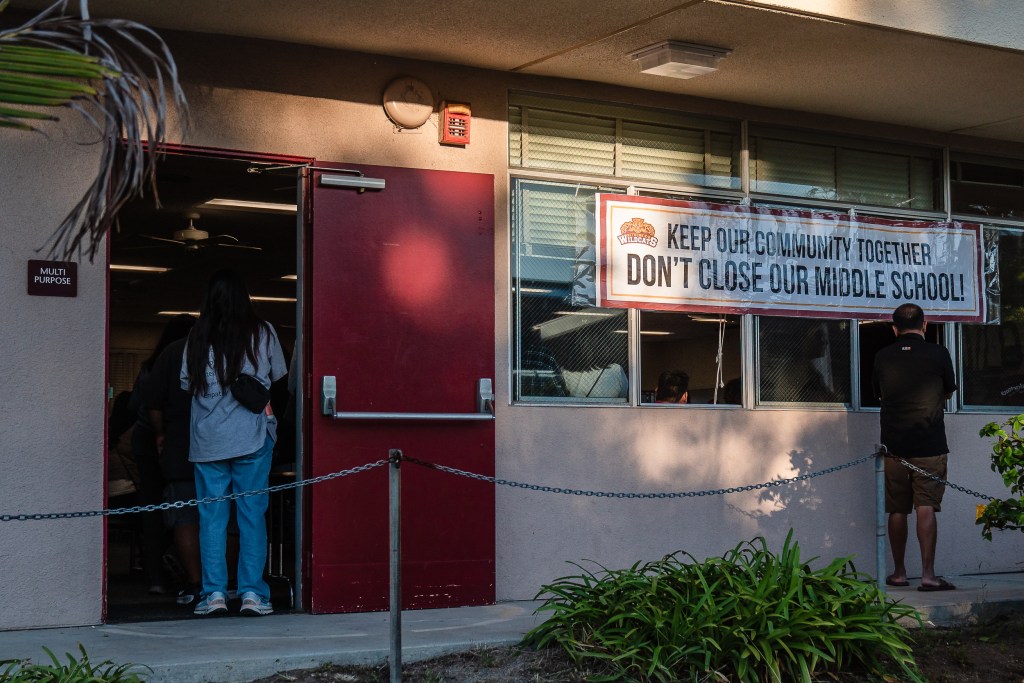
The announcement came after nearly two weeks of frenzied advocacy by parents desperate to keep Bethune’s middle school open. It was kicked off by Voice of San Diego breaking the news that the district planned to cut middle school grades at four of K-8 schools. That came as a shock to stakeholders, none of whom were consulted about the cuts.
But while the district spared Bethune, the middle school grades at the other three K-8 schools are still on the chopping block. And over the course of the last two weeks, district leaders’ explanations for the closures have them doing something rare – criticizing their own schools.
About 200 parents, current and former students, district staff and TV news cameras packed into Bethune’s carpeted auditorium on Wednesday night. Some attendees stood outside, watching through open windows.
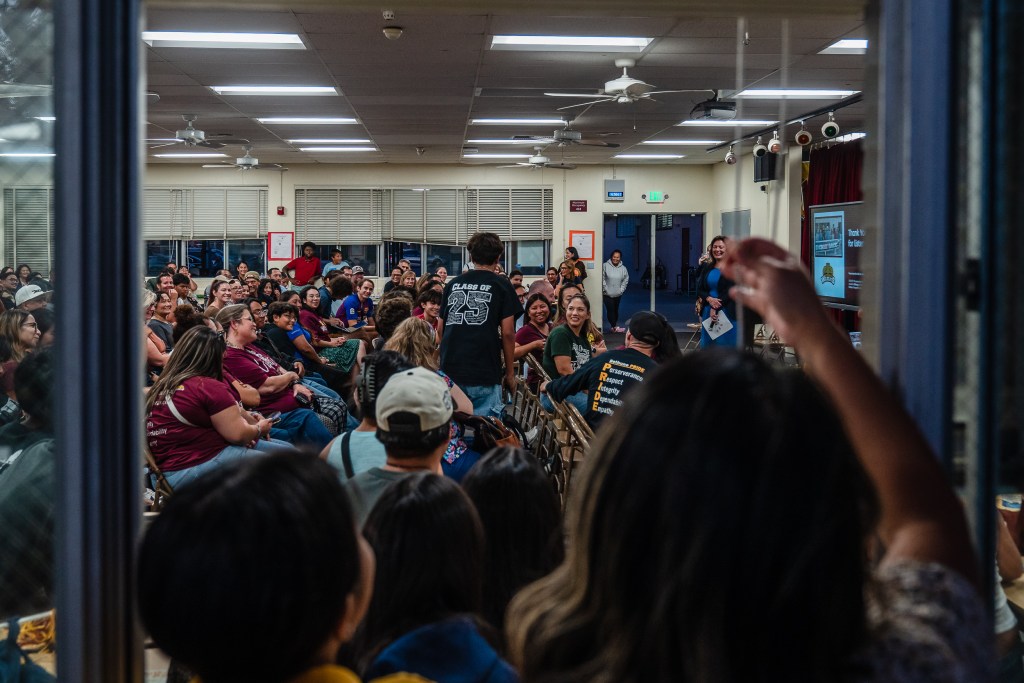
Parents of Bethune students have been the loudest voices advocating to keep their school open. The pushback was so intense that even before the meeting, Bagula said she was considering reversing the decision to close the school. The school is higher performing than the others in metrics like test scores and was also added to the closure plan later in the process. Even when it was added Bagula had misgivings.
“I want to make data-based decisions. When I looked at Bethune’s data, that’s the one that I was like, ‘Maybe not,’” Bagula told me last week.
In other words, she felt this school was not like those others.
At the meeting’s start, Bagula said she was there to listen with an open heart. Then, nearly a dozen teachers took turns espousing the virtues of Bethune.
Their test scores were higher than the other schools slated to be closed and even Bell Middle, the school where students were to be rerouted should Bethune close. Their graduates attended colleges all around the country. They produced a disproportionate percentage of valedictorians and salutatorians. Its middle school sports program was thriving. It offered robust Spanish curriculum, and a wide variety of specialized programs from ASB to a cultural club.
Then the community took the mic. Attendee after attendee lauded the school, at times tearfully. They valued Bethune’s safety, they said, and that the school felt like a family. To many, they were also actively choosing Bethune because of concerns about Bell.
Bagula, standing at the front of the room, nodded dutifully throughout.
The parents, the teachers and the students who spoke clearly felt they needed to justify Bethune’s continued existence. The message they sent was plain: This school is not like those others.

When Bagula spoke, she explained how the decision had been made. She walked the room through the metrics that played into the decision and heaped praise on Bethune.
“All of the beautiful things that your teachers said, by the way, it’s not happening at the other schools. It’s happening here,” Bagula said.
Then, she said what everyone in the room was desperately hoping to hear.
“Please know, we’re not touching Bethune,” she said, to thunderous cheers and applause.
The announcement elicited thunderous cheers and applause from the about 200 community members gathered. Afterwards, a troupe of TV news cameras spoke to tearful, relieved attendees, many of whom came dressed in shirts bearing the school’s wildcat logo.
The energy was electric. But what also stood out was Bagula’s not so subtle criticism of the other schools slated for cuts, a rarity for a district that loves to talk up their schools. And they have reason to.

The district is one of the top-performing large urban districts in the United States. According to the results of last year’s federal standardized tests, San Diego Unified’s fourth and eighth graders scored higher than any other large city tested.
But what gets lost in those glowing statistics is the deep divide between San Diego Unified’s top performing schools and its lowest performing ones. At the district’s top performing schools, more than 80 percent of students often meet state standards. At its lowest performing schools, that number hovers in the teens or – distressingly – even single digits.
This isn’t entirely surprising. The district serves more than 95,000 students at more than 150 schools in neighborhoods that range from the tony beachside community of La Jolla to those in central and southeastern San Diego, where a significant portion of the community lives below the federal poverty line.
It’s well-understood that poverty levels and student performance are closely correlated, so those socioeconomic factors inevitably show up in classrooms. But they don’t completely excuse the striking levels of performance inequities in district schools.
Community members haven’t been shy in calling out those shortcomings in the past. But over the course of the K-8 cuts fallout, even some district officials have also more explicitly claimed that some of their schools may not be giving kids what they need.
“The quality has just not been there and my conscience bothered me. How can we keep kids there when we know the quality is not up to speed?” said Trustee Sharon Whitehurst-Payne, whose subdistrict includes three of the schools slated to be closed.
“Bethune, I went by and visited them maybe a couple of weeks ago. I was impressed, they were doing a good job. And I’m not saying the others aren’t doing a good job, but it’s not meeting the kids’ needs and … parents are trying to protect their kids, their youngsters, but it’s also not preparing them for the real world.”
In an interview last week, Bagula was less explicit than Whitehurst-Payne but echoed some of her sentiment. She said it was originally principals of multiple K-8 schools who brought her concerns about how well the format was serving students. Then she began to dig into the data as part of a broader focus this year on improving the district’s middle schools.
That’s when she said she realized “it is actually a problem.”
One of the problems Bagula and others have pointed to when explaining the need for the cuts is graduation rates. Specifically, that the high school graduation rates of students who attend K-8 schools lag behind those of students who attend dedicated middle schools, like Bell Middle, where students who attend three of the K-8 schools would likely be routed to should parents not choose to send them to a school outside their area.
Bell Middle is about a mile from Bethune.
According to a recent KPBS piece, 88.74 percent of Bell Middle students graduated high school. The graduation rate for students who attended Bethune and Audubon inched down ever slightly to 88.24 and 86.11, respectively. The graduation rate for students who attended Fulton was lower, at 76 percent. The graduation rate of students who attended Golden Hill wasn’t included.
“Once I started looking at the data, I’m like, ‘Yeah, we have to do something right?’” Bagula said. “My responsibility is to make sure that children are on the pathway of success when they graduate, not just now, but for the next few decades.”
Those claims still haven’t assuaged the anger of many parents whose kids attend K-8 schools. That anger was clear during a meeting about the cuts at Golden Hill K-8 a week earlier.
It was a very different meeting. Nearly 50 parents, students and district officials sat in the school’s dim auditorium. Unlike the one at Bethune, Bagula wasn’t in attendance. Neither was the ensemble of TV news cameras.
The school’s principal, Julia Martinez, opened the meeting. She was in favor of the shift but explaining why while not denigrating the school she leads was something of a tightrope walk.
“We want access and opportunity for your children,” Martinez said. “I love my school, I really do. We’re not giving them that access and opportunity that they really deserve.”
That rationale has been a second pillar of the district leaders’ explanation for the cuts.
They’ve argued that students who attend dedicated middle schools have more educational and extracurricular opportunities than those attending K-8’s. Those include access to more elective courses, like foreign languages, advanced classes and more activities like sports, music programs and clubs.
Those programs don’t exist at Golden Hill K-8, Martinez said. Much of that is due to the small size of the school’s middle school classes, which makes standing up programs more difficult. Roosevelt Middle, the default dedicated middle school for families who attend Golden Hill K-8, though, has about 800 students. The school has advanced courses that allow students to knock out high school requirements in middle school and everything from band to ASB to a yearbook class.
It also has more basic amenities Golden Hill lacked.
“Some of the students were excited about the grass [at Roosevelt.] I didn’t even think about that,” Martinez said. “’We’re gonna’ have grass,’” she remembered some students saying. “Yeah, you’re gonna’ have a field. You’re gonna’ have sports.”
Students would now have the opportunity to experience all of that. And if they didn’t want to attend Roosevelt, families from Golden Hill, like those at the other two schools whose middle schools are being cut, were offered priority enrollment that guaranteed them acceptance to almost any district school.
But many of the parents at the meeting weren’t satisfied by the explanations. Some had chosen to send their children to Golden Hill specifically because it was smaller than schools like Rosevelt. As a result, its middle school class sizes were also much smaller, something else they valued.
They were also vocally angry about not having been included in the decision-making process.
“We didn’t get to say anything [about] how we feel at all. I didn’t hear until I was on freaking TikTok that my son’s school is closing, and I don’t think that that was fair and I think that’s why we all are angry in this room,” one parent said.
Mitzi Merino, the district’s area superintendent in charge of K-8 schools, said this plan had been years in the making, but blamed the news being leaked in the media for the way it was rolled out.
“The plan was to, in advance, talk to people, get notifications about so that they understood when it hit the news, and it just doesn’t work that way anymore in our world apparently,” Merino said.
When the meeting ended, the message was clear – Golden Hill’s middle school grades were being shut down, despite parent frustrations.
Yesica Rodriguez, one of the parents at that meeting, left feeling gaslit. While district officials blamed the media for the rollout, she wondered when they would have told parents had it not been leaked. The end of the year, when their decisions about whether they wanted to send their kids to a school other than Roosevelt would have to be made on an even tighter timeline?
She also still had misgivings about why the schools were chosen. All four schools in the initial group serve overwhelmingly low-income students. The district is keeping many other K-8 schools in wealthier areas open.
“I felt like a lot of what they were saying was purposely misleading. It was disingenuous. It was kind of insulting to our intelligence,” Rodriguez said.
What added to that insult was the way officials had spoken about Golden Hill. Rodriguez has been deeply involved in the school, volunteering for events and helping out with the foundation. She loved it. She also valued the tightknit community and the fact that she’s known some of her children’s classmates since they were three- or four-years-old. To her, the meeting seemed to cheapen all of that.
“I don’t know whether she wanted to or not, but I can’t believe our own principal was having to talk badly about her school to sell the idea of this bigger, brighter, better school,” Rodriguez said. “The way that they are handling the situation is extremely disrespectful to this community.”
US Dollar 2,000 in a Single Online Day Due to its position, the United States va02 offers a plethora of opportunities for those seeking employment. With so many options accessible, it might be difficult to know where to start. You may choose the ideal online housekeeping strategy with the bc-40 help of this post…
See more➤➤➤➤➤➤➤ Tab on my name