
This post has been updated.
Earlier this week, the New York Times published a state-by-state look at how America has changed in the year since President Donald Trump started his second term in office on Jan. 20, 2025.
The Times’ story got me thinking about what a similar examination might reveal about South San Diego County during the past tumultuous year in politics.
The answer, I discovered, is not quite what you would expect.
Like many majority-Latino regions in the United States, South County tilted rightward in the November 2024 election that returned Trump to power. A big question for political observers has been whether those voters would snap back once Trump took office.
Recent national polling suggests they have.
There is no equivalent polling for South County. Democrat Paloma Aguirre’s July victory over Republican Chula Vista Mayor John McCann in the race to fill a seat on the San Diego County Board of Supervisors is the closest equivalent we have. The race was close but did suggest at least a modest shift back to the left.

Still, I’m cautious about reading too much into voter sentiment. Attitudes fluctuate depending on circumstances.
Actions are a better indicator of people’s true priorities. And the actions of political leaders matter especially because they have a direct impact on people’s lives.
Viewed from that perspective, South County over the past year has shown a desire to step back from partisan debates and focus instead on basic community needs. Also, Trump’s America has been hard on South County budgets, both in government and in residents’ households.
One notable fact about the past year is that there have been relatively few immigration-related arrests in South County compared to other parts of California and the United States.
The Deportation Data Project, which tracks immigration arrests nationwide, documented roughly 43 such arrests in Chula Vista last year, along with three in National City and 28 in Imperial Beach. The number was higher in San Ysidro – 214 – because of the border crossing there.
Absent a headline-grabbing onslaught of immigration enforcement, local leaders have remained focused on local challenges.
The most prominent of those challenges has been shrinking budgets. Both Imperial Beach and National City last year voted to dip into reserves to fund various government programs.
One school district, South Bay Union, expects to close up to three schools in coming years because of declining enrollment and revenue. Another district, Chula Vista Elementary, recently set itself a goal of cutting $6 million to avoid drawing down reserves, with possible additional cuts to come.

At the same time, households are struggling amid a stagnant economy and looming cuts to federal benefits programs.
At a press conference Tuesday, Aguirre said 40 percent of San Diego County residents receiving federal nutrition and healthcare supports live in her South County supervisorial district. That’s roughly 340,000 people, she said.
Aguirre said she plans to ask the Board of Supervisors to authorize spending $25 to $45 million in reserve funds to help cushion the blow of federal cuts to both the CalFresh nutrition program and Medi-Cal health benefits.
A single moment at Wednesday’s meeting of the Chula Vista Elementary School District Board of Trustees encapsulated the economic squeeze faced by both governments and families.
Several parents and school employees at the meeting voiced their dismay at recent cuts to the number of district behavioral support assistants, who help students with behavioral or mental health challenges. Those cuts are part of the district’s budget trimming efforts.
At the same time, teachers’ union president Rosi Martinez said the recent rise in nationwide healthcare costs means teachers now pay an average of $1,500 per month to insure themselves and their families. She urged the board to keep such costs in mind as they look for spending cuts.
“We need to make sure our district is the best place to be,” she said.
There’s an outlier to all this Trump-era doom and gloom. While other government agencies struggle with budget problems, Chula Vista sees itself on a roll.
The city is greenlighting ambitious development projects, recently broke ground on a new homeless housing development and, this week, voted to boost certain kinds of pay for police to make it easier to recruit new officers.
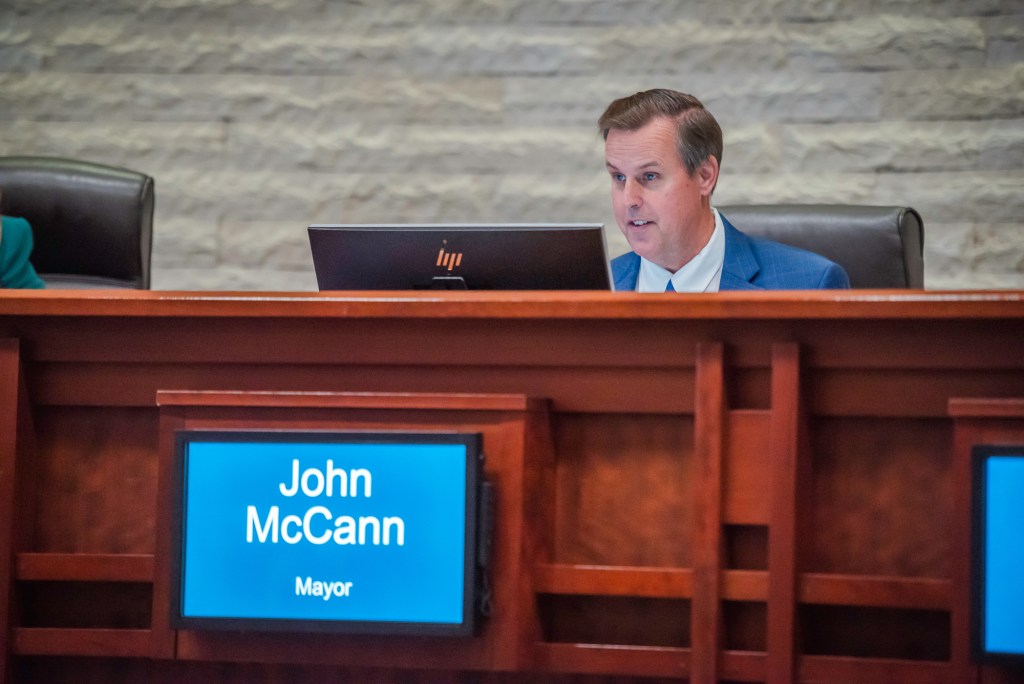
The city’s relative fiscal health – it balanced its budget last year without cutting programs or dipping into reserves – might explain an otherwise puzzling fact. In a city where Democrats vastly outnumber Republicans, Mayor McCann so far is running for re-election unopposed.
Democrats have grumbled to me privately that no one has stepped up to challenge McCann. But in the same conversations, they concede McCann is popular in Chula Vista and the city’s recent successes give him a campaign advantage.
Which suggests that in the Trump era, whatever buyers’ remorse voters may feel about 2024, local priorities dominate the local agenda. At a time when nothing in politics feels normal, that’s a surprisingly normal turn of events.
In Other News
- In addition to requesting up to $45 million in reserve funds to cushion the blow of federal budget cuts, County Supervisor Paloma Aguirre this week announced she also is seeking $19.25 million from county reserves to help neighborhoods affected by Tijuana River sewage pollution, including $4 million for more air purifiers.
- Also, Aguirre next week plans to ask county officials to authorize spending $4.75 million to fund a temporary fix for a sewage hotspot on the Tijuana River and commission two studies to quantify the health impacts of sewage pollution on nearby residents.
- One more piece of Tijuana River news: U.S. Rep. Juan Vargas and U.S. Sen. Alex Padilla last week announced they had secured $3.5 million to fund a dredging project that will remove sediment, trash and debris from Smuggler’s Gulch, reducing flood risk.
- State Sen. Steve Padilla this week introduced legislation that would bar the use of artificial intelligence algorithms from providing or advertising mental health therapy. “AI algorithms are not fit to take over the job of human therapists,” Padilla said.
- Residents seeking an update about the level of toxic industrial chemicals in Sweetwater Reservoir can attend a community meeting hosted by the Sweetwater Authority water agency at 5 p.m. Jan. 27 at 3066 N. 2nd Ave. in Chula Vista. Authority representatives will discuss levels of PFAS chemicals in the reservoir along with efforts to ensure the overall safety of the agency’s water supply. RSVP to attend here.
- Suncoast Market Co-op, a member-owned grocery store in Imperial Beach conceived and brought to life by local residents, will stage a grand opening 9 a.m. Jan. 31 at the store’s Imperial Beach location, 600 Palm Ave.
Correction: This post has been updated to correct the date for the Sweetwater Authority workshop on Jan. 27.