
Estimated reading time: 5 minutes
San Diego Unified’s board on Monday night voted to advance a proposal to build 1,500 units of affordable educator workforce housing at its University Heights headquarters.
The proposal, from the Protea + Malick developer team, would also bring a slew of amenities, like parks, retail space, a public pool and more to the site.
The much-awaited vote was the culmination of more than a year of planning and preparation. It’s also part of a slow, but growing, movement to build affordable housing for school district employees on district-owned land across California to combat the state’s ongoing housing crisis.
The board’s final choice for the University Heights property, and for a second site that was up for a vote on Monday, represent the single largest affordable education workforce housing portfolio in California. The almost 1,700 units proposed at the two sites would also nearly double the number units that have been built on school land throughout the rest of the state. The University Heights project alone is enough to fulfill the district’s goal of producing housing for 10 percent of its staff.
The votes are not a final approval, however. They will simply advance the chosen projects to negotiations over details important to district trustees. Board members were optimistic that the process would add value to the projects.
“I think we’ve got a great project and I think we’re going to make it better,” Board President Richard Barrera said. “It’s going to be as ambitious as we could get for one project to provide a solution to affordability for our employees. So I feel actually quite proud of what our board is doing tonight.”
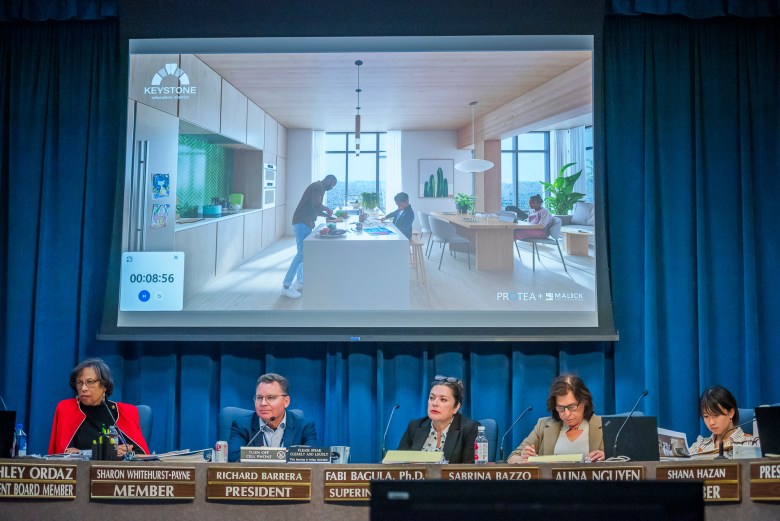
The meeting was a tense scene that resembled a high-stakes, developer version of “America’s Got Talent.”
To determine the order of the proposals, Student Trustee Ashley Ordaz drew slips of paper from a miniature aluminum bucket. Teams then raced against a ticking timer projected on a screen behind the dais, both during their presentations and when answering questions from the trustees. Presenters also took veiled and not so veiled shots at other proposals throughout.
Each team’s presentation extolled the particular virtues of their project. Affirmed’s pitch was that their units were the cheapest. Monarch/Eden’s pitch was that they were the surest option and the choice of the University Heights neighborhood group. Protea + Malick’s pitch was that they would provide the most units and the most rental revenue by far for the district.
Presenters also all pledged to work with the district to tweak their proposals to meet the board’s evolving requests. Those pledges were clearly in response to Barrera’s attempts to reconfigure the district’s original requests from developers at a December meeting. Barrera ultimately punted a planned vote on proposals during that meeting.
“We heard Trustee Barrera loud and clear that he wants to know that your employees are getting a good deal. That’s important to us,” said Protea + Malick representative Andrew Sharp (who once joked that the body of a Voice of San Diego reporter would wash up on shore during his time as a district spokesperson). “We think it’s important that everything’s below market and we’ll work with you on the affordability.”
Exactly what measure of affordability the district would prioritize was another of Barrera’s sticking points during that December meeting.
The district’s primary goal, according to its request for proposals, was to maximize the number of affordable units. The district’s definition of an affordable unit was one that costs a tenant less than 30 percent of their income. That’s different from how the state and feds define affordable units, which is tied to the median income of an area.
A district committee had recommended the project from the Affirmed team, which proposed 943 units, all affordable by federal definitions. But it wasn’t the project with the most affordable units, per the district’s definition. That was the Protea + Malick project, which proposed 1,500 units.
The Monarch/Eden proposal, which would have built 719 units, with about 400 or so affordable, was the smallest of the three projects.
During public comment, the battle lines were clear. Urbanists in the community supported Protea + Malick’s denser proposal. Allies of the University Heights Historical Society, who came by the dozens dressed in an array of reds and sporting lime green stickers that read “I Support Monarch.”
Despite the tension in the room, the board voted unanimously to advance the Protea + Malick proposal to the negotiation stage. They also detailed a number of changes they’d like to see.
Those included a reconfiguration of the income spread for the project, which as proposed featured a significant number of units only affordable to staff making more than 120 percent of the region’s area median income ($130,800). That income range would mean that, while many teachers would qualify, many other district employees would not.
Trustee Shana Hazan said the coming negotiations and data gathering would inform all manner of final specifications in the project, from rent levels to parking.
“There are lots of real data points we need to inform this. So for me, it’s making sure that the final project aligns with the needs and the demands of our employees,” Hazan said.
Barrera was rosy about his decision to punt the vote, a move he said he believed brought the board more clarity about the disparate projects.
“I think the board as a whole has a better understanding of what the proposals were doing and I think it also gave the public more of an opportunity to understand these proposals,” Barrera said.
The district also approved a project from the developer team Mirka for its Commercial Street property. That project added another potential 177 units to its affordable housing portfolio.

I think this is a great step forward and it will be a good recruiting tool for the district. There are however some issues that need to be addressed:
If someone with district housing moves on to a different job with another employer in San Diego, do they have to move out? How much time to move do they have?
I have seen instances where company housing has been used as an intimidation tool on the employees. “If you guys go on strike, you will lose your housing.”
Who is going to run the housing project, the school district or the developer? If there is an issue with the housing who do the tenants go to in order to resolve the issue, the developer or the school district?
Who gets the maintenance work for the housing, school district employees or the developer’s maintenance contractor? Will the contract maintenance employees be union?
None of these are unsolvable issues, indeed they are more routine in a new development, but it is best to handle them up front so everyone knows what they are getting when they sign on the dotted line.
From everything I see so far there will be no requirement to work at the school or at San Diego Unified to rent these units. They are not looking to build a dormitory. They are looking for a revenue stream. If they were truly serious about providing housing for employees then these units would only be allowed for San Diego Unified employees. However like most large government entity investment they try to mask it as something that isn’t fair and is somehow hurting vulnerable people. Just give employees a rent stipend and focus on education. If you want to run a business, especially real estate, go private.
Perhaps opening a shopping center would make more money.