
Homeschooling is on the rise. The number of San Diego County parents who homeschool has nearly doubled in just five years, according to a data analysis by The Washington Post. But because of the difficulty of collecting that data, the 88 percent increase recorded by the Post is likely a significant undercount.
I looked at those numbers at the local level. Read my story here.
In recent years homeschooling has become much less fringe, and those who choose to homeschool are much less homogenous. So, exactly why parents decide to homeschool their children, and what homeschooling looks like for them, can vary widely from person to person.
Here’s a look at what homeschooling means to three parents.
Jill Harness
Jill Harness was a self-professed fan of public school and even joined the PTA at her son’s school. But even for a public school-booster like herself, she felt public school wasn’t right for her child. Her son has autism and ADHD and struggled in the traditional school setting. Despite shuffling around school, Harness could never find her son the degree of support she felt he needed.
She also thought the curriculum schools offered kindergartners like her son didn’t adhere to play-based models she felt were superior. For her son, whose autism gives him a need for greater autonomy, what Harness views as the stifling nature of school was particularly damaging.
“I feel like they’re just setting these kids up with this horrible foundation where they’re going to hate school for the rest of their lives,” Harness said.
Since her family began homeschooling, she feels things have been much better for her son, even if it’s been a challenge to balance. He’s smart, Harness said. He loves science, and even as a kindergartner can sit down and read a book by himself.
“If we can get him a good strong foundation of learning and not make learning feel like a struggle, I’m hoping even if he doesn’t like school itself, he’ll still enjoy learning, and want to learn his whole life,” Harness said. She herself has struggled with the constraints of a nine to five job, which led her to freelance writing, and in turn gave her the flexibility to homeschool her son.
“I’m hoping I can keep his love of learning and also kind of serve as an example of look, ‘yeah, I know, you got your own thing. You can still do what you want to do, you just have to figure out how to make it work for you,” Harness said.
Sara Shields
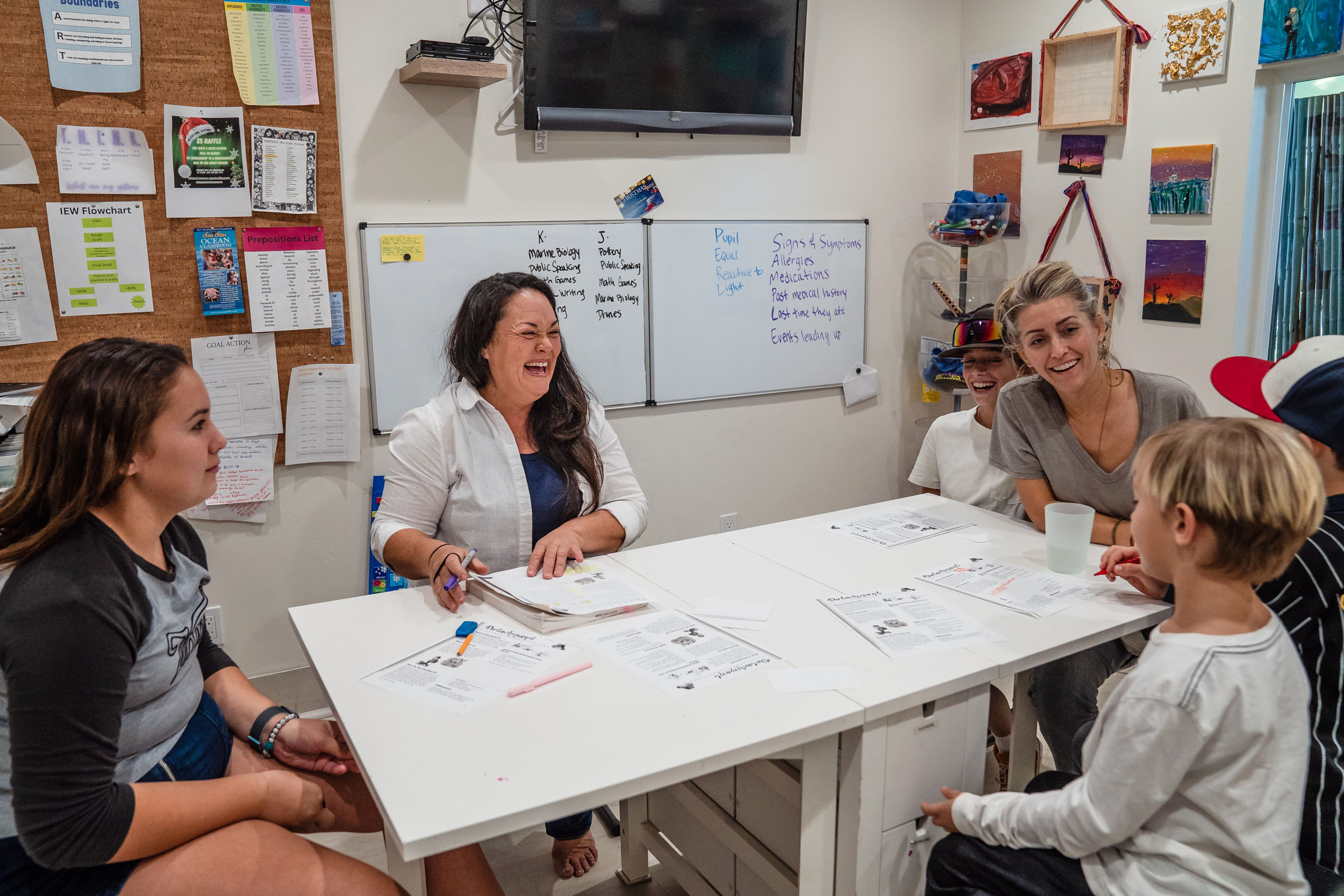
Sara Shields has been homeschooling her kids for nearly a decade. She was drawn to the alternative because of her own experiences as a child in public school.
“I remember being in elementary school and just never having the extra attention I needed given to me,” Shields said.
For example, she had dyslexia but didn’t learn that until she was an adult. Had public schools been more present for her, she doesn’t feel that would’ve been the case. When she started her own family, she and her husband decided she would be a stay-at-home mom so she could raise their kids. But when she began to homeschool in 2014, she didn’t know exactly what was required. Still, she moved forward and did the best she could.
Shields quickly found that one of the most important aspects of homeschooling is ensuring kids have opportunities to socialize was building a community. So, when she moved to San Diego from Ventura in 2021, community was one of the first things she sought out. That ultimately led her to founding the Homeschool Collective.
For Shields, like all of the parents I spoke to, one of the key benefits of homeschooling is the flexibility it offers. Shields, for example, takes a child-led unschooling approach, which is a distinctive offshoot of homeschooling that finds kids ditching the curriculum and simply learning what, and how, they want.
“My children don’t learn from textbooks, my children learn from life,” Shields said. If they’re interested in something, specifically, then we dive into that. And it might be one thing at a time, it might be three things at a time,” she said.
Research on the strategy is scarce, so the jury is still out on just how successful of an educational method unschooling is. But Shields said her kids are not only learning, they also have freedom to just be kids.
“I want them to have a childhood, I want them to enjoy their life and I want to enjoy it with them. I’m not going to send them off to school for eight hours and have somebody be responsible for them because you miss out,” Shields said.
Nicole Holderman
Nicole Holderman had long wanted to homeschool, but took the leap over the pandemic, when she said vaccine exemptions for her two children were revoked. Part of her motivation was her distrust of public school curriculum, which she felt was overtly political and clashed with her families’ Christian values.
Like Harness and Shields, they now homeschool through a public charter. She said homeschooling has given her children more time to engage in their church’s youth group and even to follow their own passions, like skateboarding and music.
Unlike Shields, Holderman, has set curriculum that includes all the standard subjects. She also takes her children to in-person classes at a Christian enrichment center twice a week and other enrichment activities like guitar and piano lessons, all of which is paid for via state funding. Her job as a naturopathic practitioner has also offered her the flexibility to make it all work.
She hopes her approach to instruction allows her children to engage deeply with subjects and think critically, rather than just do the rote memorization she feels happens in many public schools. That means looking at subjects without bias, she said, like examining the Revolutionary War from the perspective of the British, or revisiting topics like the moon landing.
“I told my kids ‘You know what, (the moon landing) is kind of a controversial topic. Some people think we landed on the moon, some people think we didn’t land on the moon. Why don’t you guys research it and figure it out and come to your own conclusions and let me know what you think,’” Holderman said.
I hope you dig into this more.
I am fascinated as to how the parents get their kids to socialize with other kids. Home Schooled kids should be allowed to play on union school sports teams , though I am sure they are not.
Are there tax benefits or other incentives to help those who want to home school their kids? After all they are relieving a burden on the system (unlike some who pay nothing and are a huge burden).