

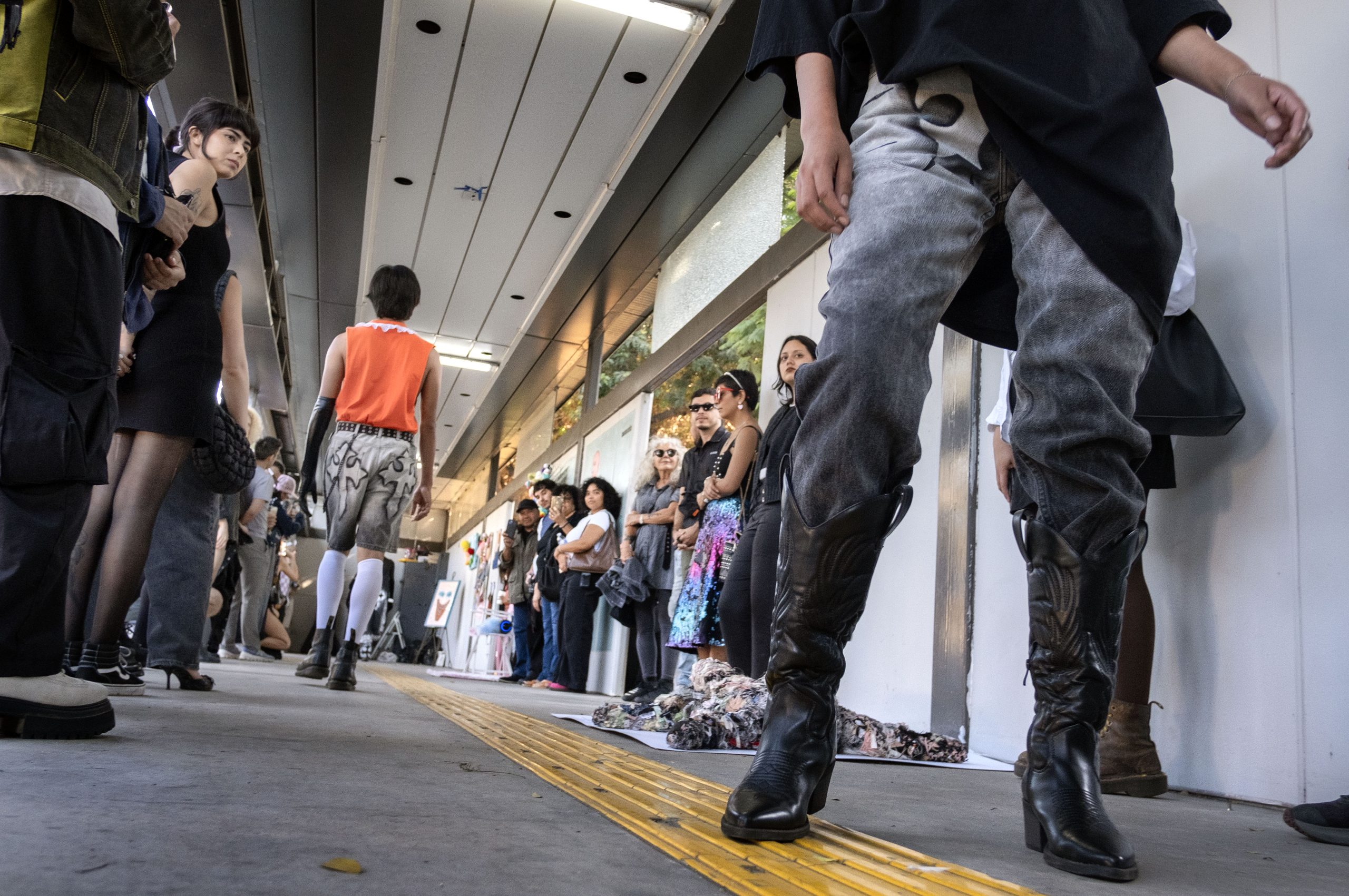
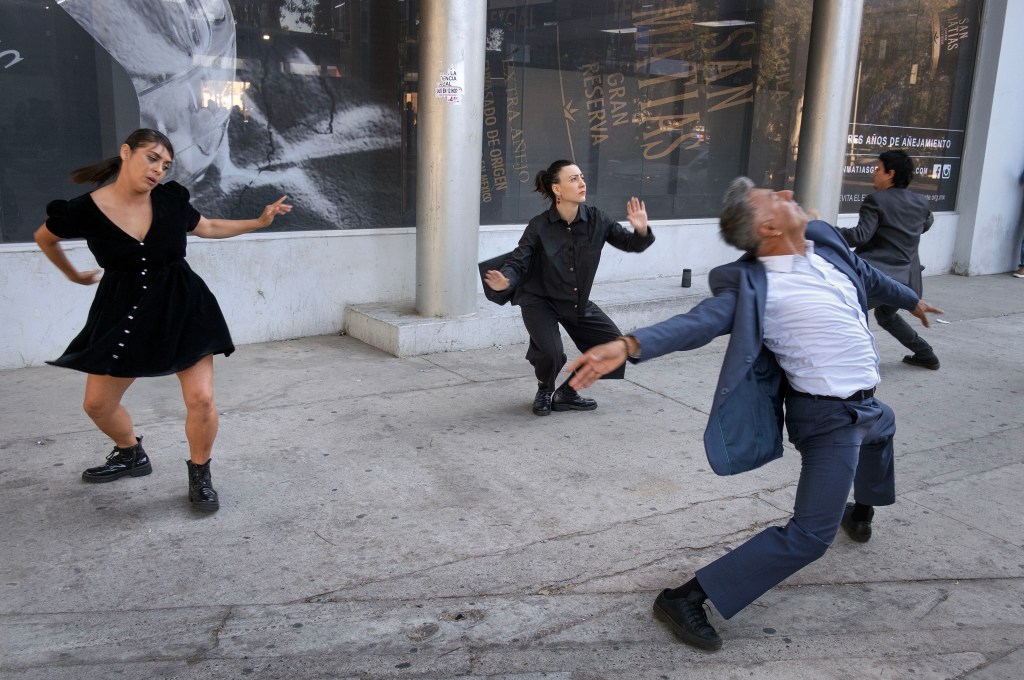
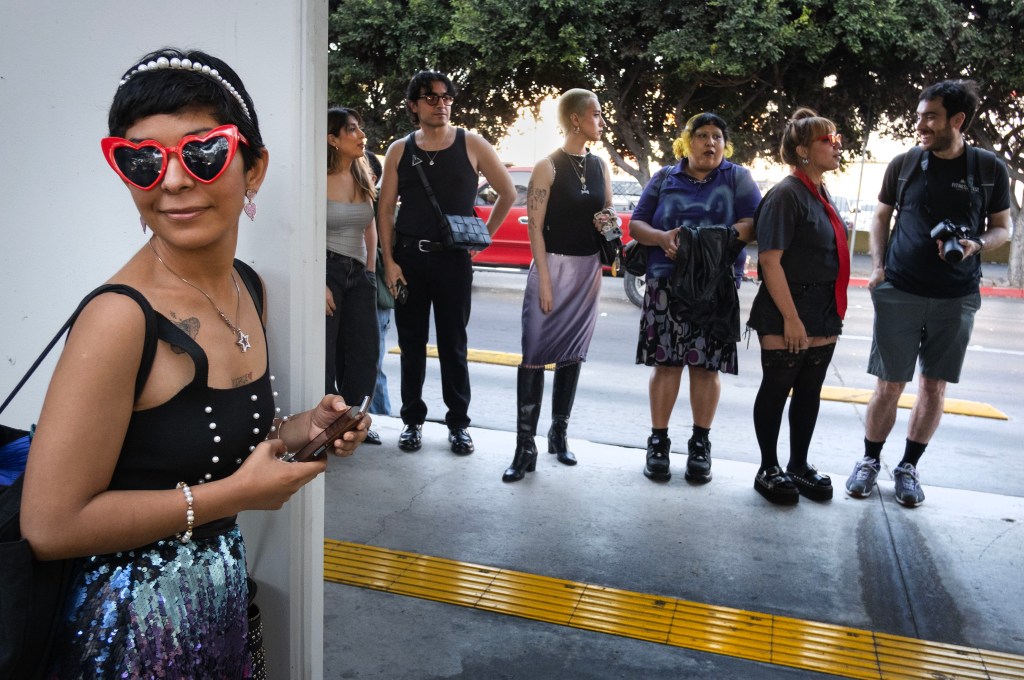
Musicians, writers, artists, designers, dancers, cyclists, architects, mobility activists occupied empty bus stations in different parts of Tijuana on Saturday in an unusual public protest. Their aim: to call attention to the city’s desperate need for a modern transit system.
Promoted by the collective Mover la Ciudad – Move the City – the civic action turned heads of drivers and pedestrians who passed by stations in a number of tourist, shopping, and government districts near the U.S.-Mexico border.
By briefly taking over the stations, participants hoped to put a spotlight on a bus rapid transit system for Tijuana that was supposedly launched in 2016 — but never fulfilled its promise. Known as the Sistema Integral de Transporte de Tijuana, or SITT, the route runs 23 miles with 45 stations from the U.S.-Mexico border down Avenida Revolucion, to the Rio Zone and down the Via Rapida highways that flank the Tijuana River channel.
“As a concept, it’s very interesting,” said Elizabeth Hensley Chaney, of Alianza por la Movilidad Activa, a Tijuana nonprofit group that promotes alternatives to cars such as safe bike routes, pedestrian access and public transit. The SITT, “promised a solution to mass mobility in the city,” she told me. “How is it that when it was launched they projected that it would move more than 50,000 people a day and that we are not seeing more than 500?”
Hensley and fellow Alianza director Daniel Gomez acted as coordinators for the day’s activities, which included dance performances, exhibits, a concert by a youth wind ensemble, and a fashion show featuring emerging Tijuana designers. Also involved were La Escuela Libre de Arquitectura in the city’s Zona Norte, the Tijuana Economic Development Council, and Tijuana’s planning chief, Nora Márquez, who presented a talk on public spaces.
Transportation a Thorny Issue
Tijuana’s main thoroughfares are often choked with vehicles as residents opt for cars rather than buses. Public transportation in Tijuana has been a thorny issue for decades, and riders have long had to contend with a disorderly and costly system of buses, microbuses and collective taxis. Unlike San Diego, the city’s public transportation is controlled by private companies working with government concessions. And through the years, politically powerful transportation unions have repeatedly defied government efforts to reform the system.
I was covering the city in 2016 when it looked like City Hall had finally made a breakthrough, getting buy-in from private bus companies to launch the SITT. Ten out of 14 companies agreed to form a consortium to operate the system under a 30-year concession with the city.
But even then, on that warm August morning, as Mayor Jorge Aztiazaran led a tour of the new system with VIP passengers and members of the media, taxi drivers pressuring for more permits began hitting the bus and tried to block it outside City Hall. It did not seem that the SITT was going to be a smooth ride.
Municipal administrations have come and gone, but the SITT has remained stuck, as mayors have avoided taking on the politically powerful transportistas.
The city is in the process of transferring the system to the state government. During a public appearance last month, the state’s transportation chief, Jorge Alberto Gutierrez, called the SITT a “pending project,” and said that currently only two buses are circulating on the route. Moving forward will entail addressing legal, financial and technical issues, he said.
Saturday’s protest marked the second time “Mover La Ciudad” took over SITT stations. Rodolfo Argote Bribiesca, a Tijuana architect, said he came up with the idea of staging a protest in the empty stations one day while stuck in traffic. He began talking to friends and colleagues, and interest quickly grew. By early 2023, they began meeting weekly to plan their first event last year.
While the protests have focused on the SITT, Argote said the delays are emblematic of a broader problem in the city: a series of public projects launched with great hopes that fall prey to corruption and political pressures.
“This frustration is not just against the government, but against citizens,” he told me. “So many failed projects and nobody says anything,” Argote said.
In Other News
New mayors: As Mexico’s next president, Claudia Sheinbaum, begins a six-year term on Tuesday, six mayors in Baja California are also scheduled to launch three-year municipal administrations. Like Sheinbaum, they are members of Mexico’s ruling party, MORENA. Ismael Burgueño,Tijuana’s mayor-elect, has already been building connections in San Diego. On Friday, he stopped by the offices of the San Diego Association of Governments (SANDAG), where he was welcomed by Nora Vargas, chair of SANDAG and of the San Diego Board of Supervisors. On Sept. 21, Burgueño, a former elementary school teacher and MORENA party leader in Baja California, threw the first pitch at a Padres baseball game in PETCO Park.
Tijuana outgoing mayor under scrutiny: Outgoing mayor Montserrat Caballero has been the subject of news articles questioning her purchase of a residence allegedly valued at over $800,000 (in U.S. dollars) in an exclusive area of Playas de Tijuana. The story was first reported by the Tijuana website Plural.Mx. Caballero told reporters last week that the property was purchased with her earnings and “great help” from her husband, a U.S. citizen. In a letter published Saturday in the Mexico City newspaper Reforma, she said the property’s value was closer to $80,000. Caballero is a former member of MORENA who was expelled after she was accused of supporting a candidate from a rival party in the June 2 elections.
U.S. fentanyl smugglers: Drug cartels are using U.S. citizens to smuggle fentanyl into the United States, and the San Diego border is a prime corridor, according to recent news reports. The phenomenon has been reported in recent weeks on KPBS-FM, the New York Times and the CBS news program 60 Minutes. In fiscal year 2023, 86.4 of individuals sentenced for fentanyl smuggling in the United States were U.S. citizens, according to the U.S. Sentencing Commission.
From undocumented migrant to federal legislator: A San Marcos woman who spent 20 years in the United States as an undocumented immigrant has returned to Mexico as a federal legislator. San Diego Union-Tribune’s Alexandra Mendoza tells the story of Maribel Solache’s remarkable journey.
Explorer, historian, photographer: Harry Crosby, a longtime San Diego resident who researched some of the most remote reaches of the Baja California peninsula, died on Sept. 12 at the age of 98. Crosby was a historian and photographer and the subject of a 2022 documentary, “The Journeys of Harry Crosby,” co-produced by Isaac Artenstein of Cinewest, and the San Diego History Center.
San Diego-Tijuana Jazz Festival: The first annual San Diego-Tijuana International Jazz Festival runs Friday through Sunday. It features performances in Tijuana, San Diego, and Escondido. For a full schedule, consult the event’s website.
Border Blur: Architects from San Diego and Tijuana are scheduled to discuss the challenges and opportunities of working in a region that straddles two countries during a panel discussion on Oct. 16 at the World Design Capital pavilion at Balboa Park from 5 p.m. to 7 p.m.
Foodies take note: The annual Baja Culinary Fest takes place from Oct. 16 to 20 in Tijuana. Events include special dinners on Oct. 16, 17 and 18, a state culinary contest on Oct. 19 and a “Gastronomic Expo” on Oct. 19 and 20 in the parking lot of Caliente Stadium. Updated information is posted on the Facebook Page.
i really like it.