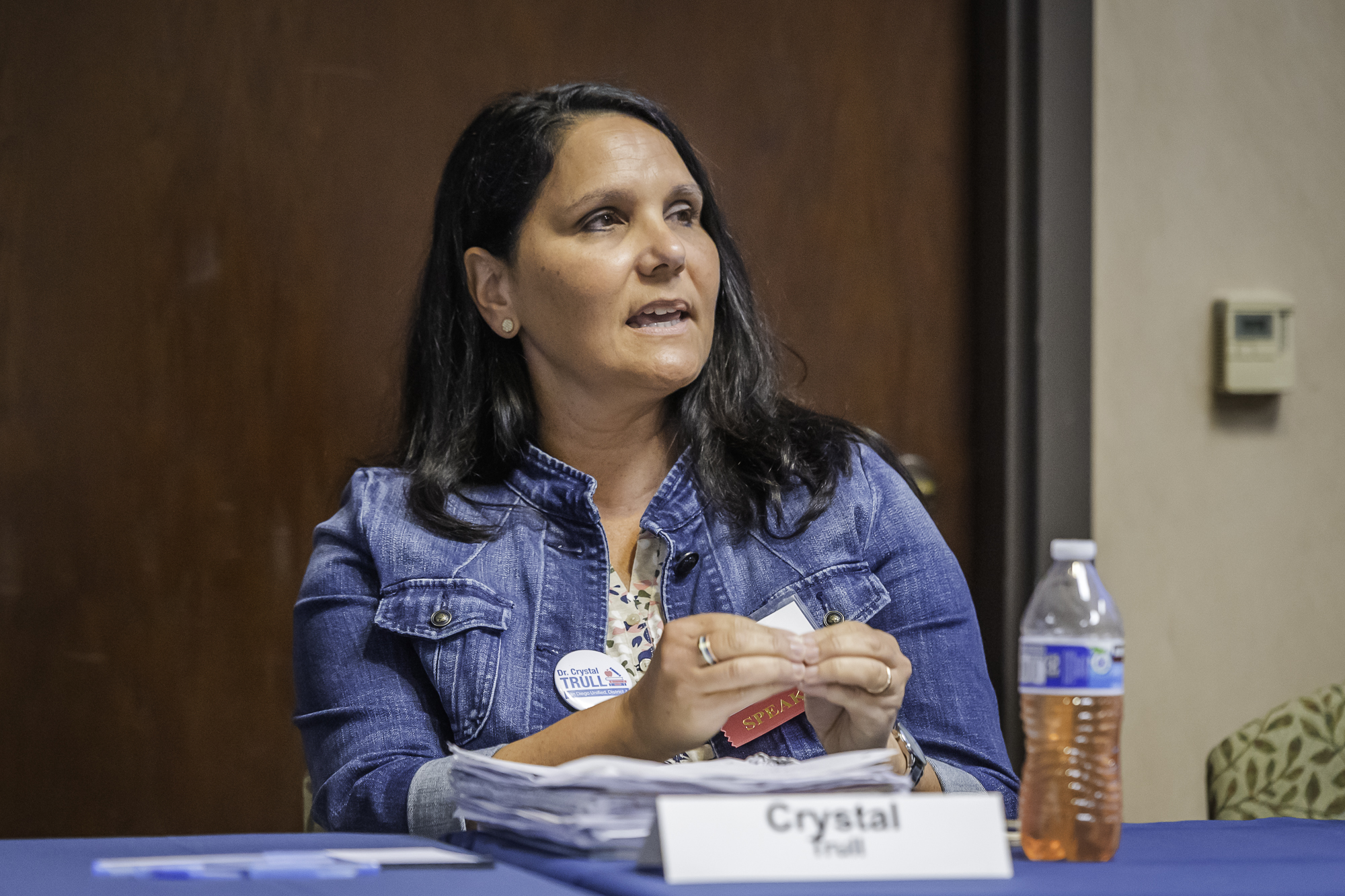
It’s happened a couple of times now. I sit down at a San Diego Unified meeting, pull out my pen and notepad and look over and see Crystal Trull. Often, she’s hauling around an almost comically large binder.
Trull, who’s running for the district’s Area A board seat, isn’t new to being a candidate. She also ran four years ago. Both times her current opponent, incumbent Sabrina Bazzo, won the support of the district’s teachers union. That, paired with the fact that it’s been more than a decade since an incumbent board member lost, make her candidacy an uphill battle.
But with the recent upheaval of the district’s firing of Superintendent Lamont Jackson after an investigation revealed he’d sexually harassed at least two female employees and the release of a federal report slamming the district’s failures dealing with sexual misconduct complaints, Trull feels voters may be ready to embrace her.
Editor’s note: This interview has been edited for length and clarity.
Q: The district’s firing of Superintendent Jackson has San Diego Unified in a crisis. What do you feel the board needs to do moving forward?
A: The district really needs to find the best person for the job. They put in [Fabiola Bagula] as the interim superintendent and I think that will work in on an interim basis but she was hired to handle instruction as the deputy superintendent and I just want to be really sure that we have the right person.
Q: The board has indicated they may want to keep Bagula on permanently. Would you be in favor of that or do you think launching a search is more appropriate?
A: I would absolutely want to do a search. She may be the right person, and that would be great, but we also want to make sure we’ve looked under every rock.
I want to be sure that the community understands what we need in a superintendent and that the person that we do put in that role will meet those qualifications.
Q: I’ve heard concerns from stakeholders that San Diego Unified lacks accountability and transparency and that it’s hurt their sense of trust in the district. A recently released report that highlighted the district’s failures in handling sexual misconduct complaints compounded that. As a San Diego Unified parent, do you feel that there is a lack of accountability and transparency?
A: My short answer is yes. I’ve been in the district over a decade and even when my [child], who’s a senior right now, first started kindergarten, trust and transparency was a problem.
When I ran in 2020, I spoke about the need to restore trust in our district. The recent scandal has definitely impacted that. I think most people feel like, ‘how did we let this happen?’ And I feel the same.
What I think about is those are the people that we do know about … that may have been impacted by (Jackson’s) behavior.
And … the 253 cases (from the federal report) are the cases of people who reported but I know for a fact many students and other teachers won’t say anything for fear of retaliation, or (fear the cases won’t) be handled well.
That weighs on me very heavily.

Q: How would you as a board member approach improving accountability and transparency and thereby building back trust with the community?
A: It’s going to take time.
Our current board operates the way that they’ve been operating for years, and so (I) as a new person to that role really has the opportunity to bring these issues to light … because the board really does not do that.
The district tries to not acknowledge anything bad. As a parent, I got this email from the district … about how they revamped their whole Title IX department. That was the first I’d ever heard of this revamping. I’m the (District Advisory Council for Compensatory Education) chair, and every year we get a report on the uniform complaint procedure, which is Title IX complaints.
This department was in place in January 2023. We got an update in September 2023 and there was nothing new in that update.
The district responded with this news because it got negative press with the (Jackson) scandal and the federal report.
They’re really going to have to step up … their ability to be transparent about what’s really going on behind the scenes. They have to stop making closed door decisions. They have to allow greater participation with community.
Those are the kinds of things I want to do as a board member.
I’m a firm believer, when there are secrets and lies … people get hurt, and I don’t want that to continue with our district.
Q: Do you think there’s more investigative work to be done in regards to Jackson’s behavior and the way the district approaches sexual misconduct complaints that goes beyond being more open and honest?
A: There’s a mindset of an open and honest and transparent approach, but then there’s actual tactical piece.
One of the things that … could help make that happen is to really demand regular reports and updates about where these cases are. Not just sexual misconduct, but other things like special ed. There are a lot of issues around special ed that are not resolved.
There are some things with English learners not getting the courses that they need.
A lot of stuff happens in our sports community… between coaches and players that is reported or sometimes isn’t reported.
I want us to commit, as a district, to treat each other well and with respect and to make sure that we have the process in place for that.
That starts at the top.
Q: San Diego Unified facing another big crisis, which is that it’s been running at a deficit and that deficit is projected to grow even larger in coming years. How do you think the board should approach driving it down?
A: We need to look at that consent agenda.
All of the contracts, all of the millions of dollars that are approved with just one vote, we need to tease that apart and really see everything that’s in that consent agenda.
What is it supposed to be doing? Does it have a direct and positive impact on student success. Are we going to monitor it? Can we fix it along the way if it’s not achieving what we expected it to achieve?
Oftentimes people just get shuffled around because of seniority or because of, you know, enrollment or openings … I want to be sure that the people who are in those positions actually have the right skill set.
I want to make sure that our physical properties are kept up so that we’re not wasting money with products and services and equipment that just don’t work.
If the board isn’t paying attention to those things, that’s a problem.
You must dig into that budget. You have to be able to understand what’s going on with the budget, and not just rely on your district’s budgeting department to tell you.
Q: Do you feel the board isn’t paying close enough attention to these things?
A: The decisions they’re making, it makes me wonder.
Based on the study I did with my graduate students … (the board) spent between 45 seconds and a minute and 30 seconds approving the consent agenda, which was anywhere between $30 million to $220 million. So that tells me that they’re not really discussing this in public.
They may be saying we talked about this in private, but … if you are talking about it in private, why are you making intentional choices that actually put us in a deficit situation?
Q: Decisions like granting teacher raises last year and reversing the layoffs that were announced likely added to the deficit. Would you have voted for those things?
A: I’ve heard from some teachers that if they knew layoffs would happen after the raises, they would not have supported that level of raise. It put a lot of teachers in an uncertain spot for a good six weeks.
As a board member, I want to support teachers. I want to make sure that teachers have a livable wage, that they don’t have to work two and three jobs and can really focus their expertise on the classroom.
But 15 percent (raises) across the board is a heavy lift. What I would have done is given increases to lower end salary teachers. We really want to make sure that we’re retaining and recruiting high quality teachers, so prioritizing the lower end and then phasing in some of those teachers who are already kind of at the top end of their of their salaries.
Q: In your view, that strategic move likely could have prevented the layoffs that were rescinded from being announced?
A: Absolutely, strategic is the right word.
We really need to be thinking ahead and not just reacting to the state budget.
I would want to make sure that the budget is on every meeting agenda. We need to be talking about where we’re at, where we’re going, what we need.
That’s what I do with nonprofits. I work with their boards and help them be strategically and physically ready and proactive.
I would take that same approach as a board trustee, making sure that we’re strategic and proactive looking at least two years down the road.
Q: The long-term trend of enrollment decline has exacerbated the budget deficit. It’s not happening just at San Diego Unified, it’s happening all over. Do you think there’s a way for the district to start to tamp down on that decline?
A: There are lots of reasons why enrollment is down, and even why kids don’t show up to school… chronic absenteeism has been a challenge.
There’s some things we can’t control like cost of living … but we do have control over what happens on our school campuses. After Covid, a lot of parents I’ve talked to got really disenchanted.
They felt like the district let them down, the district didn’t listen. They lost trust, and then they see scandals like (Jackson’s firing) or … inappropriate teacher behavior that seems to go unresolved.
With enrollment decline, I think we can really get a handle on that by instilling trust.
It also goes back to why would a student want to come to school? Hopefully they want to come to school because they’re building relationships with their peers, with the trusted adults on campuses … but also they’re challenged.
If they come and sit in a classroom and the feeling is, ‘what am I even here for?’ … kids will check out and they won’t want to show up.
We need to really start using some strategies to make sure that kids want to come to school both academically and socially and for their mental health.
Q: San Diego , Uunified, like every district in America, faces this tough challenge in that students from wealthier backgrounds have long outperformed students who come from poorer backgrounds. How would drive down this achievement gap?
A: Wealthy or poor… the difference is parent engagement and involvement. We’ve seen a lot of studies where if there’s a strong home to school partnership, it really benefits students across the board,
Some wealthier communities, parents are able to be involved more because they have flexible schedules … and (in) some of our poorer communities both parents work two and three jobs, so their level of engagement looks a lot different. But that doesn’t mean poor communities don’t want to be involved.
Some of those families don’t have a lot of the time to volunteer in the classroom, to be on the PTA, so what are some of the other ways that they can still support their child? Most of that comes with communication from the teachers (and) school sites, and not just leaving information, but also gathering information from the families about what their needs are.
But there are some real barriers. Some classrooms are large, and there’s a whole variety of needs in the classroom, so we have to be able to support things like pull outs.
Working potentially with smaller groups of kids takes money and resources, but we can be creative.
Q: Why did you run for school board in 2020 and what made you feel like you wanted to give it a go again this year?
A: In 2020, I already was very involved with my kids at that time.
I got to see a lot of things that were happening in the district: different programs that were implemented without being fully funded, inconsistent policies, board meetings that would go hours and hours, and parents … didn’t have a voice.
I thought … that’s not right. Somebody needs to change that. So, I thought, I’m going to run for school board.
That was right before the pandemic. The primary was in March, and then March 13, everything shut down, so I feel like I didn’t really get a good chance to run.
This time around, I thought to myself, ‘I have even more experience now that I have children in high school.’ I bring that full gamut, real time post covid experience that I can bring to the school board … and I have more than 20 years experience working with nonprofit boards.
I understand what it means to be a board member, and what that responsibility is. I understand how to implement the strategy. I understand how to implement accountability. That’s what I do with the nonprofits that I work with.
Q: How will you as a board member differ from Sabrina Bazzo?
A: I actually have real classroom experience.
I am an educator in our institutions of higher education, teaching graduate students at (University of California, San DIego) and (University of San Diego), so I understand real time assessment, learning outcomes, developing curriculum, working with students.
I have over 20 years experience working with a variety of community groups, constituents… through my work with nonprofits, and I have an ability to build consensus across groups. I understand what it means to develop strategy. I understand what it means to be a board member. I understand what it means to approach organizations and help support change or recover from crises.
I also have a real commitment to transparency.
I am committed to making my meetings open to families and parents in the community and I really have a desire to be involved with the communities that I represent. I want to have office hours. I want to be able to invite people to come ask me their questions, share their concerns, and also bring back what our solutions are.
I want to push for transparency about the budgeting process and where we are at the district, and really allow people to have a sense of real time understanding of our budget. And I want to focus on resources. I want to focus on the people, the property, the finances. I want that to be I want us to connect to how that impacts our students. And I want to establish metrics and accountability, which I really haven’t seen her do.