
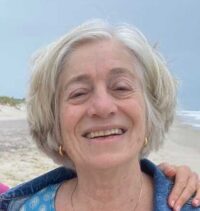

Tucked behind the hillsides that rise between Rosarito Beach and Ensenada, the small open-air market at La Mision features stalls with used clothes, tables of dried chilis and a stand of colorful fruit drinks. That’s where I found Joan Lucci and Anne Porter last Monday, by a folding table with a poster that read “Yes We Can Vote from Mexico.”
The two women are among several hundred U.S.-expats living in and around La Mision, a coastal village located about 45 miles from the U.S. border. Since July, they’ve been focused on a singular mission: to make sure friends and neighbors in the area–those who are U.S. overseas voters–are able to register to vote and request their ballot in time for the Nov. 5 election, no matter which U.S. state they call home.
”The process is different in every state and can be different from county to county,” said Lucci, who moved to Baja California four years ago from New Mexico. “It’s been quite a learning experience.”
With low turnouts, overseas voters have long been overlooked by U.S. political campaigns. But interest has grown as polls show razor-thin margins between the top presidential contenders–Republican Donald Trump and Democrat Kamala Harris. Just a few thousand votes could tip the scales in key battleground states.
Lucci and Porter are volunteers with Vote from Abroad, an arm of Democrats Abroad that helps overseas voters worldwide with the process. The group, which assists voters no matter what their political affiliation, has eight chapters of varying size across Mexico. Baja California’s small and newly established chapter is the only one on Mexico’s northern border.
“It can be pretty onerous for a lot of people to go through with this process,” said Hope Bradberry, Mexico country chair for Democrats Abroad and head of the San Miguel de Allende chapter in the central Mexican state of Guanajuato. In areas with large numbers of retirees, voters often need help with issues such as how to find the ballot sent by email from their county’s registrar of voters.
“I say, ‘Can I look at your phone?’ And then in less than five minutes, I’m like, ‘Here’s your ballot,” she said.
In recent weeks, overseas voting has been a hot topic. Trump has accused Democrats of preparing to cheat through overseas voting, though experts say that scenario is virtually impossible. Republicans have filed lawsuits seeking to disqualify some ballots from overseas.
But U.S. voters have been casting ballots from abroad for years. Since 1986, all U.S. citizens living outside the country have been entitled to vote in federal elections – whether members of the U.S. military or private citizens. The first step is registering and requesting an absentee ballot through the Federal Voter Assistance Program.
The potential is large – the Federal Voting Assistance Program estimated that some 2.8 million citizens living overseas were of voting age in 2022. The largest numbers were in Canada, Britain and France. Mexico, with some 90,000 potential voters, ranked seventh, behind Israel, Australia and Japan.
James McCann, a political science professor at Purdue University in West Lafayette, Indiana, conducted a survey of U.S. citizens living in Canada in 2022 and it showed “many said they were deeply interested in American politics,” though only about 25 percent were registered to vote.
A key reason is that political parties and other groups have not focused on getting overseas residents to register and cast their ballots in the same way that they have done domestically. “Think of it as a lot of untapped civic potential outside of the country’s boundaries,” he said.
Across Mexico, Vote from Abroad volunteers have helped 9,000 voters request ballots this year, Bradberry said. Since September, the San Miguel de Allende chapter, which operates out of an office, has helped close to 1,000 people.
Baja California’s new chapter, which started outreach efforts in July in La Mision and the community of Punta Banda, has helped about 200 people so far, Lucci said.
A major challenge is the fact that they have no office and have had to carry out outreach efforts at makeshift outdoor stands, without Fax, reliable phone service or electricity. At La Mision last Monday, Lucci was relying on her cellphone and laptop to contact various county registrar of voters offices as she helped guide individual voters who stopped by.
For all the hurdles, “I feel like I’m doing something that promotes democracy,” Lucci said. “This has been a very stressful season and time, and it’s a great way to channel that energy in a very positive way.”
In Other News
Gay nightclub owner murdered: Friends and employees of Omar Guido Chavez, the owner of a popular LGBTQ+ nightclub in downtown Tijuana gathered at the club on Sunday in his memory following his murder earlier this month. Chavez, owner of the Sodoma nightclub, was found dead in the trunk of his car two days after his disappearance on Oct. 16. State officials say they found a “narco message” beside his mutilated remains. Two suspects are in custody. A prosecutor said last week that there was no evidence linking his murder to a hate crime. (Zeta, San Diego LGBTQ News, The Bay Area Reporter)
New Tijuana police chief: A longtime official with Mexico’s former intelligence agency, CISEN, Juan Manuel Sánchez Rosales assumed the reins of Tijuana’s police department earlier this month. Tijuana Mayor Ismael Burgueño told reporters his new chief was recommended by federal authorities. During his campaign, the mayor had said he would appoint Julian Leyzaola, the former police chief, to the position. Leyzaola will instead serve in an advisory capacity. (El Sol de Tijuana, Zeta)
Mexico’s new president visits Baja California: Nearly a month after her inauguration, Mexican President Claudia Sheinbaum visited Tijuana and Rosarito Beach on Saturday. Sheinbaum toured the San Antonio de los Buenos sewage treatment plant. During her visit, she also promised to build 50,000 new homes in Baja California and said her administration would guarantee residents access to drinking water. The president did not publicly mention public safety issues, a top concern for many residents. (San Diego Union-Tribune, Voz de la Frontera, Reforma, Punto Norte)
Remembering slain journalists: Journalists murdered this year in Mexico will be remembered in Tijuana with a “Day of the Dead” altar to be dedicated Friday at the state cultural center, CEART, in eastern Tijuana. This marks the third consecutive year that Tijuana journalists are installing an altar to protest the slayings and demand that the killers be brought to justice.
San Diegans weigh in on “border crisis”: As the Nov. 5 presidential election fuels rhetoric about the U.S.-Mexico border, the San Diego Union-Tribune’s Alex Riggins and Alexandra Mendoza interviewed more than two dozen San Diego County residents from Jacumba to Otay Mesa to San Ysidro.
Indefinite immigration detention: Growing numbers of people who have won their cases in immigration court are remaining in detention while U.S. Immigration and Customs Enforcement appeals the judges’ rulings, Kate Morrissey writes in Capital & Main.
PedWest partial closure continues: The opening of the PedWest pedestrian entrance at the San Ysidro Port of Entry in 2016 was seen as a game-changer in reducing border wait times, adding more inspection lanes to process pedestrian border crossers between Tijuana and San Ysidro. Yet it’s been four years since it’s been fully operational, reports Gustavo Solis of KPBS radio. “And there is no sign of its reopening any time soon,” he says.
Books, coffee and jazz: KPBS’s Matthew Bowler profiles Libros, Cafe y Jazz, a unique bookstore in Tijuana off the beaten path that is celebrating its 15th anniversary.
World Design Capital: Champions of a Tijuana cultural initiative known as Callejon Rio Bravo are preparing to present their project at the World Design Capital’s Exchange Pavilion on Thursday from noon to 6 p.m. The project involves the conversion of a largely abandoned alley off of Bulevar Agua Caliente in Colonia Revolución into a cultural and educational space. Thursday’s scheduled events in San Diego include poetry, dancing, ranchero music, and other activities intended to evoke the spirit of the alley, said Adrian Gamboa, director of CZ GREEN, a nonprofit that has been spearheading the effort.
Thanks for sharing this insightful piece on overseas voting! It’s fascinating to see how dedicated folks like Lucci and Porter are ensuring that even those living abroad can exercise their voting rights. I was wondering, for those voters who face challenges with slow internet or limited tech skills, are there any community initiatives in Baja California to offer extra support on this front?
For anyone curious about living costs around the world, there’s a site called https://world-prices.com/en/mexico/prices that might be handy, though it’s hard to say how accurate or current their data is.
Appreciate all the hard work you’re doing to keep us informed!
Thanks for writing, and feel free to contact me at sandradibblenews@gmail.com