

It was an election year dominated by sales tax measures.
In North County, four cities – Encinitas, Escondido, Oceanside and San Marcos – asked residents to vote on sales tax measures that could provide relief to their budgets, bolster public safety, improve infrastructure and maintain quality of life.
Of the four measures, only one of them failed. Encinitas’ proposed one-percent sales tax increase, Measure K, was rejected by voters, with nearly 52 percent voting “no.”
But the other North County sales tax measures passed by wide margins, each earning 60 percent or more of the vote. So, why did Encinitas – a city whose demographics and political leanings suggest residents would support a sales tax increase – reject one, while other cities overwhelmingly supported them?
Coupled with overall frustration with the rising cost of living, it likely came down to a deeper dissatisfaction among Encinitas residents with how their city is being run and financially managed. This became clear when voters decided to oust the city’s mayor and an incumbent city councilmember.
In Encinitas, there are a lot more registered Democrats than there are Republicans. According to voter registration records released last week by the San Diego Registrar of Voters, the city has roughly 20,000 registered Democrats compared to about 11,500 registered Republicans.
In general, Democrats are more likely to support tax increases, but when it comes to local taxes, there are several factors at play, said Mason Herron, a political consultant at Edgewater Strategies, via email.
“These measures tend to work when you have four things going for you: people feel they can afford it (so inflation frustration might have been a headwind this cycle), they believe the money will benefit their community directly, they trust the people pushing for it (especially in smaller cities with good track records), and there’s an end date,” Herron said. “You might get by with three out of four, but your chances really drop when you only have two or fewer.”
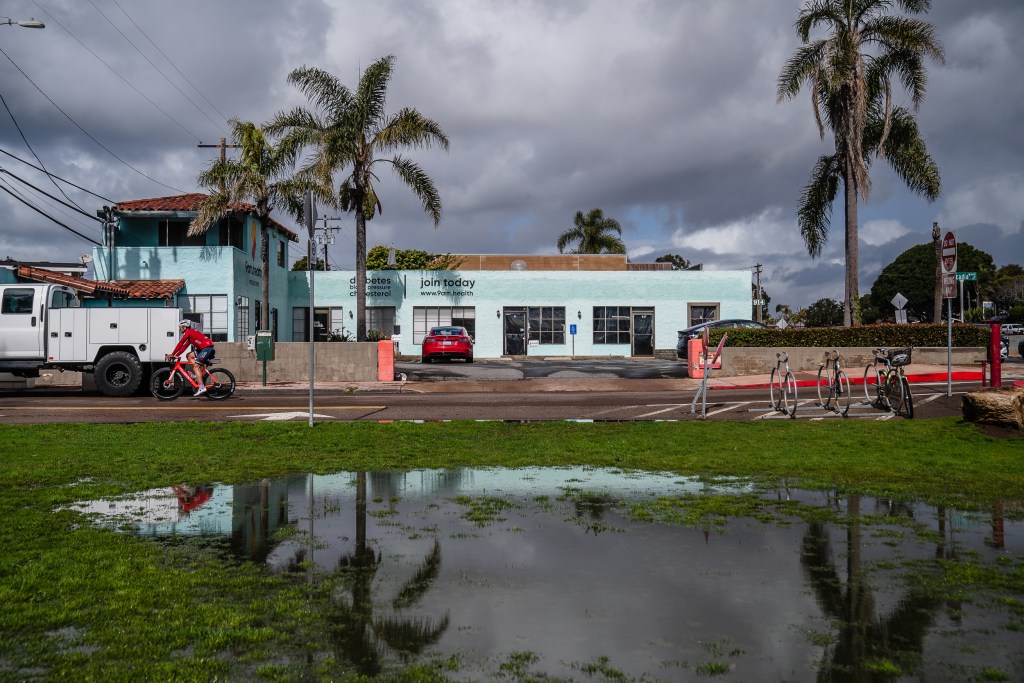
Measure K, which would’ve expired after 10 years, was projected to generate about $15.4 million each year for Encinitas, which city leaders said would’ve been used to ease an infrastructure backlog of roughly $257 million. It would have funded repairs on aging storm drains, bridges, sidewalks and public facilities; maintained beaches and parks; and supported city services and public safety. It also promised a citizens’ oversight committee and independent audit reports to monitor how the funds would be spent.
The San Diego Taxpayers Association did an independent analysis of the measure and chose to support it, mainly because of the city’s need for more infrastructure funding.
“While the city has historically had higher revenues than expenditures, the trend of increasing expenditures poses a problem for Encinitas as they try to keep costs low while providing key infrastructure and performance,” the report read. “As a result, the city does not have additional revenue for day-to-day maintenance of their infrastructure… this can result in neglect of the infrastructure if no additional revenue is generated.”
But despite the city’s infrastructure issues, and the measure’s guaranteed expiration date, most residents strongly opposed it.
Residents have shown distrust in the city’s leadership for quite some time. Voice of San Diego previously reported about Encinitas’ ongoing battle with state housing laws that are forcing more housing production, something most residents don’t seem to want. The city’s outgoing council is mostly in favor of complying with state housing mandates.
It’s one of the main reasons residents elected City Councilmember Bruce Ehlers to replace incumbent Mayor Tony Kranz. They also voted out incumbent Councilmember Allison Blackwell in favor of newcomer Luke Shaffer. And they elected newcomer Jim O’Hara over his more pro-development opponent Destiny Preston. All three of them have been outspoken about their desire and readiness to challenge state housing laws.

Ehlers, Shaffer and O’Hara were also opposed to the sales tax measure, while their opponents were in favor of it.
“With Encinitas…on paper, you’d think that community would support a tax increase, but instead, they not only shot down the tax but also voted out the officials who supported it,” Herron said via email. “There are many reasons these folks might have lost, but it’s hard to ignore the correlation with the tax increase. It would make sense that voters would reject both the elected officials and the tax measure they put their names on.”
Conversations on social media about Measure K also reveals widespread dissatisfaction of how elected officials have spent city funds.
“We have wasted so much money through trendy vanity projects and cost overruns,” wrote one user on Facebook. “Meanwhile the city has continuously deferred long overdue road maintenance and many other sorely needed infrastructure upgrades.”
“No new taxes, this is not the time to raise our cost of living,” another Facebook user wrote.
O’Hara, a business owner who won the District 2 City Council seat left vacant by Councilmember Kellie Hinze, echoed these sentiments in an interview with Voice.
“The cost of living is going up, and for us to add on to that doesn’t make a lot of sense,” he said. “I think also our previous council’s spending on what residents view as trophy projects and then asking for money for things that should have come first is something I saw a lot of people being frustrated by.”
Skepticism about how exactly the funds would be spent was a flaw in the measure that the County Taxpayers Association also pointed out in their analysis. Although the ballot measure listed different projects that the money could fund, it wasn’t clear how the money would be allocated, which could’ve raised concerns, according to the report.
Under California law, general sales taxes cannot be earmarked for specific purposes. Doing so would require two-thirds voter approval, rather than the simple majority. As a result, the revenue would go into the city’s General Fund, leaving it up to the council to decide how to spend it. This is similar to the other sales tax measures that passed in North County, but when combined with Encinitas residents’ frustration with leadership, that likely didn’t help.
Revisiting Herron’s logic about what typically helps these sales tax measures become successful: residents need to feel like they can afford it, believe the funds will directly benefit their community, trust the people advocating for it and see that the measure has an end date.
Encinitas residents may have felt that only one of those criteria was met: the measure had an end date.
Encinitas has a highly educated and informed electorate and they had correctly lost faith in the past Mayor and City Council majority. It was time for a change. “Give me more to spend” is not received well when the complaint is “you’re wasting our tax dollars”.
I wish the article had expanded on what “trophy projects” those opposed are referring to. Is it the Coastal Rail Trail, which is widely used and popular? Or is it the Leucadia streetscape, which is finally providing decent parking at the north end of town on 101 as well as introduced traffic circles that keep traffic flowing while slowing down dangerous speeds of people looking to use 101 as an alternative to the 5 freeway? I’m not sure if those are what these people mean or not. Meanwhile, Leucadia will continue to flood. It would be interesting to get the breakdown of how each district voted for measure K. I read another article that support for the Measure E sales tax in San Diego was largely opposed by the wealthier communities but supported by those in less resourced communities south of 8, which is also those hardest hit by the flooding there. Maybe Leucadia residents voted for K but the other districts did not? I’d love to know.
It’s also interesting to note that Encinitas as a city voted in favor of Mike Levin, Tasha Boerner, and Terra Lawson-Remer, but voted the city council to be highly conservative going forward. It will be interesting to see if those in the new council will have better luck against state housing law or will just incur more expensive lawsuits down from the state that we cannot win.
The majority of Encinitas voters rejected the additional sales tax proposal because they recognize that City Councils there have a long record of misspending and wasting money. Why give them more taxpayer money to throw away?
Happy to expand on trophy projects for Louise. These include the over budget, two year late, poorly executed Streetscape, bike lanes, bike lane expansion, bike lane paint (tons and tons of it), road diets, road narrowing, the money pit that is ongoing at Pacific View, the Santa Fe disaster road project, the dangerous and confusing 101 bike lane and parking ‘upgrades’ all along our once pristine coastline, giving restaurants over one hundred of our city’s much needed downtown parking spaces along with free rent for additional outdoor space, new ugly concrete barriers to replace the old ugly orange plastic barriers, and, well you get the picture.
Maybe Louise hasn’t noticed the gridlock traffic in Leucadia, or realized about 1300 new residences will be built within 1 square mile in north Leucadia.
If Louise attended council meetings she’d understand the majority of residents frustrations and why we kicked out the old spendthrift council and voted on, what we hope, are more responsible representatives.
She’d also learn that Mayor Tony Kranz and City Manager Pam Antil only left us with less than $2 million in our general reserves.
The residents of Encinitas have finally wised up and said no to a tax increase filled with empty promises.
Also, if Louise paid attention to the new mayors words, rather than the oppositions, she’d understand that Bruce Ehlers has no intention of breaking the law, but he does plan to partner with other cities to change the law. Look up Our Neighborhood Voices, Louise. You might learn something.
Besides sour pusses like Louise, the majority who voted for change couldn’t be more happier with the outcome.