
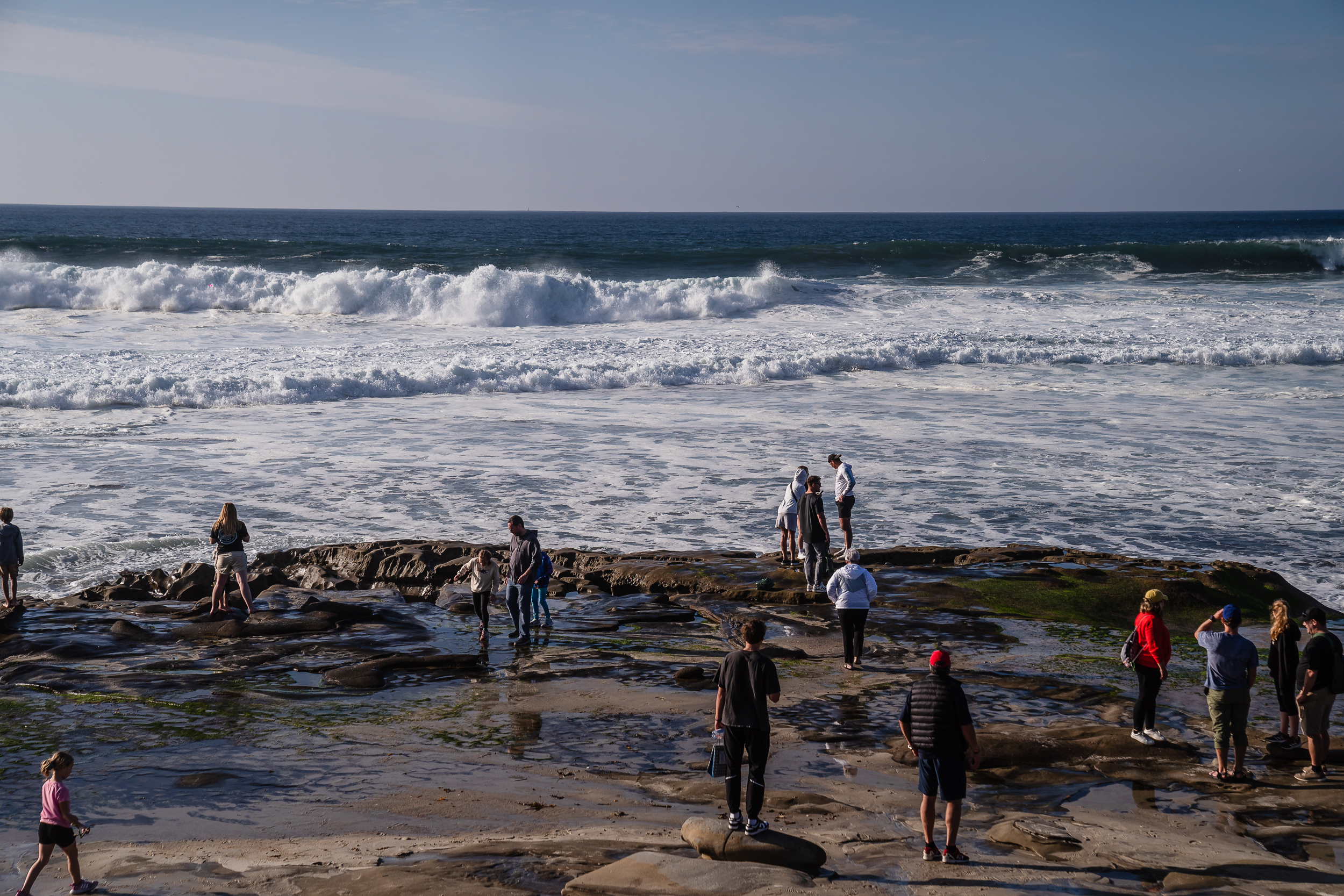
Last week, reporter Jakob McWhinney wrote about the on-again, off-again attempt by some San Diegans living in the La Jolla neighborhood to divorce San Diego and create their own independent city. (It’s currently very much on-again.)
That effort is unlikely to succeed for a whole number of reasons, but particularly because it would require voters across San Diego to allow them to secede.
On last week’s Voice of San Diego Podcast, Mayor Todd Gloria shared a hot take: He doesn’t think La Jolla voters would actually support it after they figured out what they’d have to take on. “If there’s a separation, there’s a separation. So, the city of San Diego will not be providing policing services, landfill services, sewage services … We will not be contracting them.”
Proponents of independence have made no secret their interest in potentially contracting singular services from the city of San Diego. They’ve even pitched it as a potential source of income for San Diego.
But to Gloria, it seems like a nonstarter. “As a Mayor, I wouldn’t recommend it,” he said.
Read more here and listen to the whole podcast episode here.
Related: Councilmembers unanimously selected their colleague Joe LaCava to serve as the Council President. LaCava represents the neighborhoods of La Jolla, Pacific Beach, Torrey Pines, Carmel Valley, University City and Del Mar Mesa on the City Council. (Axios)
He has been an ally for Mayor Gloria on divisive topics like the large shelter proposed in Mission Hills at Kettner and Vine.
One outstanding question: McWhinney asked LaCava for his take on La Jolla’s efforts to secede from the city of San Diego. He lives in La Jolla.
But he didn’t have a position on the issue, his staff told us. He does not have a take on whether his neighborhood should be part of the city of which he is now the second most prominent leader.
Did the 2028 Mayor’s Race Just Start?
City Hall observers were buzzing about Councilmember Raul Campillo’s speech after he was inaugurated for a second term. It included a promise that he would work to put another sales tax measure on the ballot in 2026. And he pointedly blamed the city’s financial hardship on a vote 22 years ago.
Wait, what, why? The vote he was referring to was the notorious decision in 2002 to both enhance city employees pensions while the city also decided not to pay as much in the pension system as was required. It was an open deal with the pension committee’s member’s who represented labor groups: Their workers got better benefits and, in exchange, the city could balance its budget easier.
The vote began the pension crisis, which dogged city politics for, well, apparently, forever. Here was Campillo’s comment:
“In November 2002, our City Council doubled down on a mistake they had made a few years prior: It stared at a budget deficit like we are doing right now, but instead of responsibly asking for a new revenue source like I just did, our then-leaders raided the pension, on the consent agenda nonetheless, which spurred federal investigations, destroyed the public’s trust in us for a generation, denigrated the honorable public servants who revealed the problem, and caused our liabilities to balloon so badly that mayors and councils have undermined our own city workforce and left our neighborhood infrastructure to crumble,” he said.
The real target: The seemingly random comment was almost certainly an allusion to Rep. Scott Peters, who was on the City Council at the time and is considered a potential candidate for mayor, like Campillo.
Related: inewsource published a fascinating map on how neighborhoods in the city of San Diego voted on Measure E, the sales tax increase, which failed. Greg Moran writes that, “a look at the vote breakdown across the city shows a demonstrable split along the city’s longstanding dividing line of Interstate 8.”
Battery Building Could Become Harder in San Diego County

San Diego Supervisors learned a key lesson Tuesday: Their fire chief can impose stricter fire safety rules on battery storage projects without their blessing.
And that’s just what San Diego County Fire Chief Tony Mecham will do until the state updates California’s fire code related to renewable energy battery installations.
“The Fire Chief for the San Diego County Fire Protection District has the authority to … make additional requirements on projects to adequately address public safety, fire suppression and firefighter protection,” wrote Jeff Collins, director of San Diego County Fire in a statement.
Battery developers were wringing their hands over the proposed rules claiming they would render projects infeasible. Collins went on to say that those rules “capture county fire’s expectations for proposed battery projects” until the national and state fire codes get updated.
So, it seems developers should expect to make changes to their project’s design and it remains unclear whether some will back out altogether because they won’t pencil under new rules.
Originally, the board of supervisors met Tuesday to vote on some proposed rules until lawmakers learned the fire chief can do that on his own. It was a “what’s our role” moment for the board which ultimately voted to simply accept a report from their fire district on suggested ways to provide more space around and between battery cells and ease residents’ concerns.
Toxic Chemicals Found in Sweetwater Reservoir

The agency that supplies drinking water to thousands of South County residents recently announced that it had discovered toxic industrial chemicals in its reservoir.
Our Jim Hinch reports that the level of PFAS chemicals, also known as “forever” chemicals because of how long they remain in the environment, were discovered in October.
The levels found in the reservoir exceed state and federal standards, but the leader of the Sweetwater Authority told Hinch the water is still safe to drink. The water agency is conducting more testing and then will determine if they need to install new treatment systems.
Bad timing: The alert comes at a time when the agency is facing a lot of scrutiny from rate-payers because the agency also recently discovered that its dam requires more than $20 million in repairs. A proposal to install floating solar panels on the reservoir has also stirred up opposition.
More South County news: In the latest South County Report, Hinch also follows up on the Sweetwater Authority’s new board members and a spicy National City meeting.
San Diego Unified Officials Announce Solutions for Some of Its Deficit
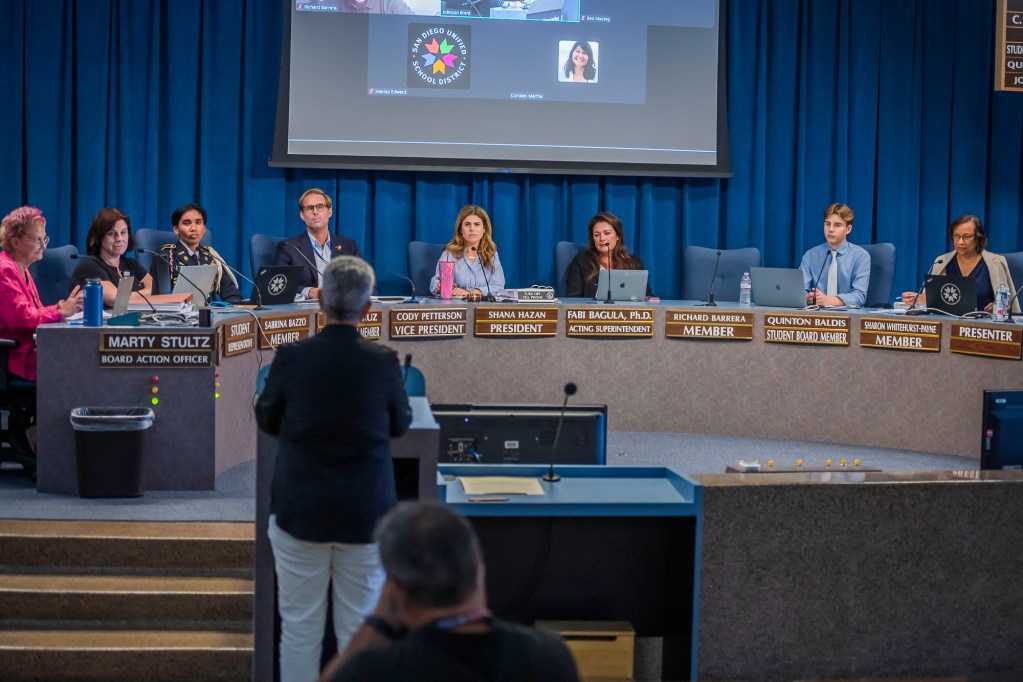
San Diego Unified officials announced yesterday they’d cut more than $60 million from next year’s budget deficit. That leaves a $113 million gap left to bridge.
The savings are coming from a couple of different places. First, the district expects it will receive additional funding from the state and federal government. Officials have also chosen not to fill some vacant roles, implemented incentives for early retirement and plan to spend $58 million in reserves.
Not out of the woods: While these moves have helped drive down some of next year’s deficit, the district is facing an even bigger $211 million deficit the following year. Officials like board member Cody Petterson have pledged to look for long-term fixes.
“The idea that we’re going to burn the furniture here for one-time savings, I believe this board will be committed to finding consensus solutions that will be enduring,” he said.
Exactly what those fixes will look like is still unclear, but Shana Hazan, president of the district’s board, has said she doesn’t expect any significant cuts to services for students despite acknowledging that “we do need to right size, and we do need to recalibrate.”
She also expressed confidence that the district will not have to resort to teacher layoffs this year. Instead, she said they’re turning to significant cuts in the district’s central office staff.
Song of the Week
Spacehall Sound Machine, “Hold It Together”: The band’s sound is underpinned by Bozzone’s driving, authoritative drum lines and is gilded with seductive and ghostly keyboard and guitar parts. In many ways, “Hold It Together,” is the EP’s most basic track. Unlike the more frilly “Piledriver,” or “Dark Horse,” the track embraces emptiness, allowing brief riffs or whirrs of synthesizer to echo into the nothingness.
Read more about the Song of the Week here.
Like what you hear? Check out Spacehall Sound Machine at Soda Bar on Thursday, Dec. 19.
Do you have a “Song of the Week” suggestion? Shoot us an email and a sentence or two about why you’ve been bumping this song lately. Friendly reminder: all songs should be by local artists.
In Other News
- The city of San Diego and Seaworld have reached a settlement in the yearslong battle to get the park to pay back rent. Seaworld will pay the city $8.5 million, close to what the city said it was owed, but less than what the city was suing for. The terms of the settlement also require the park to give some residents passes to visit the park. (City News Service)
- San Diego County Supervisors voted 3-1 to keep the county from granting access to Immigration and Customs Enforcement, or ICE, from using county resources such as facilities and staff. (CBS 8) As Voice contributor Kate Morrissey previously reported, such policies and actions don’t prevent ICE from enforcing immigration laws.
The Morning Report was written by MacKenzie Elmer, Jakob McWhinney and Andrea Lopez-Villafaña. It was edited by Andrea Lopez-Villafaña.
California and San Diego are so poorly run that people are fed up. This should be an eye opener and we need better leaders and policy. Use our tax payer money properly and efficiently.
How many of those voters would still vote for Measure E, now knowing that the politicians had already planned to hijack the money and continue to ignore the infrastructure problems? Their votes were wishful thinking, just like increasing the gas tax seven years ago was going to fix our roads. As long as there is money to waste, the politicians will find a way to waste it.