
Read our series of Q&As with candidates vying to replace recently resigned Board Chair Nora Vargas. Click here.
San Diego City Councilmember Vivian Moreno starts answering questions before they’re even asked.
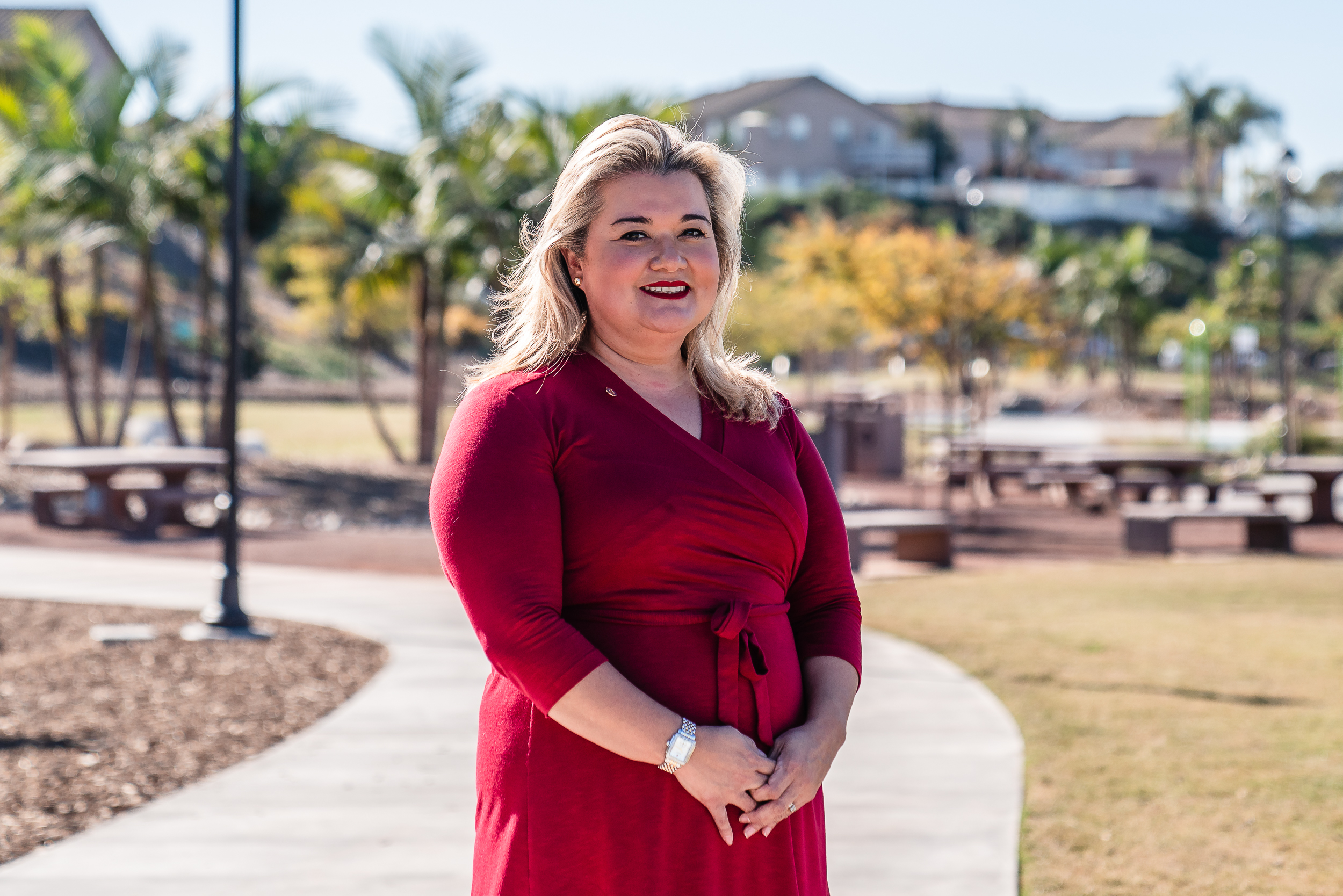
Arriving at Riviera del Sol Park in Otay Mesa last week for an interview about her bid to become South San Diego County’s next representative on the County Board of Supervisors, Moreno barely paused to say hello before launching into a detailed explanation of how she used her political leverage to get the park built after years of inaction.
“This was…one of my first budget actions,” she said of her efforts to complete Riviera del Sol and refurbish or complete other parks in her South San Diego Council district that were vacant lots or in need of work when she took office. “I’m showing you how [South San Diego County] has been left behind. And I’m also showing you the work that I’ve done as a legislator that I am going to do as a Supervisor that will really change and address a lot of the issues that the county has with the South Bay.”
Moreno, a Democrat, was elected to the San Diego City Council in 2018 following a career as a broker-buyer in the metal industry and stints volunteering for local Democratic candidates. She was re-elected in 2022 after gaining a reputation as a centrist who forged mostly amicable relationships with labor unions, law enforcement and the building industry.
Asked why she was running to replace recently departed Supervisor Nora Vargas, who resigned for unexplained reasons last month, Moreno said, “I got involved in politics because I knew that this is where you enact change.”
She also, unexpectedly, cited her Catholic faith. A member of Our Lady of Guadalupe Jesuit Parish in Logan Heights, where she was confirmed six years ago and married in 2022, Moreno said, “I am both a Catholic and I am a politician…When I became a Councilmember, I knew I needed Jesus in my life so I got confirmed after I was elected.”
Born in San Diego in 1982, Moreno graduated from Bonita Vista High School and went on to attend Southwestern Community College and the University of California, San Diego, where she graduated in 2007 with a degree in political science and international relations. She now lives in Ocean View Hills, where she and her husband, Miguel Angel Rodriguez, recently bought a home.
If elected Supervisor, Moreno said she would seek to speed up housing construction in San Diego County, work to abolish the toll on State Route 125 and ask “hardline questions” in county agencies—especially those dealing with homelessness and behavioral health—that she said had moved too slowly to address some of San Diego’s most pressing problems.
Above all, she said, she would seek to reverse what she described as years of government neglect in South San Diego County. “Just because we did it a certain way does not mean we need to continue doing it that way, right?” she said. “My impression is that the work is not being done.”
Editor’s note: The following interview, the second in Voice of San Diego’s series of in-depth conversations with candidates seeking to represent District 1 on the Board of Supervisors, has been condensed and edited for clarity:
Q: You said homelessness will be one of your top priorities on the Board of Supervisors. How do you plan to tackle the problem?
A: I think the county hasn’t addressed to its fullness our unsheltered population. I think it’s been left to the cities to figure it out. And as an elected official myself, I think that is an injustice. Not only for the cities, but obviously for the individuals that are out there unhoused. So, I certainly propose to take a more robust role in that effort. With homelessness, the county is the one that gets the funding. The county is the one that’s able to tap into the funding. So, the county absolutely needs to step up.
Q: How will you ensure the county does more?
A: Being a representative of the eighth largest city of the United States of America, I will say that these are really big bureaucracies, right? These are really big entities that have been doing things a certain way. And I remember going into the city [of San Diego] and saying, “Okay, but why are we doing it like this? It doesn’t make any sense anymore.” So, we absolutely need somebody that will hit the ground running on day one and ask some really hardline questions and work collaboratively.
Q: Where do you feel the county’s response has been inadequate?
A: Mental health. That’s one of the biggies. S[enate] B[ill] 43 [a recent state law that gives government authorities greater power to compel people with mental illness or drug addiction into treatment] is a topic that we’re not ready for compared to some of the other cities in the state of California. In San Diego County, my impression is that the work is not being done, right? Important work that needs to be done in order to fly the plane isn’t being done. The engine isn’t being checked and we’re about to take off. And so, one of the priorities is making sure that [county] management lines up with the Supervisors and we’re holding people accountable. We need the county to be the lead on this, which we have been lacking. That’s the issue. Everybody’s been working in a silo. We need the county to take the lead.
Q: Why hasn’t the county taken the lead?
A: Because they don’t have Vivian Moreno as a supervisor.
Q: Ha! But seriously, do you think there needs to be a change in leadership in departments responsible for addressing homelessness and mental health?
A: I think I would not be able to answer that.
Q: That’s not the same as saying you support the current leadership.
A: I will say that, like any leader that comes into any position, you need to make an assessment of what’s going on. So, that’s going to require me on day one to have meetings with all the directors to get the lay of the land. Talk to the unions, see what’s happening with staff, right? Where are we falling short?
Q: You also mentioned removing the toll on SR125. Why is that a priority?
A: We’re double taxed on that highway. State [taxpayer] funding was utilized to pay for that toll road. And every single time somebody pays for the toll, they’re getting taxed again. I voted no on the Deloitte contract [a controversial sole-source toll-collection contract hastily approved last year by leaders of the San Diego Association of Governments, which manages SR 125]. I said it’s rushed. This seems like a quick fix. And, you know, I’ve been in politics long enough to know that there is no quick fix. And now we’re seeing it’s going to cost more money. And why does that matter? Because we’re the only region [in San Diego County] where we have this toll. I have a lot of friends and family in East Lake and in the Bonita area, and they’re getting double taxed. And I don’t think that’s appropriate.
Q: What are your other transportation priorities?
A: I’ve been a huge advocate for the Blue Line [Trolley route] and the San Ysidro Intermodal Transit Center. The reason I’ve been focused on San Ysidro is because every single day, 12,000 individuals jump on the San Ysidro trolley. We’re an international welcoming mat in San Ysidro, and yet the Metropolitan Transportation Service focuses so much time and effort on serving [the] Comic-Con [convention]. I’m a San Diegan, so, you know, God bless Comic-Con. But in four days of Comic-Con, you have the same amount of people jump on the Trolley as you do on any given day in San Ysidro. My vision for the San Ysidro Intermodal Transit Center is for it to be like the train station in Munich. Where you walk in and it’s like, “Wow, where am I?” And that’s welcoming you to the United States of America.
Q: You mentioned several times that South County has been neglected by government agencies. Why do you think that happened?
A: I ask myself this question all the time. Why? Why? It’s the district that I was raised in. To know that, growing up, I wasn’t afforded the same opportunities that a kid north of Interstate 8 was, to me that’s ridiculous and I want to stop that.
Q: Was racism a factor?
A: I mean, I will say that the county government’s [demographic] makeup 20 years ago was not what the community’s makeup was, right? It absolutely wasn’t. And I know we had a fierce leader in [former District 1 Supervisor] Greg Cox. And he absolutely built the library in Bonita, and he built a new Boy Scouts camp. But I don’t know. There wasn’t the political will [to make more systemic changes], I guess.
Q: You haven’t mentioned the Tijuana River Valley sewage crisis. It’s a major district priority. How do you plan to address it?
A: I live in Ocean View Hills. I wrote an op-ed about my experience [living close to the Tijuana River] and I called upon my congressional leader to come out and smell what we’re smelling, smell what my seven-day-old child had to smell. I kind of opened up and became a little vulnerable in that situation. It’s an issue that the South Bay has been dealing with for many, many years. Decades. And the federal government is the one that adheres to the 1943 Clean Water Act. The International Boundary Waters Commission [responsible for treating cross-border sewage] is a federal agency, right? They are tasked with addressing this issue and they’re not doing their job.
Q: Last policy issue. You said you want to speed up housing construction. What’s your view of the county’s Vehicle Miles Traveled policy, which seeks to limit development in far-flung parts of the county that generate longer commutes?
A: That has been an absolute issue in Otay Mesa here. It’s making it more difficult to build. Also, the data used to craft the policy doesn’t take into account the folks that come into San Diego County each day from outside the county. We have 70,000 people crossing the U.S.-Mexico border every day. Other people commute from Riverside because they can’t afford a home in San Diego. It might be that by limiting development here, we’re actually forcing people to drive even farther.
Q: Anything else you want voters to know about you?
A: Number one, I am going to represent Democrats, Republicans, decline to state. I’m going to represent everybody. So, I have to have my doors open for everybody. I’m not the expert in everything. So, I am going to seek expert advice. I want to hear from the people who are living in this district. I want to hear from developers. I want to hear from environmentalists. I want to hear from folks so that I can be educated in my decisions. In me, you will get a person that is intelligent, that is open and that is thoughtful. But the lens that I will always look at everything through is District 1. District 1 constituents are my bosses. They’re the ones that tell me how high to jump. They’re the ones who could hire and they’re the ones who could fire me. So, they are the ones that I’m going to listen to always.
She talks out of both sides of her mouth. She says south bay residents are “double taxed” by paying a toll on the 125. Yet she voted to put prop B on the ballot. that requires taxpayers to now be “double taxed” by paying for trash pickup. She also fails to mention (or doesn’t know the history) that that stretche of 125 that has a toll was built by a private comp as a toll road. When SANDAG purchased it, the only way the deal penciled out was by keep it a toll road until the loan paid off. It’s a similar situation as the Coronado bridge that charged a toll until it was paid off. She is clearly pandering to voter by promising free stuff once again.