

More than four years after San Diego voters backed the creation of the Commission on Police Practices, a City Council committee is recommending city policy changes to address challenges that have snarled the effort.
For now, no specific changes are on the table for a commission that has yet to fully fulfill the independent oversight role that voters envisioned in 2020.
At Councilmember Marni von Wilpert’s urging on Wednesday, the council’s public safety committee voted 2-1 to have the commission, its attorney, her office and the City Attorney’s Office work on potential reform proposals. The plan is to present them at a future committee hearing before taking them to the full City Council.
Wednesday’s vote followed the departures of the commission’s former executive director and attorney who each wrote exit memos suggesting changes at the commission chair’s request. It also followed Police Chief Scott Wahl’s recent announcement that his department won’t adopt stricter pursuit policies that the commission recommended.
von Wilpert said Wednesday she doesn’t want the city to begin searching for a new executive director until it gets a handle on “why people are resigning and why we’re not succeeding yet.”
Most commissioners and advocates who spoke at Wednesday’s meeting argued that the commission should maintain its independence and get time to work out its problems.
“I think the CPP status is no fault of its own,” Commission First Vice Chair Ada Rodriguez said after a formal commission presentation. “The commissioners were appointed before a full working staff, and I think we deserve a chance to operate how it’s intended before we try to make so many changes.”
von Wilpert said the City Council committee will get another update from the Commission on Police Practices in April.
All Californians Will Feel the Burn of LA Fire Claims

The California FAIR Plan will impose a $1 billion charge on insurance companies to cover claims from the Los Angeles fires last month, California Insurance Commissioner Ricardo Lara announced Tuesday.
That means … commercial insurers will in turn pass the costs along to homeowners, raising costs for ratepayers throughout California.
The FAIR Plan is an insurance pool that covers homeowners in high fire risk areas of the state. Between 2020 and 2024 the number of FAIR Plan policies more than doubled, from 210,007 to 463,158. In San Diego County, FAIR Plan policies nearly quadrupled from 9,670 to 37,375.
Lara wrote that this is the first time the state has approved assessments in more than three decades. He also added that the need to assess money from commercial insurers shows the FAIR Plan isn’t working.
“The fact that we are once again facing this issue 30 years after wildfires devastated these same communities highlights the need for change,” Lara said in a statement. “Thirty years of stagnant regulations have placed more people at risk.”
Palomar Health’s Credit Rating Downgraded Again
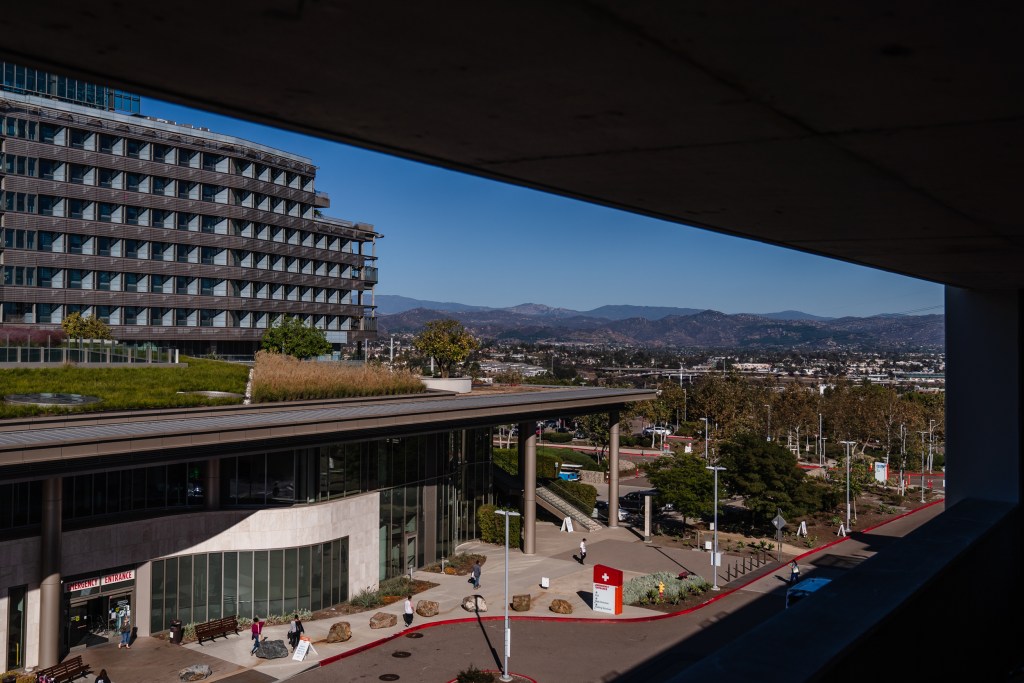
Palomar Health is getting hit with some more bad news.
Moody’s, one of the world’s big-three credit rating agencies, has downgraded the public healthcare system’s credit rating once again.
Palomar’s rating went from Ba2 to Caa3; in other words, it went from having a substantial credit risk to having a very high credit risk and being of poor standing, according to a report by Becker’s Hospital Review.
The lower rating reflects Palomar’s thinning liquidity, which refers to how much cash is readily available, or how quickly something can be converted to cash. It also reflects an increased risk of “bankruptcy filing or liquidation,” the report says.
In December, the hospital system, which operates Palomar Medical Centers in Escondido and Poway, revealed that it had a $165 million operating loss in its previous fiscal year, the Union-Tribune reported.
In 2023, Voice of San Diego was the first to report that Palomar Health financial position was rapidly declining. It’s part of a larger trend of hospitals across the nation seeing less patient volume and less overall revenue.
The Moody’s report did note that Palomar Health, with help from consultants, has found areas for potential improvement in 2025.
Trump Adds San Diego Billionaire to Kennedy Center Board
President Donald Trump has appointed San Diego real estate magnate Doug Manchester to the Kennedy Center for the Performing Arts board.
Manchester was one of Trump’s many new appointees at the arts institution including onetime San Diegan Richard Grenell, who is now the Kennedy Center’s interim executive director.
Not his first appointment: Trump appointed Manchester, former owner of the San Diego Union-Tribune, to serve on the Kennedy Center board during his first term in 2020. Trump also repeatedly nominated Manchester to serve as the U.S. ambassador to the Bahamas before the San Diegan withdrew the nomination, citing safety threats. After the 2019 announcement, a CBS News investigation revealed what it deemed a “possible pay-to-play scheme” between Manchester and the Republican National Committee.
In Other News
- There are people who are still trying to make the revitalization of San Diego’s civic core happen. Last year, Mayor Todd Gloria halted plans to give San Diego’s Civic Center a facelift because of budget troubles. But Axios San Diego reports that private groups are still working on a vision.
- Speaking of budgets … one county supervisor wants county staff to look for ways the county can raise revenue in an effort to get ahead of possible federal program cuts and tariffs. San Diego Board of Supervisors Chair Terra Lawson-Remer said she wants “no stones unturned.” (KPBS)
- Is connecting San Ysidro and Sorrento Mesa with a trolley realistic or a fantasy? KPBS reports that the long-planned project, known as the Purple Line, has a high price tag and some engineering challenges to overcome.
- A San Diego federal prosecutor appointed by President Joe Biden was fired on Wednesday. (Times of San Diego)
- San Diego’s breweries are struggling to stay open. At least 11 have closed since last year. (NBC 7)
The Morning Report was written by Lisa Halverstadt, Deborah Brennan and Tigist Layne. It was edited by Andrea Lopez-Villafaña.
The only reason to dip the Purple Line into Mission Valley is to pick up a handful of riders there, since the goal was to connect the South Bay with Sorrento Mesa. Just build a bridge over the valley, like the 805, and, if you really need a Mission Valley Station to connect with the Green Line later, build a 100% affordable housing high-rise to enclose an elevator to a mid-span station. That ought to save $10 billion or so…