

A state program that supports schools in their efforts to partner with the community in order to improve student outcomes has been praised for its success. Now, the funding behind it is set to expire.
Community schools receive grants from the state to offer additional resources to students and their families, like dental or vision care, workshops for parents, tutoring, after school activities and more. The school’s district also has to chip in.
Chollas-Mead Elementary is one of 25 San Diego Unified’s community schools. State funding has allowed the school to provide a sort of pantry for the community filled with canned food, cleaning supplies, clothes, school supplies and more. The school also brought on a social worker, added more sports programs and more.
The approach has led to students and families feeling more supported, connected and safe.
But our Jakob McWhinney reports that these grants have a sunset date – in other words, the program could end in the coming years if the district can’t pitch in.
That’s going to be tough given that San Diego Unified is facing a big budget deficit.
More on schools: We’re hosting a workshop on Saturday, March 1, for our A Parent’s Guide to San Diego Schools. Our reporters and editors will be at the City Heights Library at 2:30 p.m. to answer all your questions. You can download the guide here.
Lessons From San Diego’s Camping Ban

It’s been eight months since a U.S. Supreme Court ruling gave cities the power to clear homeless encampments regardless of shelter availability. CalMatters reporters investigated some of the impacts of San Diego’s unsafe camping ordinance on homeless people and homeless service providers.
Remember: San Diego’s ordinance prohibits tent camping in all public spaces if shelter beds are available, and near homeless shelters, schools, parks and transit centers regardless of shelter availability.
Here’s what CalMatters found:
- Even though code officers put homeless people’s belongings in storage after clearing an encampment, some homeless people have lost their valuables – like IDs, birth certificates, medication and dog food. Code officers told CalMatters that some things are missed because they are in pockets or containers or are sometimes mixed into a bag with drug paraphernalia or spoiled food items.
- The ordinance has made it more difficult for some service providers to stay in contact with homeless people. Outreach workers who regularly visit encampments to maintain engagement, provide wound care, give counseling and more find it more difficult to keep track of homeless people because they are now moving around more often.
- Many homeless people are camping on state property – freeway ramps, under bridges, overpasses. San Diego police cannot enforce city ordinances on state land.
Cajon Valley School District Sued by State Over Sexual Health Curriculum
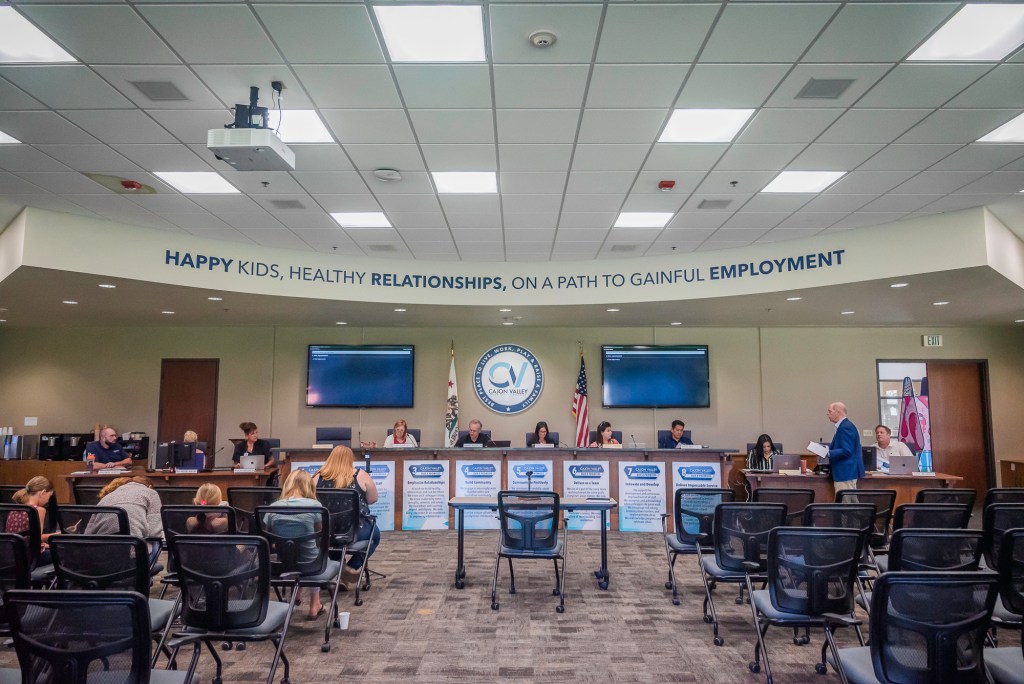
The California Department of Education has filed a petition asking a judge to force the Cajon Valley Union Elementary School District to comply with state law regarding LGBTQ+ inclusion in its sexual health curriculum.
This is the latest skirmish in a simmering culture war that’s hit the district. The department of education’s lawsuit comes after state investigators issued a report in July notifying the district that its sexual health curriculum was out of compliance with various elements of state law.
Specifically, state officials found the curriculum did not acknowledge that people with sexual orientations other than heterosexuality exist and did not include information about same-sex relationships, gender expression and identity or the impacts of negative gender stereotypes. State officials gave the district until January to adopt a new sexual health curriculum that did comply with state law.
In September, the district submitted an updated version of the curriculum. State officials determined the new curriculum did comply with state law, but the district’s board never officially approved the updated curriculum. Last month, the state notified the district that in order for the district to be in compliance, the curriculum must be “operative.” In other words, the board had to approve it.
Despite the warning, at a board meeting later that month, district trustees voted down the new curriculum.
In Other News
- The Port of San Diego has been quietly removing the language of diversity, equity and inclusion from its website for months, starting with renaming its DEI team the Culture of Belonging team back in October. But the agency says it’s not disguising DEI efforts from the federal government. (Union-Tribune)
- Video footage released last week of a San Diego police officer shooting and killing a teenager in January is raising some questions about whether the shooting was legally justified. (KPBS)
- A proposal to increase the minimum wage for San Diego’s tourism workers is moving forward, causing friction between the city’s labor groups and the city’s business community. (Axios San Diego)
The Morning Report was written by Tigist Layne and Jakob McWhinney. It was edited by Andrea Lopez-Villafaña.