
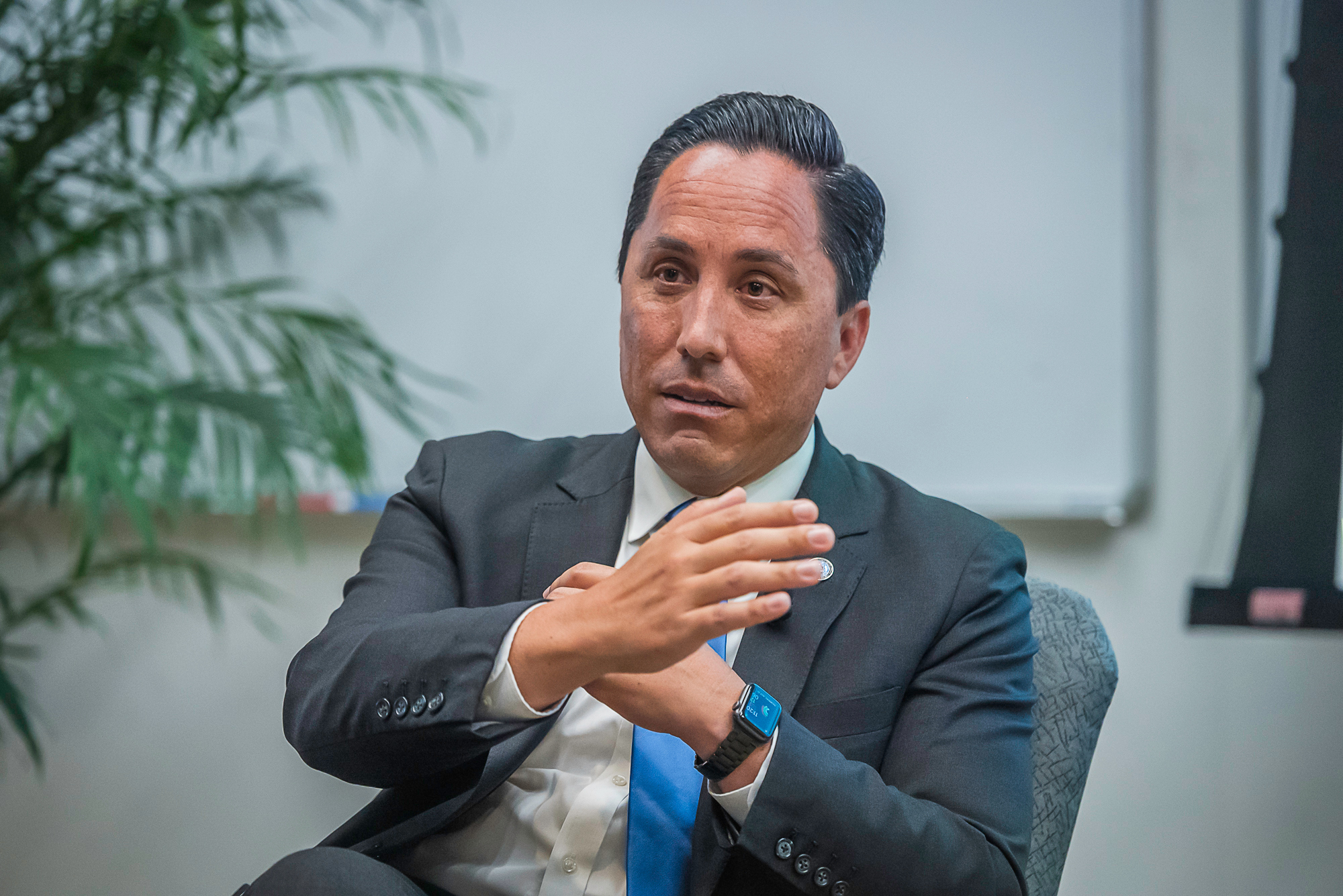
San Diego Mayor Todd Gloria is co-sponsoring state legislation that could lead to more conservatorships for people with serious psychotic illnesses who languish in the CARE Court process.
A few years ago, Gloria was among the CARE Court proponents who envisioned that people who struggled in the program could end up in involuntary treatment.
“While CARE Court is not conservatorship, it could eventually lead to conservatorship,” Gloria said at a May 2022 press conference announcing the legislation championed by Gov. Gavin Newsom.
The law Newsom signed later that year hasn’t played out that way in San Diego County. County officials say CARE Court isn’t a pathway to conservatorship and report that no CARE enrollees have ended up on conservatorships as a direct result of the process. They emphasize that CARE is a voluntary program and only enroll people who choose to participate. While the county and others have hailed San Diego’s CARE Court rollout as the most successful in the state, these moves don’t match the rhetoric that surrounded the legislation.
The city of San Diego and its police department are among those frustrated with the county’s approach. They argue that San Diegans in the gravest conditions often aren’t willing to accept treatment voluntary – and that these individuals often most disturb other San Diegans and generate emergency calls.
Since the county isn’t proactively exploring potential conservatorships for struggling CARE participants, Gloria teamed with state Sen. Ben Allen of Santa Monica and the California State Association of Psychiatrists on SB 367. The bill that would give other players –including Superior Court judges who oversee CARE cases – the authority to request investigations that could lead to involuntary care.
For now, only the county can directly issue those orders and it says it hasn’t pursued any. The county does say its teams have called first responders – namely Psychiatric Emergency Response Teams and Mobile Crisis Response Teams – “many times” when they have encountered people in crisis during the CARE process. It’s unclear how many of those calls led to up to 72-hour evaluation holds that sometimes trigger the process for longer-term conservatorships.
SB 367 would allow stakeholders including judges, emergency room doctors and psychiatrists to request investigations by county conservators’ offices. Allen said the goal is to empower more players to act and help vulnerable people with psychotic illnesses avoid unnecessary encounters with police or hospitals.
“The hope is by allowing more people the authority to refer for a conservatorship investigation more people in need will be considered for the appropriate level of care,” Allen told Voice of San Diego.
Gloria spokesperson Rachel Laing struck a similar tone in a statement.
“This legislation will address gaps in existing law to ensure the extremely vulnerable people we’re trying to help can access care,” Laing wrote.
Since San Diego County’s CARE Court program rolled out in October 2023, the county reports that it has reached 105 voluntary treatment agreements that have helped participants stabilize, access medication and move off the street.
In a statement, the county emphasized this statistic and described CARE as a “valuable new tool to address community mental health needs.” It also emphasized how its program has been viewed across the state.
“The local implementation of the CARE Act is widely regarded as the most successful in the state,” county spokesperson Tim McClain wrote in a statement. “From our vantage, the San Diego County Superior Court has thoughtfully considered, approved, and monitored individually tailored services delivered for each of the 105 participants. We look forward to continued success.”
But as of last week, 49 of 285 CARE petitions for treatment – or 17 percent – were dismissed because a person refused to participate.
Statistics like these and the city’s own experience with CARE have led city officials to conclude that the voluntary program is leaving behind the most vulnerable San Diegans.
In partnership with the state psychiatrists’ association, the city and its representatives have urged legislative tweaks including SB 367 to ensure people whose conditions are deteriorating are linked with treatment whether or not they agree to participate in CARE Court. This push has been a focus in meetings with legislators and in an October memo to Gov. Gavin Newsom before a virtual gathering with his team this fall.
“CARE cannot help the severely mentally ill when voluntary willingness is the only way to enter the program,” unnamed city officials wrote in the October memo.
San Diego Police Officer Dave McGowan of the police department’s Intervention Services Unit, which typically focuses on people in crisis who often generate lots of police calls, said people with psychotic illnesses who police are called to help often aren’t being pushed into treatment.
McGowan argued that people in the gravest conditions whose behavior most disturbs other San Diegans often aren’t willing or able to voluntarily accept treatment and noted that CARE Court doesn’t factor in whether a person is generating a significant number of emergency calls when considering who qualifies. (The latter is something the city is also lobbying to change.)
McGowan, who has submitted multiple unsuccessful CARE petitions, said the department has watched multiple patients languish after petitions were dismissed. He declined to detail specific cases, citing federal privacy protections.
Through mid-January, county data showed 12 of the 48 CARE petitions submitted by first responders including police officers resulted in voluntary care agreements. First responder submissions accounted for 19 percent of CARE petitions in the program’s initial 15 months.
The city noted in its October memo to Newsom that some patients’ use of emergency medical services spiked after CARE Court dismissals.
“We need options for those who are unwilling or unable to engage voluntarily,” McGowan told Voice earlier this year.
Amber Irvine, program manager of the county’s CARE Court program, said last month that the city isn’t seeing the whole picture – and that the county isn’t giving up on vulnerable San Diegans. She said the county engages a person repeatedly after a petition is submitted and asks other outreach teams to follow up after dismissals in hopes of connecting them with treatment.
“I think there’s some unrealistic expectations around the timeframes of being able to effectively engage someone,” Irvine said.
Now the city is pushing legislation to give stakeholders other than the county power to order evaluations during the CARE process and beyond.
Dr. Aaron Meyer, vice chair of governmental affairs for the state psychiatrists’ association, said Allen’s bill is an attempt to create the connection between CARE Court and conservatorships that was originally envisioned.
“SB 367 brings back the initial goal of CARE Court in being able to directly refer for a conservatorship investigation,” said Meyer, also a UC San Diego psychiatrist and the city of San Diego’s first behavioral health officer.
Meyer and city officials argue other changes are also needed to the CARE Act.
Among the other items on their laundry list of proposed tweaks: Updates to confidentiality protections in the CARE ACT they say can now make it difficult for first responders and other medical providers to make the case for involuntary treatment. They also want to allow government agencies rather than just individuals to list themselves as petitioners when recommending someone as a CARE Court participant, updates to forms that petitioners must file and more data reporting to track outcomes for people who were the subject of CARE petitions.
For now, the city’s lobbying continues.
The county says it will “monitor any proposed amendments to the (CARE) Act.”
The County should have gone all in on Laura’s Law. It would have saved a lot of people unnecessary grief.
Daniel Smiechowski is challenging Mayor Todd Gloria for re-election, after previously running in 2018 and 2022 to represent City Council District 2.
To help inform voters, the San Diego Union-Tribune asked all the candidates a series of the same questions about their priorities, positions and campaigns. Their emailed answers have been lightly edited for clarity.
Why are you running, and what makes you the best candidate?
I am running to change the direction of city government from one owned by the developers to one beholden to the citizens of San Diego. I am motivated by the idea that the noblest motive is to serve. It is my desire to bring new solutions to recurring problems. When I am elected, I will implement long-term solutions that will allow me to serve as mayor and retire from public service knowing that my service made a difference.
I am the best candidate because I have spent my life advocating for the citizens of San Diego; I am not a career politician. I have no desire to continue in public office after I have been elected mayor. For those reasons I will make decisions that will not further my political career but will be what I consider to be in the best interests of my fellow citizens.
What are the top 3 issues facing the city?
00:10
02:00
Read More
1. Reducing the cost of housing in San Diego.
2. Solving the homeless problem.
3. Reducing the expense of running our government.
What are the first 3 things you would do in office if elected?
The highest priority in my administration is to stop all projects that involve the sale of city-owned land. I would lease city land, using the Port District model of stewardship in administering the use of our land. All rezones would be approved with the developer selling the rezoned land to the city.
I would institute a 10% pay cut of all salaries in city government that exceed $150,000. I would put into effect a hiring freeze on all positions where the base salary is $150,000 or more. I would eliminate and consolidate departments that have high overhead. I would use the savings to hire more employees who provide service, not supervision.
All new hires in the city government would be enrolled in Social Security. I would liquidate the current pension program by not covering any more employees. Eventually the city will pay off the multibillion-dollar debt that keeps growing.
Do you support a 1-cent general city sales tax increase, and/or a half-cent county sales tax increase that would fund transportation? Why or why not?
The way to control government spending is to control expenses not raise taxes. If the city had adopted a policy of leasing their land when the Port District started it, the city would be just like the Port District relying only on lease payments not taxes.
Fiscal responsibility starts with a mayor who will cut salaries and pensions. San Diego is required by law to balance its budget. Instead of selling our land to balance the budget, lets reduce the cost of government. Raising taxes only increases expenses by encouraging new costs.
What should the city do to combat its housing crisis?
The price of housing doubles every 10 years because the value of the land increases.
The solution to both problems is to stop selling city-owned land and lease it like the Port District.
I will build a low-income high-rise apartment complex on leased city-owned land. I will require that the units have four private bedrooms, two full baths and a kitchen. The lease payments will be predicated on a percentage of the gross rents over 60 years. The winning bid will have purchased the right to use the land at less than 25% of the cost of a comparable project. At the end of the 60 years the land comes back to San Diego and we can do it again.
This will provide a comparable sale for a leasehold estate. It will demonstrate the feasibility of building low-income housing that pays for itself without using government subsidies.
How should public safety and civil liberties be balanced when it comes to homelessness enforcement, behavioral health policy and police surveillance?
Public safety and civil liberties cannot be thought of as a scale in and out of balance. This is an illusion created to confuse the voters as to the core problems we face in San Diego.
There is no comparison when addressing unfair laws that criminalize poverty and poor healthy policies that fail to address the core issue of healthcare.
Police surveillance has nothing to do with poor health policies and the homeless.
The solution to these problems is leadership that has a desire to address each of these issues as separate problems with unique solutions.
Recent flooding has brought new attention to failures of city infrastructure, and how the effects of climate change can disproportionately impact poorer neighborhoods and communities of color. How should the city combat this?
A short-term solution is to educate and involve the citizens of San Diego to take responsibility for their own streets and drains. A neighborhood watch program that cleans the sewer grates of leaves and debris before the streets floods reduces the load on our city employees.
The real problem is poorer neighborhoods do not have large campaign donors who can influence politicians when they prioritize spending on infrastructure. The older pump stations are located in the poorer neighborhoods. Giving priority to their replacement instead of the more affluent areas of town would be the tide that raises all boats equally.
San Diego faces a big budget crunch, along with a nearly $5 billion infrastructure funding shortfall. Where would you propose cutting, where should more revenue be sought, and what else should the city do?
The major cost to our budget is personnel salaries and benefits. Reduce the salaries of the mayor and all elected city officials and cut their staff. Institute a hiring freeze on all positions that have a base salary of $150,000 or more.
Pensions are a cost that will bankrupt the city unless we stop it now. It is a privilege not a career to work for the government in a leadership capacity. Put all new hired employees on Social Security. Let those positions that pay more than allowed for coverage by Social Security take care of their own retirement.
Originally Published: February 20, 2024 at 3:30 PM PST