
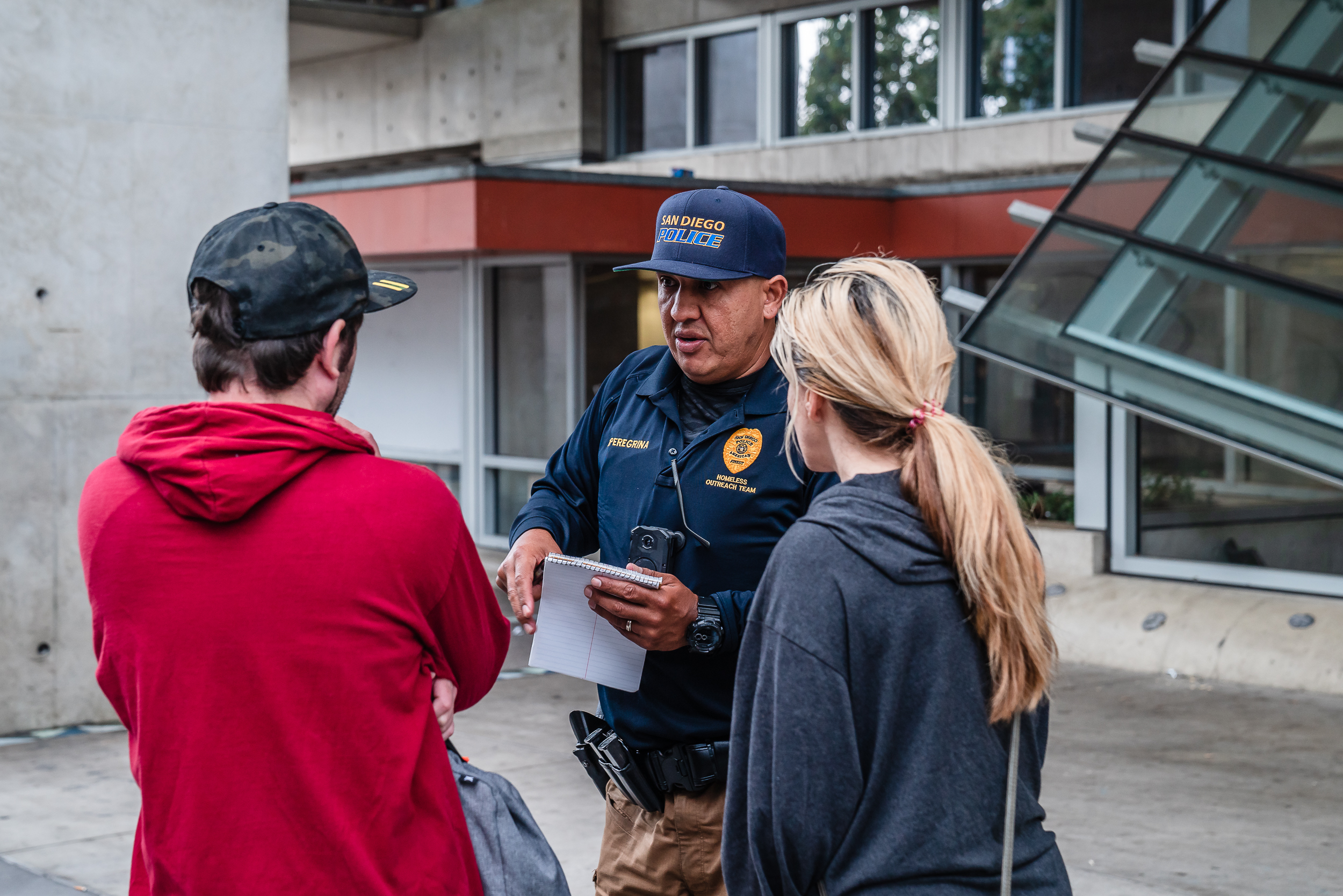
San Diego Police Chief Scott Wahl recently deployed more officers to combat homelessness in the city.
Wahl, who became the city’s top cop in June, last month assigned 20 officers fresh out of the academy and in-the-field training to enforce crimes tied to homelessness and respond to quality-of-life issues such as open drug use.
He’s also assigned more officers to teams focused on linking homeless residents with shelter and other services.
Wahl says the reassignments in the department’s Neighborhood Policing Division, which he helped create in 2018, will bolster the department’s homelessness response and give new officers experience that will also pay off when they move to patrol assignments. Officers in the Neighborhood Policing Division focus on responding to concerns tied to homelessness and quality-of-life crimes rather than typical emergency calls. They also try to try to connect homeless San Diegans with shelter and other services.
Wahl’s plan is to have newly trained officers spend about three months working on the division’s enforcement teams and to have other academy classes that typically total 20 to 35 officers follow them.
Wahl is hopeful bolstering the division can help reduce homelessness despite consensus among most homeless service experts that police action usually complicates homeless residents’ lives and thus efforts to move them off the street.
Wahl has long argued that police shouldn’t be at the frontline of the homelessness epidemic but are forced to serve as the bottom line to address health and safety concerns when service providers and others can’t step in.
“This is not about making folks’ lives even more difficult,” Wahl said. “This is about drawing a line that we will have – it’s a hard stop – that we cannot have people dying on our streets.”
On top of the increased enforcement resources, Wahl also created a new four-person unit of veteran officers focused on aiding vulnerable residents who are often visibly struggling with addiction or other health crises on the street. These San Diegans – not all of whom are homeless – often inspire numerous 911 calls from others who are concerned about them and cycle between jails, hospitals and treatment programs.
Wahl also added four officers to the division’s Homeless Outreach Team. These teams don’t wear typical police uniforms and spend their shifts trying to help homeless residents get into shelters and other programs.
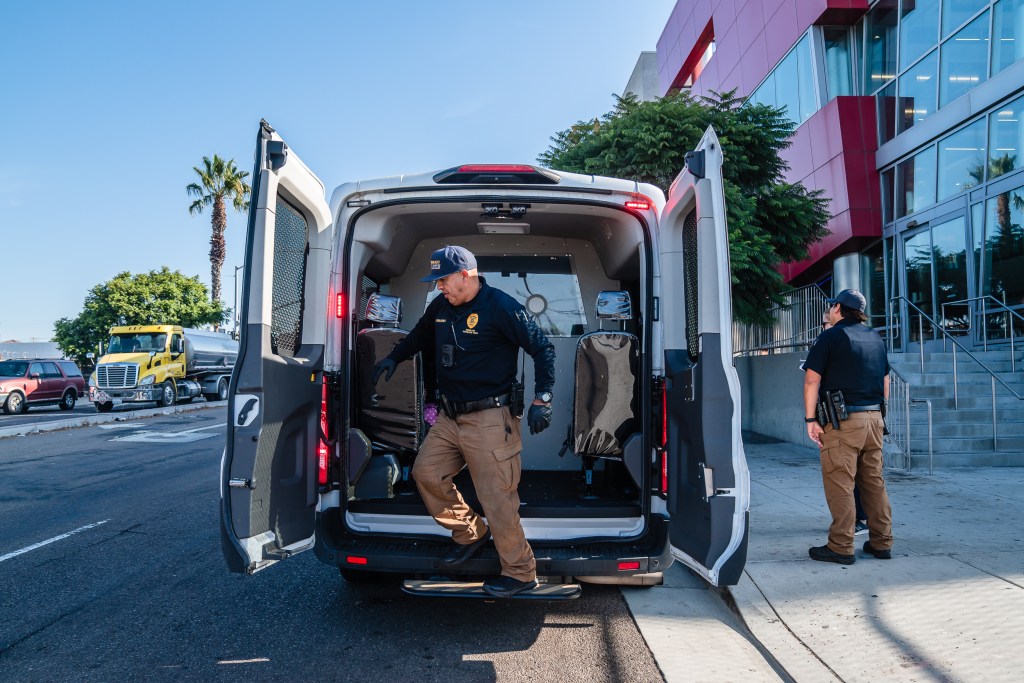
Wahl decided after taking over as police chief that he needed to increase staffing in the Neighborhood Policing Division to address community demands. As homelessness has boomed in the city, so have housed residents’ calls for the city to crack down.
Wahl thinks the lack of consistent enforcement in recent years contributed to more visible homelessness. He said his recent staffing decision was meant to help the city reset expectations on the street about what’s acceptable and bat back potential health crises.
Wahl remains haunted by a 2017 hepatitis A outbreak that hammered the homeless community. Downtown homeless camps were the epicenter of the deadly outbreak and San Diego police responded by clearing encampments that had built up for two years, a move Wahl said at the time was a bid to save lives.
Wahl helped create the Neighborhood Policing Division months after the outbreak drew national headlines. The division helped standardize the police department’s approach to homelessness-related enforcement. On Wahl’s watch, the department formally instituted a progressive enforcement approach to crimes tied to homelessness. The model calls for offers of shelter and other services before tickets or arrests.
The progressive enforcement approach – and the Neighborhood Policing Division – endured after former mayor Kevin Faulconer left office in late 2020 and now-Mayor Todd Gloria took over.
At its height, Wahl said about 85 police employees were assigned to the division. As the department struggled with a staffing shortage, the division fell to less than half that number. Meanwhile, street homelessness and overdose deaths dramatically spiked. Then the City Council narrowly approved a camping ban last year to give police another enforcement tool.
Now Wahl is directing more resources to try to make a bigger impact on the crisis and at least temporarily increasing staffing in the division to pre-Covid levels.

Wahl tapped Capt. Steve Shebloski, a 28-year San Diego police veteran, to lead the Neighborhood Policing Division.
Following Wahl’s direction, Shebloski said the division is focused on impact and community engagement rather than arrest quotas or efforts to simply push homeless residents from one place to another. Shebloski said he tells officers to interact with homeless residents and use discretion on whether a ticket or another sort of response would be most helpful.
Shebloski is enthusiastic about what he describes as a “comprehensive approach” to addressing homelessness.
That approach includes more officers offering services and the new unit intensely focused on aiding people with complex addiction or other challenges who often tie up police and fire resources. Many are repeat offenders who draw lots of community complaints that Shebloski believes police and other criminal justice players can collectively urge into treatment. Not all are homeless.
Shebloski said officers in the new Intervention Services Unit clocked a 15-hour day last month working with a public defender and others to get a man who had triggered hundreds of 911 calls into a treatment program.
That kind of collaboration is what Wahl envisioned for the unit focused on engaging people who have repeatedly fallen through the cracks. He also expects this team to play a key role when the county implements a conservatorship expansion law that will make people with severe substance use disorder eligible for holds.
John Brady, a homeless advocate who once lived on the street, said he appreciates the department’s increased focus on trying to help people with significant health challenges who might otherwise die on the street.
But Brady, who leads a group of San Diegans who have struggled with housing insecurity, said his organization is not on board with the likelihood of increased enforcement tied to homelessness, especially as many homeless San Diegans who want shelter struggle to access it. He fears stepped-up enforcement could lead more unsheltered residents to move to remote areas that make it more difficult to access services.
“We are firmly against any additional enforcement,” Brady said. “We’re driving people away from resources and into dangerous situations, including fire hazards.”
Shebloski said he’s hoping the department can persuade more homeless residents to access services.
“My goal is we’re not the move-along division,” Shebloski said.
OK, I see good intentions, but where do these people actually go? Is there shelter space available for them or are they put on a months long waiting list? Same question for the treatment programs. . .
When people are put on a long waiting list they tend to get frustrated and disappear.
The homeless are now being pushed into dangerous locations by the police sweeps: Freeway Margins, The River Bottom, Canyons.
The fire a week or so ago that came very close to getting into residential neighborhoods in the College area and the Talmadge area probably started in a homeless encampment just off of Montezuma Road in a canyon.
All these good intentions do nothing if there is no place for the homeless to go.
The Marston House in Balboa Park is just sitting there. I figure it can house about 30 beds. What do you say?
There is no such “consensus,” nor are “homeless service experts” doing anything remotely like a competent job. And “housed” residents? For crying out loud…
Hey Halverstadt, whatever happened to Michael McConnell? And I’m oh-so-sorry Cusack got her butt whipped.
Hopefully Michael McConnell got flushed down the nearest toilet because that’s where he belongs. He does not have any experience with the homeless, and if you listen carefully to his statements, all he does is complain and criticize. He never offers any solutions because he has none to offer. But that is because he is just a retired coin and baseball card dealer who now wants to make a name for himself in any way possible. Any news organizations who interview him and label him a “homeless advocate” are irresponsible and foolish and I have had no problems telling them that. McConnell is a waste of air and space.
Spending 15 hours on one drug addict is a shameful waste of limited resources. Use handcuffs, that is what we pay you for, not to play social worker.
Where is the plan to stop people from living in canyons? This is a major disaster waiting to happen. What does the fire chief think about this and can the fire department handle multiple canyon fires at the same time?
San Diego dodged a catastrophe in the College area, let’s see if the Mayor and City Council have learned anything from it.
People who willfully choose to be a parasite on society with no redeeming value, should be eliminated from it.