
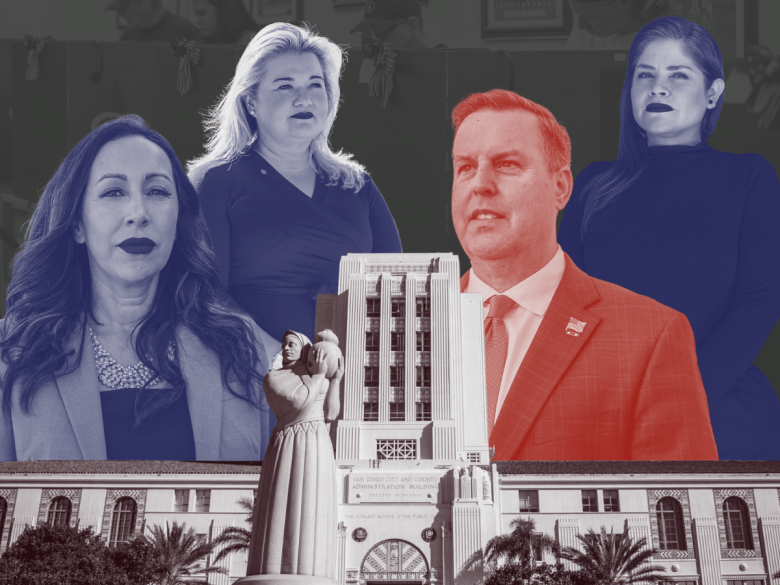
Four months ago, San Diego County Supervisor Nora Vargas, who represented South County’s District 1, abruptly resigned her seat and disappeared from San Diego politics.
Vargas’ resignation – still unexplained despite the diligent efforts of pretty much every single curious person in District 1 – set off a bomb in San Diego politics. Not only were South County’s 638,000 residents suddenly without an elected representative in county government, the partisan balance of power in the county was up for grabs.
Prior to Vargas’ resignation, a 3-2 Democratic majority controlled the County Board of Supervisors – a majority gained, ironically, in part by Vargas’ pathbreaking 2020 election. Until then, Republicans held a generations-long lock on county government.
As did the rest of the nation, San Diego County moved to the left politically during the Covid-19 pandemic, led in part by policies enacted by Democrats’ newly won majority. Long considered a bastion of Republican power in California, the county began embracing Democratic priorities, including new environmental restrictions on development, new resources for immigrants and a more compassionate approach to homelessness and drug addiction.
This week, South County voters could change all of that. Seven candidates are in the race to replace Vargas. Voting centers opened Saturday and voters can cast their ballot in person, by mail or at drop-off locations until 8 p.m. April 8. (See here for voting information.)
Of the seven candidates, four currently hold elected office in South County: Imperial Beach Mayor Paloma Aguirre, Chula Vista Councilmember Carolina Chavez, Chula Vista Mayor John McCann and San Diego City Councilmember Vivian Moreno. (See here for our in-depth coverage of the candidates, including Q&As, policy positions and updates on the race.)
Together with independent expenditure committees working on their behalf, the candidates have raised more than $2 million in campaign cash and bombarded voters’ mailboxes and social media feeds with advertising.
The campaign blitz reflects the race’s high stakes. Aguirre, Chavez and Moreno are Democrats. McCann is a Republican whose policy priorities differ sharply from the Board’s current Democratic tilt. McCann also happens to be one of the candidates with a strong chance of winning.
Though Democrats outnumber Republicans two to one in District 1, McCann has high name recognition in the district’s largest city and – at least according to my informal conversations with District 1 voters – is mostly well liked, even by many Democrats, and is not seen as an idealogue.
A recent analysis of votes conducted by Mason Herron, a partner at the political consulting firm Edgewater Strategies, found that Republican turnout is slightly ahead of where it was at this point in the November 2024 election. That could change, obviously. But it suggests that, as often happens in small-turnout special elections, the electorate in this race is slightly more conservative.
Last November, partisans in San Diego spent heavily in the contest between District 3 Supervisor Terra Lawson-Remer, a Democrat, and Republican challenger Kevin Faulconer, former mayor of the city of San Diego. The race was viewed as a battle royale for partisan control of the Board. In the end, it wasn’t close, and Lawson-Remer coasted to victory.
Little did everyone know, another contest over San Diego’s partisan future was just around the corner. And, arguably, given the unpredictable dynamics of special elections, McCann has an even better shot at winning than Faulconer ever did. It would be doubly ironic if heavily Democratic South County, which powered Democrats’ ascension to power just five years ago, ends up handing control of county government back to Republicans.
One final note. If no candidate wins more than 50 percent of the vote on April 8, the top two finishers will face off in a July 1 runoff. Sources who have followed polling say no candidate is expected to win outright next week. But McCann appears likely to be one of the top two finishers.
That has left Democrats battling it out for second place. A recent analysis of campaign spending, also by Herron of Edgewater Strategies, found that most money in the race has flowed to Democrats, who in turn are slugging it out with an onslaught of negative ads.
Interestingly, there hasn’t been much of a policy debate among Democrats. They mostly agree on the district’s top priorities – affordable housing, the Tijuana River Sewage crisis, a history of underrepresentation in county government – and differ only slightly in their major policy pronouncements.
That has left them poking into each others’ pasts to find weaknesses that can be exploited in negative ads.
It also appears to have kept them mindful of an interesting and under-examined change I’ve observed in South County politics. Unlike four years ago, when Vargas campaigned on more left-leaning issues such as reproductive rights and greater compassion toward immigrants and the unsheltered, voters this year appear to be moving toward the political center. The candidates have followed.
All three Democrats told me they oppose the county’s so-called “super-sanctuary” policy – championed by Vargas – that bars county employees from helping federal immigration authorities. All three criticized the county’s current approach to homelessness and said they want more vigorous efforts to help people get off the streets. And all three candidates promised to address the high cost of housing and seek early removal of the toll on State Route 125.
Chavez even told me she doesn’t care about political party identification. “The community doesn’t care about parties anymore,” she said. “They care about results.”
What a difference five years makes.
This article really leans on partisan Dems vs Repubs.